
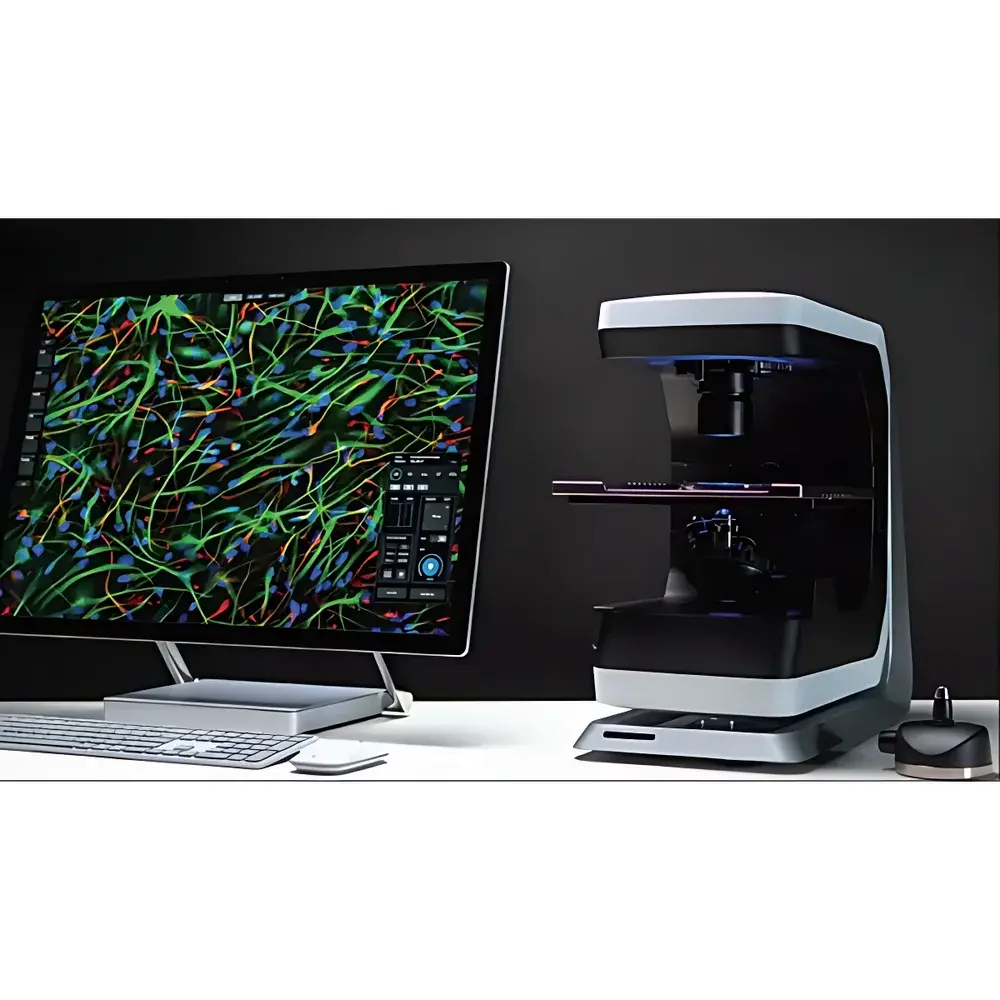
ECHO Revolution Integrated Motorized Upright-Inverted Smart Microscopy System
| Brand | ECHO |
|---|---|
| Origin | Beijing, China |
| Configuration | Upright & Inverted Combined Platform |
| Standard Objective | Fluorite (FL) Objectives |
| Optional Objective | Apochromatic (APO) Objectives |
| Imaging Modes | Brightfield, Phase Contrast, Fluorescence, Polarization |
| Automation | Motorized Z-focus, XY-stage, Filter Cube Turret, Illumination Intensity Control |
| User Interface | Integrated Touchscreen Display with Mouse/Joystick Support |
| Power & Control Architecture | Fully Embedded Controller, Internal Cabling, No External Boxes |
| Optical Performance | High-NA FL/APO Objectives, Optimized for Live-Cell & Fixed-Sample Imaging |
| Compliance | Designed to support GLP/GMP-aligned workflows |
| Software Features | Real-time Z-stack acquisition, Multi-point time-lapse scheduling, Multi-channel spectral registration, Tile-scan mosaic stitching, Autofocus (contrast-based & hardware-assisted), Export formats: TIFF, OME-TIFF, JPEG2000 |
Overview
The ECHO Revolution Integrated Motorized Upright-Inverted Smart Microscopy System is a purpose-engineered platform for high-fidelity widefield optical imaging across diverse life science applications. Unlike conventional single-configuration microscopes, the Revolution system implements a mechanically synchronized upright-inverted dual-mode architecture—enabling seamless transition between specimen mounting conventions without manual reconfiguration or optical realignment. Its core optical design follows Köhler illumination principles and incorporates infinity-corrected fluorite (FL) objectives as standard, with optional apochromatic (APO) objectives available for enhanced chromatic correction and numerical aperture (NA) performance. The system supports quantitative widefield modalities including brightfield, phase contrast, polarization, and multi-band fluorescence imaging—each mode activated via motorized filter cube turrets and LED-based illumination modules with independently tunable intensity control. Engineered for reproducibility in regulated environments, the Revolution platform maintains optical path consistency across modes and magnifications, minimizing alignment drift during extended time-lapse experiments or multi-user laboratory deployments.
Key Features
- Mechanically coupled upright-inverted configuration enabling rapid switching between slide-mounted and dish/culture-well mounted specimens
- Fully motorized XYZ stage with sub-micron repeatability (±0.2 µm) and programmable coordinate recall
- Automated Z-axis focusing using hybrid contrast-detection and piezo-assisted coarse/fine focus actuation
- Integrated touchscreen interface with context-aware workflow menus—no external PC or controller required
- Embedded illumination management supporting spectral stability across LED excitation bands (365–660 nm)
- Internal power regulation and signal conditioning architecture eliminating external cabling clutter and electromagnetic interference
- Multi-modal synchronization: simultaneous acquisition of brightfield reference + multi-channel fluorescence channels with hardware-triggered exposure timing
Sample Compatibility & Compliance
The Revolution system accommodates standard 1–4 well culture dishes, 35 mm petri dishes, glass slides (up to 1 mm thickness), and chambered coverslips. It integrates seamlessly with commercially available environmental control enclosures for live-cell imaging (CO2, temperature, humidity). All optical components comply with ISO 10110-7 surface quality standards, and fluorescence filter sets meet ISO 13675 spectral transmission specifications. The system’s software architecture supports audit-trail generation per FDA 21 CFR Part 11 requirements when deployed with validated third-party LIMS integration. It is routinely employed in laboratories conducting immunofluorescence staining validation (per CLSI EP25-A), FISH probe verification (per CAP guidelines), and histopathological slide digitization compliant with ASTM E2912-13.
Software & Data Management
The embedded operating system provides native acquisition, annotation, and export capabilities without dependency on external host computers. Acquired datasets are stored in OME-TIFF format with embedded metadata—including objective ID, exposure parameters, filter positions, stage coordinates, and timestamped Z-stack indices. Batch processing supports tile-scan stitching (with seam correction), channel registration (affine transformation matrix applied per field), and intensity normalization across time points. Data export options include lossless TIFF, compressed JPEG2000, and CSV-based morphometric summaries. Remote monitoring and script-based acquisition scheduling are supported via Ethernet-connected API (RESTful endpoints with JSON payloads), enabling integration into automated screening pipelines.
Applications
- Long-term live-cell dynamics: Mitotic tracking, organelle translocation, wound-healing assays under controlled environmental conditions
- Clinical histopathology: Digitization of H&E and IHC-stained tissue sections with consistent color fidelity and spatial resolution
- Molecular cytogenetics: Multiplex FISH analysis with precise spectral unmixing and co-localization quantification
- Neuroscience: Dendritic spine morphology assessment in primary neuronal cultures using low-phototoxicity LED excitation
- Drug discovery: Phenotypic screening of compound-treated cell populations using multi-parameter readouts (nuclear area, cytoplasmic texture, membrane integrity)
FAQ
Can the Revolution system be used for both fixed and live specimens without hardware modification?
Yes—the upright-inverted mechanical coupling allows immediate transition between slide-based fixed samples and dish-based live cultures while maintaining calibrated optical paths and motorized stage coordinates.
Is the system compatible with third-party environmental chambers?
Yes—standard chamber interfaces follow ANSI/ISO 15378-defined mounting footprints and accommodate commercial CO2/temperature units with analog voltage or digital RS-232 feedback integration.
Does the software support batch processing of multi-position time-lapse datasets?
Yes—acquisition scripts can define position lists, Z-intervals, channel sequences, and time intervals; post-acquisition tools enable synchronized alignment and intensity normalization across all positions and time points.
What objective families are supported beyond the standard FL series?
APO-corrected objectives with NA ≥ 0.95 and working distances ≥ 0.17 mm are fully supported, including water-immersion variants optimized for thick-tissue fluorescence imaging.
How is photobleaching minimized during multi-channel fluorescence acquisition?
LED illumination modules feature pulsed drive capability with user-defined duty cycles, and the system enforces inter-channel dark intervals to reduce cumulative photon dose—critical for preserving viability in long-duration live-cell experiments.




