
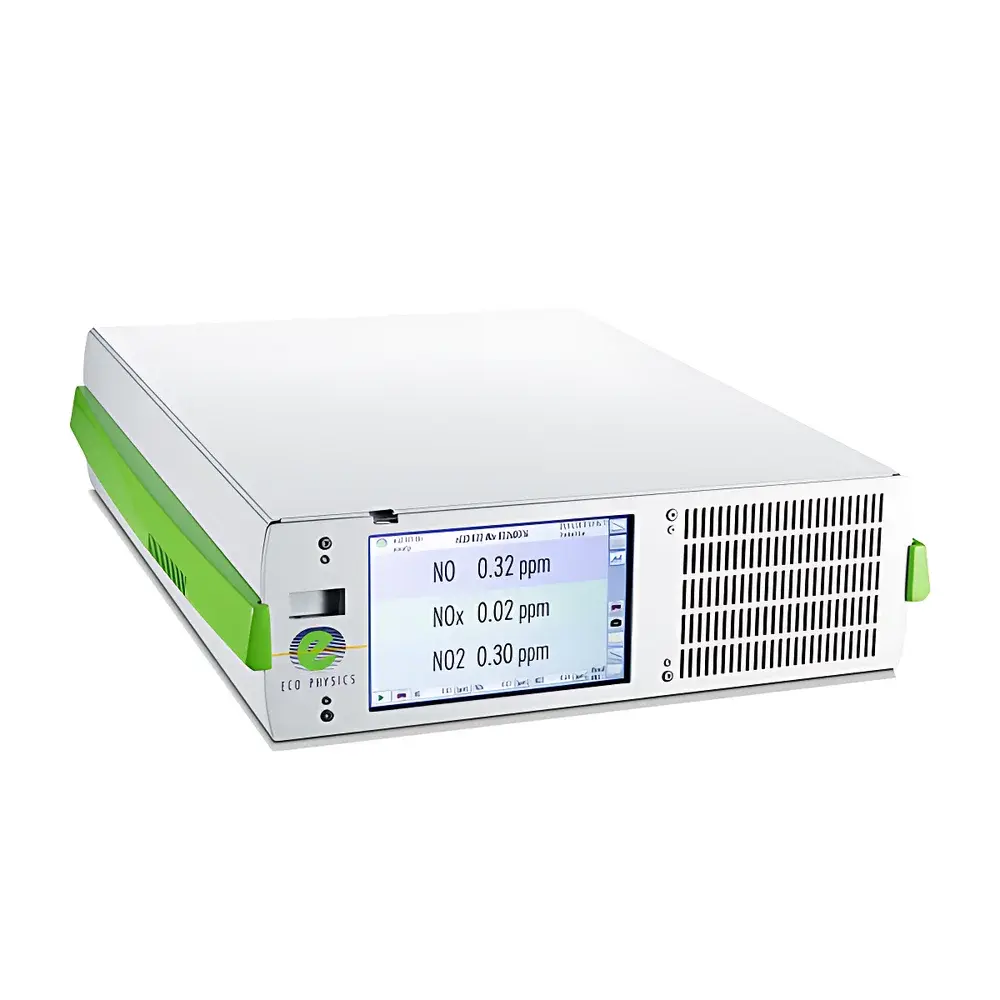
ECO Physics nCLD 822 Nitrogen Oxides Analyzer
| Brand | AGC |
|---|---|
| Origin | Switzerland |
| Manufacturer Type | Authorized Distributor |
| Product Origin | Imported |
| Model | ECO Physics nCLD 822 |
| Pricing | Upon Request |
Overview
The ECO Physics nCLD 822 Nitrogen Oxides Analyzer is a high-precision, chemiluminescence-based (CLD) gas analyzer engineered for trace- to low-concentration NO, NO₂, and NOₓ quantification in ambient air, stack emissions, and laboratory research environments. Developed by ECO Physics — a Swiss manufacturer specializing exclusively in nitrogen oxide measurement technologies since the early 2000s — the nCLD 822 leverages the well-established gas-phase reaction between nitric oxide (NO) and ozone (O₃) to produce excited nitrogen dioxide (NO₂*), which emits near-infrared photons upon relaxation. This photonic signal is detected by a thermoelectrically cooled photomultiplier tube (PMT), enabling sub-part-per-trillion (ppt) detection limits with exceptional long-term stability and reproducibility. Unlike broadband optical methods, CLD offers species-specific selectivity for NO without cross-sensitivity to CO, SO₂, or hydrocarbons. The nCLD 822 is optimized for continuous, unattended operation in regulatory-grade monitoring networks and research-grade atmospheric chemistry studies.
Key Features
- Chemiluminescence detection principle compliant with EPA Method 42, EN 14792, and ISO 7935 for NOₓ measurement
- Integrated ozone generator with high-voltage discharge design, delivering stable O₃ output across variable ambient temperatures and pressures
- Dual-stage particulate and chemical scrubbing: stainless-steel inlet filter + catalytic ozone destruct unit operating at >300 °C — eliminating need for consumable carbon traps and preventing secondary contamination
- Heated sample line (up to 190 °C) with temperature-controlled Peltier elements to suppress ammonium nitrate (NH₄NO₃) condensation in humid or NH₃-containing matrices
- T₉₀ response time ≤ 0.1 s for NO, enabling real-time emission profiling during transient combustion events
- Modular electronics architecture with isolated analog I/O, RS-232/485, and optional Ethernet interface supporting Modbus TCP and ASCII protocols
- Internal pressure and temperature sensors with automatic compensation algorithms per ISO 12039 and ASTM D6522
Sample Compatibility & Compliance
The nCLD 822 is validated for use with dry and humid gas streams (RH ≤ 95 %, non-condensing), including flue gas (post-SCR/deNOₓ), urban background air, clean-room purge gases, and human breath condensate headspace analysis. It meets EU Directive 2008/50/EC requirements for ambient NO₂ monitoring when deployed with certified calibration protocols and zero/span verification every 24 hours. All firmware and data logging functions adhere to GLP and GMP documentation standards; audit trails, user access levels, and electronic signature support are available via optional software packages compliant with FDA 21 CFR Part 11. Calibration traceability follows NIST SRM 2628a (NO in N₂) and BIPM-certified reference gases.
Software & Data Management
The instrument operates with ECO Physics’ proprietary CLD Control Suite v4.x, a Windows-based application enabling remote configuration, real-time signal visualization, automated calibration sequence execution, and raw data export in CSV/NetCDF formats. Internal memory stores ≥ 30 days of second-by-second measurements (including auxiliary sensor readings) with timestamped metadata. Optional cloud integration supports MQTT-based telemetry to SCADA platforms or environmental data management systems (EDMS). All firmware updates are digitally signed and verified prior to installation. Data integrity is preserved via cyclic redundancy checks (CRC-32) on all stored records and write-protected archive partitions.
Applications
- Ambient air quality monitoring networks (AQMS) requiring compliance-grade NOₓ reporting under national implementation plans
- Continuous emissions monitoring systems (CEMS) for thermal power plants, cement kilns, and waste incinerators
- Laboratory studies of tropospheric chemistry, including OH radical kinetics and NOₓ–VOC–ozone formation pathways
- Process gas purity verification in semiconductor manufacturing (e.g., bulk N₂, Ar, He carrier gases)
- Clinical research applications such as exhaled nitric oxide (FeNO) analysis in asthma phenotyping studies
- Mobile monitoring platforms (e.g., van-mounted or UAV-deployed units) where low power consumption (< 120 W) and vibration resistance are critical
FAQ
What is the minimum detectable concentration (MDL) for NO using the nCLD 822?
The instrument achieves an MDL of 0.025 ppb (3σ, 1-hour average) under standard operating conditions (25 °C, 1013 mbar, 1.2 L/min flow rate).
Does the nCLD 822 require external NO₂-to-NO converters?
No — it includes a heated molybdenum-based catalytic converter (operating at 325 °C) integrated into the sample train for quantitative NO₂ reduction, eliminating external converter dependencies.
Can the nCLD 822 be used for NH₃ measurement?
Not natively — NH₃ quantification requires the CLD 844CM-h variant with dual-converter architecture. The nCLD 822 is configured for NO/NO₂/NOₓ only.
Is ozone calibration required regularly?
Ozone output is stabilized via closed-loop voltage control; no routine O₃ calibration is needed. Annual verification against a certified UV photometer is recommended per ISO/IEC 17025 accreditation requirements.
What maintenance intervals are specified for field operation?
Scheduled maintenance includes quarterly particulate filter replacement, annual PMT window cleaning, biannual pump membrane exchange, and converter efficiency validation every 6 months — documented in the included Maintenance Logbook module.
Related Products







