
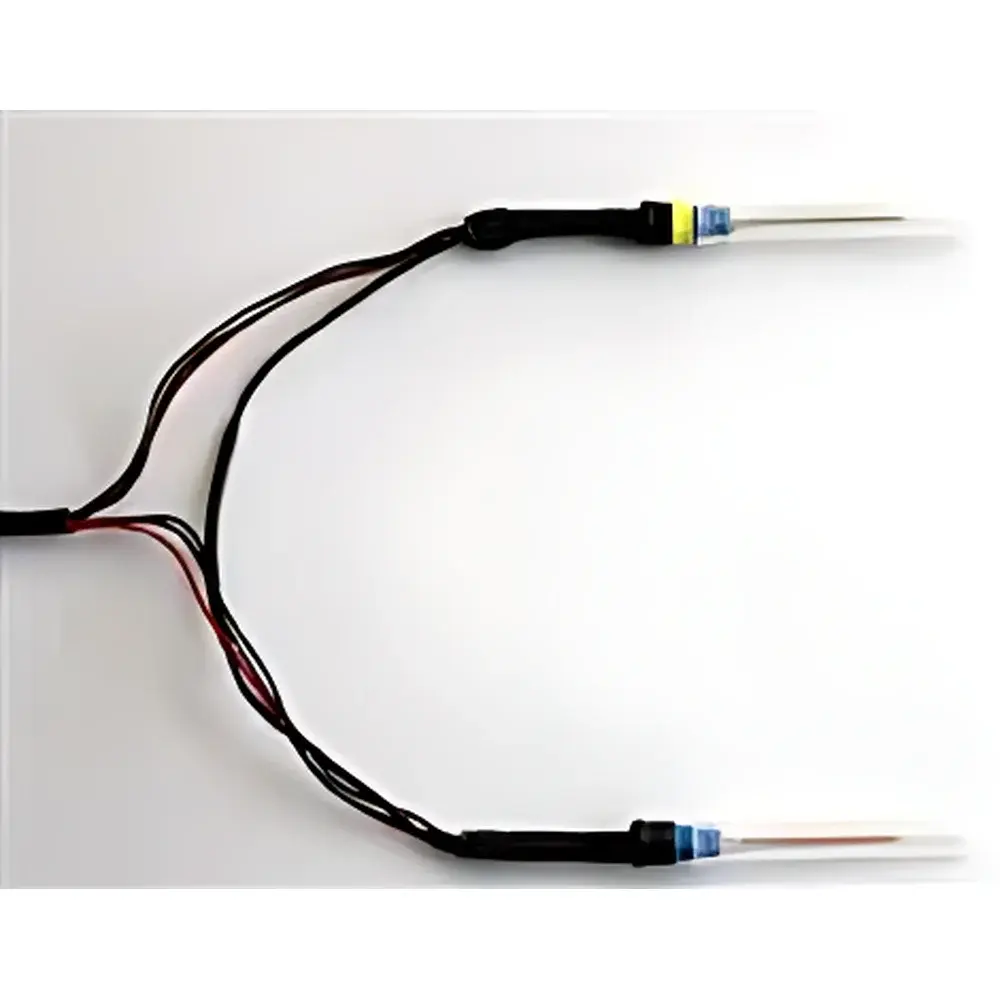
Ecomatik SF-G Granier-Type Stem Flow Sensor
| Brand | Ecomatik |
|---|---|
| Origin | Germany |
| Model | SF-G |
| Measurement Principle | Granier Thermal Dissipation Method |
| Probe Configuration | Dual-needle, Constant Current Heating |
| Output Signal | 0–1000 µV differential voltage |
| Power Consumption | 0.2 W ±5% (84 mA @ 12 VDC) |
| Operating Temperature | –25 to +50 °C |
| Cable Length | Standard 5 m (extendable to 20 m) |
| Suitable Stem Diameter | >5 cm |
| Probe Variants | SF-G33 (33 mm needle / 20 mm heater), SF-G43 (43 mm / 20 mm), SF-G63 (63 mm / 20 mm) |
| Compliance | Compatible with ISO 17025-accredited data acquisition systems and GLP/GMP environmental monitoring workflows |
Overview
The Ecomatik SF-G Granier-Type Stem Flow Sensor is a precision field-deployable instrument engineered for continuous, non-destructive measurement of sap flow velocity in woody plant stems using the thermal dissipation method originally developed by A. Granier in 1985. It operates on the physical principle that axial water movement in xylem tissue convectively transports heat away from an upstream heated probe, thereby reducing the temperature gradient between two axially separated thermocouples. This measurable temperature differential (ΔT) exhibits a well-documented empirical relationship with sap flux density (Js, in g·m−2·s−1), enabling robust quantification of transpiration-driven water transport under natural canopy conditions. Designed for long-term ecological monitoring and physiological research, the SF-G sensor delivers high temporal resolution and inter-unit reproducibility when integrated into calibrated data acquisition networks—particularly where diurnal patterns, drought response kinetics, or species-specific hydraulic architecture are under investigation.
Key Features
- Dual-needle stainless-steel probe design with integrated constant-current heating element and matched thermocouple pairs for stable ΔT detection
- Three standardized probe lengths (SF-G33, SF-G43, SF-G63) optimized for varying xylem depth and stem anatomy across broadleaf and coniferous species
- Low-power operation (0.2 W ±5%) ensures compatibility with solar-recharged remote stations and minimizes thermal self-interference
- Differential microvolt output (0–1000 µV) provides high signal-to-noise ratio for precise analog-to-digital conversion
- Robust aluminum housing and resin-sealed insertion interface enhance mechanical stability and thermal coupling fidelity in heterogeneous bark structures
- Modular cable system (5 m standard, extendable to 20 m) supports flexible deployment in complex forest understories or orchard canopies
Sample Compatibility & Compliance
The SF-G sensor is validated for use on dicotyledonous and gymnosperm species with stem diameters exceeding 5 cm, including but not limited to Quercus robur, Fagus sylvatica, Picea abies, and Pinus sylvestris. Its installation protocol—requiring minimal cambial disruption via 2 mm pilot drilling and 8 mm bark isolation—adheres to internationally accepted minimal-invasiveness standards for long-term dendroecological studies (cf. ICAS, IUFRO Working Group 7.03.07). All SF-G units are manufactured and tested in accordance with DIN EN ISO 9001 quality management protocols. When paired with Campbell Scientific CR1000 or equivalent data loggers configured with 13-bit A/D resolution and audit-trail-enabled firmware, the full measurement chain satisfies requirements for traceable environmental data reporting under ISO/IEC 17025 and supports GLP-compliant experimental documentation.
Software & Data Management
Raw ΔT signals from the SF-G sensor are acquired via standard analog input channels and processed using the Granier sap flux equation: Js = 119 × (ΔTm − ΔT)1.231, where ΔTm denotes maximum temperature difference under zero-flow conditions (typically measured during nocturnal periods). Ecomatik provides open-format calibration templates compatible with LoggerNet, Edlog, and Python-based analysis pipelines (e.g., sapfluxnet library). For regulatory environments requiring electronic record integrity, integration with CR1000 systems enables 21 CFR Part 11-compliant data logging—including user authentication, time-stamped audit trails, and immutable storage on removable SD cards (up to 2 GB). Optional AM16/32B multiplexer support allows scalable deployment across up to 64 sensor channels per logger node without signal degradation.
Applications
- Long-term forest water balance modeling and evapotranspiration partitioning at stand and watershed scales
- In situ validation of remote-sensing-based transpiration estimates (e.g., from thermal infrared or eddy covariance towers)
- Physiological phenotyping of drought tolerance traits across germplasm collections and breeding trials
- Urban tree water use assessment for sustainable green infrastructure planning
- Coupled carbon–water flux analysis in FACE (Free-Air CO2 Enrichment) and climate manipulation experiments
- Calibration and ground-truthing of hydraulic architecture models incorporating xylem conductivity and vulnerability curves
FAQ
Why must nighttime sap flow be assumed zero in Granier-based calculations?
Because the original Granier calibration assumes negligible nocturnal transpiration and convective heat transport in most temperate species; however, users working with species exhibiting significant night-time stomatal conductance (e.g., Opuntia, Agave) should apply species-specific corrections or supplement with independent sap velocity validation methods.
Can SF-G probes be reused across multiple growing seasons?
Yes—provided probes are removed prior to cambial reactivation in spring and reinstalled with fresh thermal coupling resin; annual inspection for corrosion or insulation degradation is recommended.
What data acquisition specifications are mandatory for reliable SF-G signal resolution?
A minimum 13-bit A/D converter, programmable excitation control for constant-current source stability, and ≥1 Hz sampling frequency are required to resolve sub-millivolt ΔT dynamics without aliasing.
Is factory calibration provided with each SF-G unit?
Each probe undergoes individual thermal characterization in controlled climatic chambers; a unique calibration coefficient sheet (including nominal ΔTm and heater resistance) is supplied with shipment.
How does bark thickness affect SF-G accuracy?
Excessive bark (>15 mm) may attenuate thermal coupling; the included 8 mm isolation drill bit ensures consistent probe–xylem proximity, and resin application compensates for interfacial thermal resistance—validated against gravimetric sap flow benchmarks.



