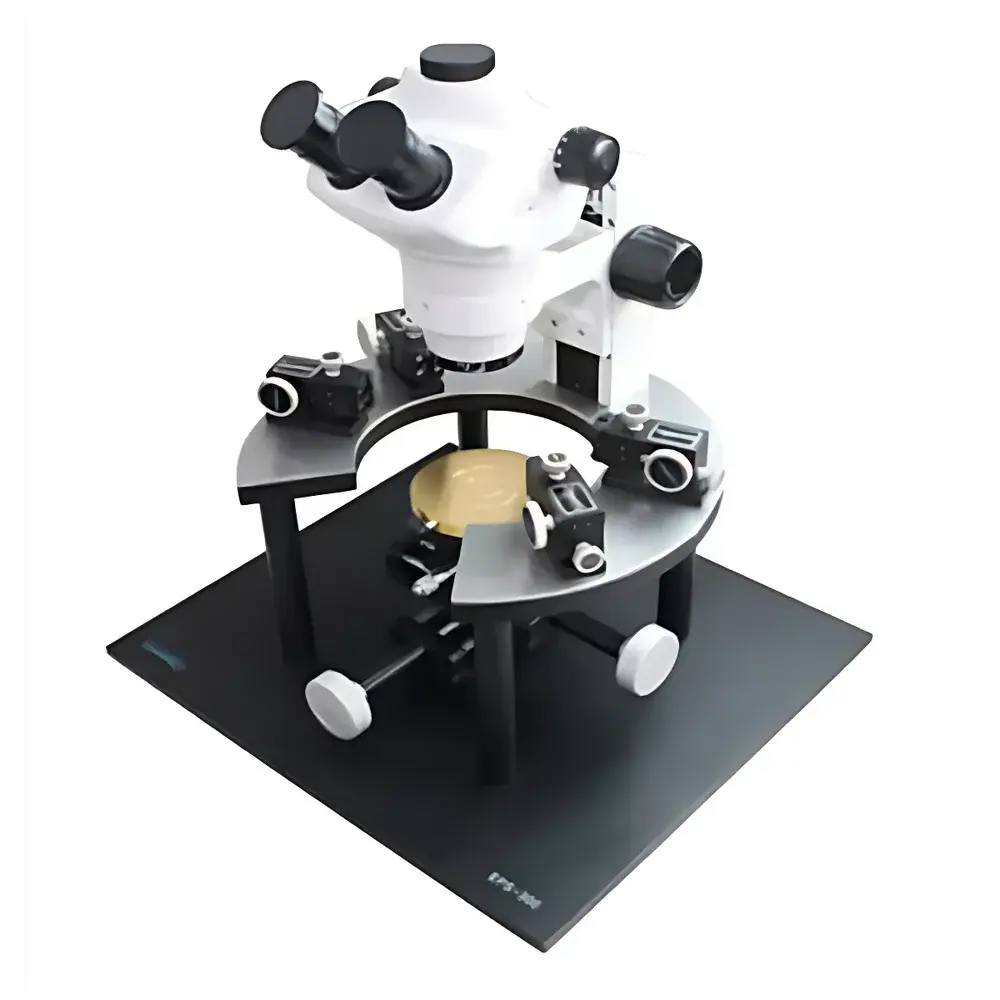
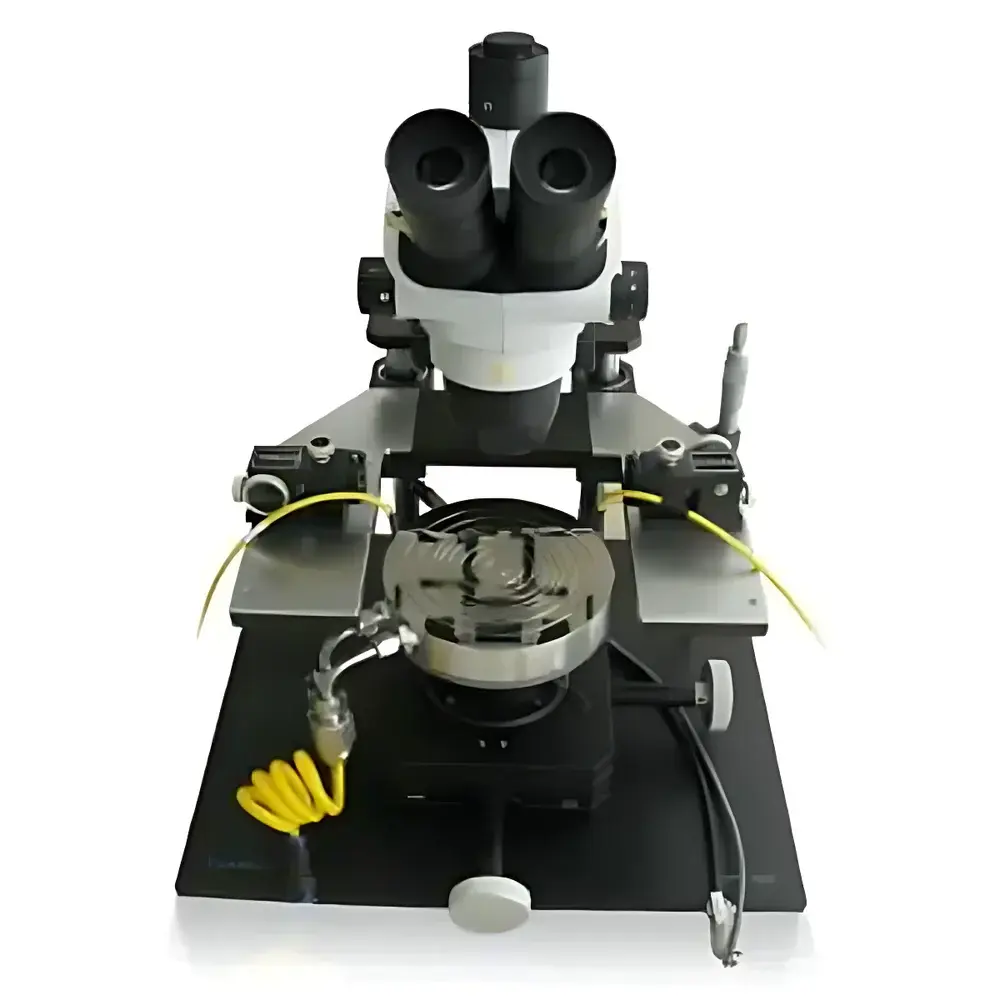
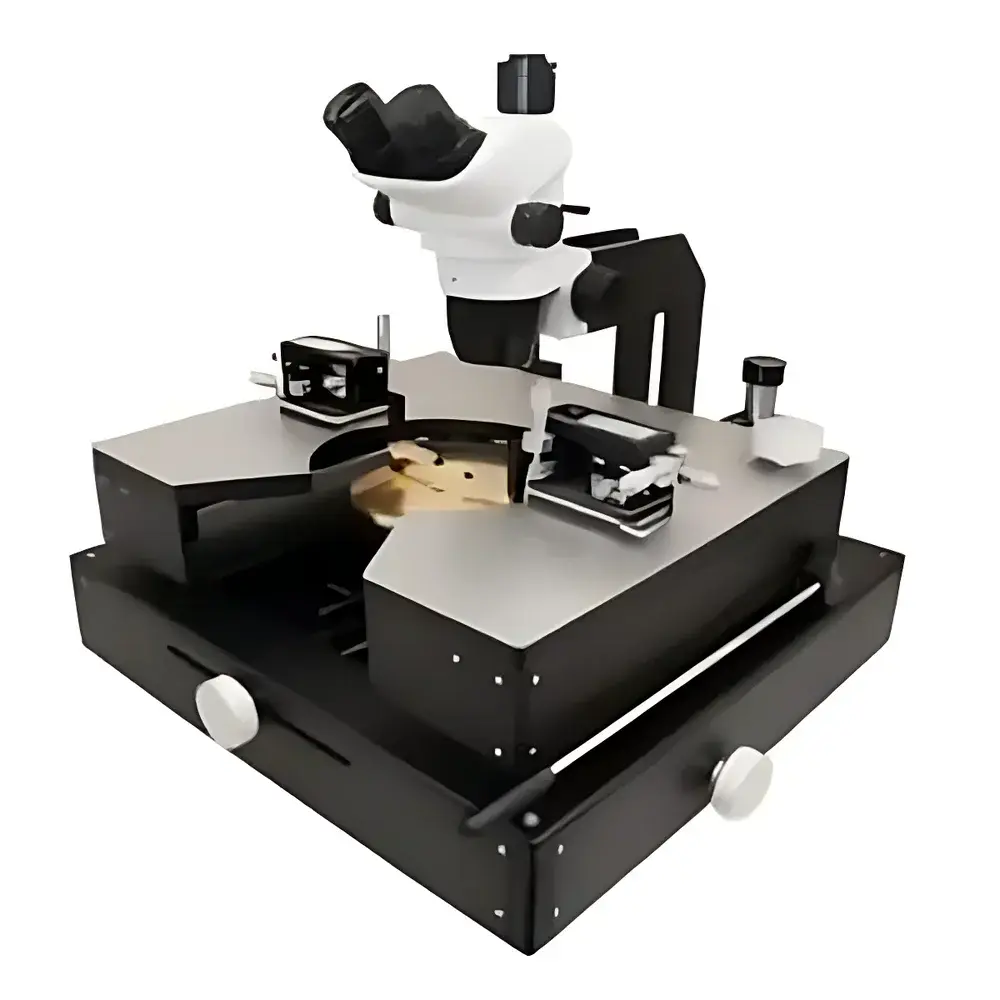
ECOPIA EPS-300/EPS-500/EPS-1000 Manual Temperature-Controlled Probe Station
| Brand | ECOPIA |
|---|---|
| Origin | South Korea |
| Model | EPS-300 / EPS-500 / EPS-1000 |
| Type | Manual probe station |
| Category | Temperature-controlled probe station |
| Compliance | Designed for ISO/IEC 17025-compliant lab environments, compatible with ASTM F1768 and SEMI S2/S8 safety standards |
| Software Interface | Analog signal output (BNC), optional digital I/O for external controller integration |
| Stage Travel | X/Y fine adjustment via micrometer drives (10 µm resolution), Z-axis manual lift with locking mechanism |
| Maximum Wafer Size | EPS-300: up to 4″ |
| EPS-500 | up to 6″ |
| EPS-1000 | up to 8″ |
| Thermal Options | Optional heated chuck (−40 °C to +200 °C) available on EPS-500 and EPS-1000 |
| Vacuum Compatibility | Standard vacuum-compatible baseplate (10⁻³ mbar) for glovebox or controlled-atmosphere integration |
Overview
The ECOPIA EPS-300, EPS-500, and EPS-1000 series are manually operated, temperature-controllable probe stations engineered for precision electrical characterization of semiconductor devices, microelectronic components, and advanced materials. Each model employs a rigid granite or aluminum alloy baseplate with low-thermal-drift kinematic stage architecture, ensuring mechanical stability during long-duration DC/AC parameter measurements, IV/CV sweeps, and leakage current analysis. Unlike automated platforms, these stations prioritize operator control fidelity, tactile feedback, and modularity—making them ideal for research laboratories, failure analysis labs, and process development facilities where flexibility, repeatability, and environmental adaptability are critical. The core measurement principle relies on direct physical contact between calibrated tungsten or铍铜 probe needles and device under test (DUT) pads, enabling four-point probe resistivity mapping, transistor transfer curve acquisition, and junction capacitance profiling under ambient, inert, or thermally regulated conditions.
Key Features
- High-resolution micrometer-driven XYZ motion system with 10 µm incremental positioning accuracy and backlash-free lead screws for repeatable probe placement.
- Modular thermal chuck options: EPS-500 and EPS-1000 support Peltier-based heating/cooling stages (−40 °C to +200 °C) with ±0.5 °C temperature uniformity across 4″–8″ wafers, traceable to NIST-calibrated sensors.
- Lock-pin mechanism (EPS-1000 only) prevents probe retraction drift during extended bias stress tests or thermal cycling experiments.
- Glovebox- and shielded-box-ready design: compact footprint (EPS-300: 320 × 320 × 280 mm), non-magnetic construction, and EMI-shielded signal routing paths minimize noise coupling in sensitive low-current (<1 pA) measurements.
- Interchangeable probe holders (SH-100, SH-200) accommodate standard 0.5–2.0 mm probe diameters and support coaxial, triaxial, or guarded configurations for high-impedance applications.
- Integrated grounding bus bar and isolated signal return paths comply with IEEE Std 1114-2001 for low-noise probing infrastructure.
Sample Compatibility & Compliance
The EPS series accommodates bare die, packaged ICs, PCBs, photovoltaic cells, MEMS devices, and 2D material flakes on Si/SiO₂, sapphire, or flexible substrates. Chuck clamping supports flatness tolerances ≤5 µm over 100 mm diameter, validated per SEMI MF-1530. All models meet CE marking requirements for electromagnetic compatibility (EN 61326-1) and functional safety (EN 61010-1). Optional upgrades include vacuum-sealed chucks (10⁻³ mbar operational range), anti-static surface coatings (surface resistivity <10⁹ Ω/sq), and ISO Class 5 cleanroom-compatible housings. For regulated environments, the station’s analog signal architecture enables full audit trail integration when paired with GLP/GMP-compliant source-measure units (e.g., Keysight B2900A, Keithley 2600B) and timestamped data logging systems compliant with FDA 21 CFR Part 11.
Software & Data Management
As a hardware-centric platform, the EPS series does not include embedded firmware or proprietary software. Instead, it is designed for seamless interoperability with industry-standard instrumentation control frameworks—including LabVIEW™, Python (PyVISA), MATLAB® Instrument Control Toolbox, and SCPI-compliant SMUs. Analog BNC outputs provide real-time voltage/current monitoring without digitization latency, while optional TTL-triggered I/O ports synchronize probe touchdown events with external oscilloscopes or pulse generators. Users retain full ownership of metadata annotation, calibration record management, and raw data storage—ensuring compliance with internal QA protocols and third-party accreditation audits (e.g., A2LA, UKAS).
Applications
- Semiconductor process development: gate oxide integrity testing, contact resistance mapping, and hot-carrier injection stress evaluation on 65 nm–1 µm node devices.
- Fault isolation in IC failure analysis: emission microscopy (EMMI) correlation, laser beam induced current (LBIC) scanning, and time-resolved IV transient capture.
- Perovskite and organic PV R&D: stabilized efficiency tracking under thermal soak (85 °C/85% RH) and light-soak conditions using integrated solar simulators.
- 2D material transport studies: Hall effect mobility extraction on exfoliated MoS₂ or graphene heterostructures under cryogenic or elevated temperature bias.
- Biomedical microdevice validation: impedance spectroscopy of lab-on-chip electrodes, neural probe interface characterization, and electrochemical sensor calibration.
- Automotive electronics qualification: high-temperature bias testing of SiC power modules per AEC-Q100 Grade 0 specifications.
FAQ
Can the EPS-300 be used inside a nitrogen-filled glovebox?
Yes—the EPS-300 features a fully sealed baseplate, non-outgassing elastomers, and feedthrough-compatible BNC connectors, making it suitable for Class 1000 glovebox integration.
Is thermal calibration documentation provided with the heated chuck option?
ECOPIA supplies NIST-traceable calibration certificates for all temperature sensors installed on EPS-500 and EPS-1000 chucks, including as-found/as-left data at three points across the operating range.
What probe needle types are recommended for sub-picoampere measurements?
Shielded tungsten needles with gold-plated tips (e.g., GGB Picoprobe® series) and triaxial cabling are strongly advised to minimize leakage and capacitive coupling in ultra-low-current applications.
Does the EPS-1000 support wafer-level probe card alignment?
No—it is optimized for single-die probing and discrete device evaluation; wafer-level alignment requires motorized optical alignment subsystems not included in the manual platform architecture.
Are replacement parts such as micrometer dials or stage inserts available separately?
Yes—ECOPIA maintains a full spare parts catalog with documented interchangeability across EPS generations, including ISO 9001-certified manufacturing records for all machined components.