
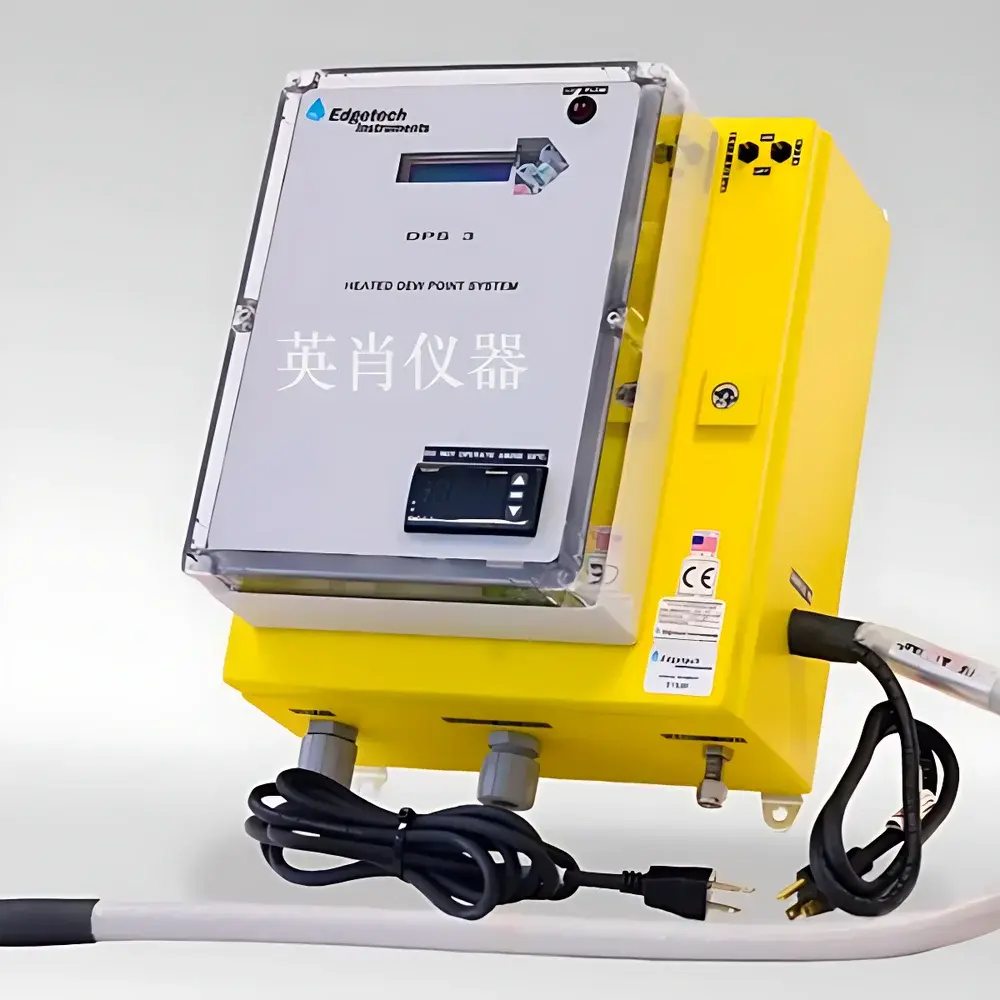
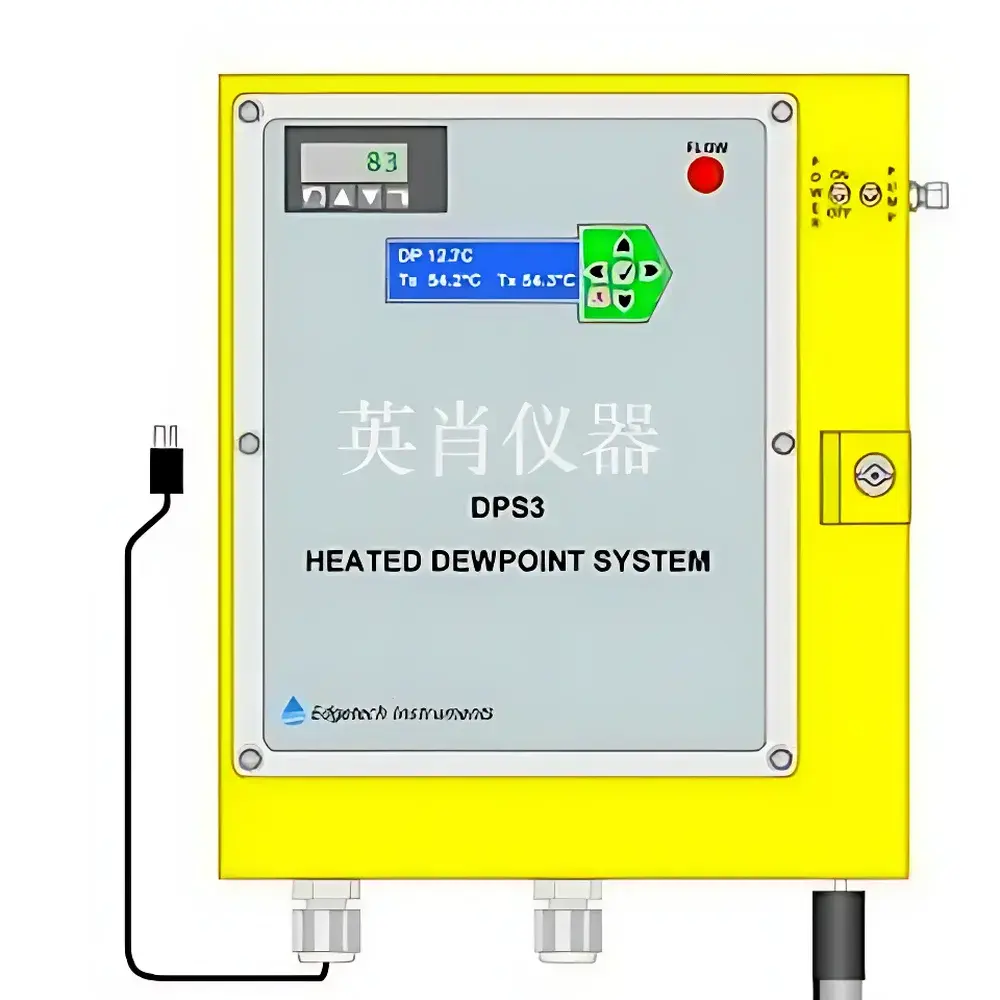
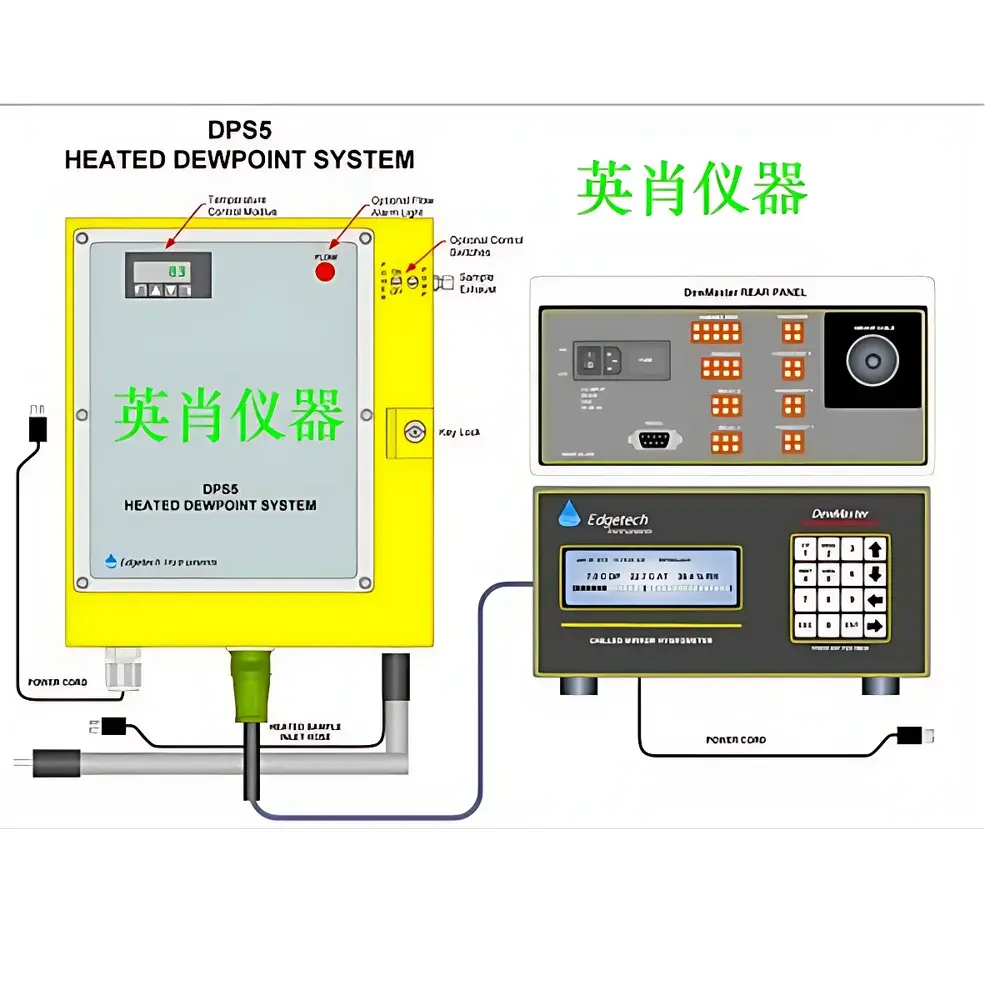
EdgeTech DPS Series Heated Chilled-Mirror Dew/Frost Point Hygrometer System
| Brand | EdgeTech |
|---|---|
| Origin | USA |
| Model | DPS |
| Type | Online Dew Point Meter |
| Principle | Chilled-Mirror Condensation |
| Operating Temperature Range | 20–99 °C |
| Accuracy | ±0.2 °C |
| Repeatability | ±0.05 °C |
Overview
The EdgeTech DPS Series Heated Chilled-Mirror Dew/Frost Point Hygrometer System is a primary-standard, traceable humidity measurement platform engineered for high-accuracy, continuous dew point and frost point determination in demanding industrial and laboratory environments. Unlike capacitive or polymer-based sensors, the DPS employs the fundamental chilled-mirror condensation principle—where water vapor in a gas sample is condensed onto a thermally controlled, optically polished mirror surface, and the phase transition temperature (dew point or frost point) is detected via real-time optical reflectance monitoring. This method is recognized as the reference standard by ISO 8503-1, ASTM E104, and IEC 61294, delivering metrologically defensible data essential for process validation, calibration transfer, and regulatory compliance.
A key engineering distinction of the DPS system lies in its fully heated sampling architecture. Conventional chilled-mirror instruments fail when sample gas dew/frost points exceed ambient or sensor housing temperature—causing uncontrolled condensation upstream and measurement drift. The DPS overcomes this limitation by actively heating the entire optical path—including mirror housing, inlet manifold, sample line, and detector optics—to a user-defined temperature above the expected dew/frost point. This eliminates condensation in non-sensing regions, ensures laminar flow stability, and maintains thermodynamic equilibrium at the mirror surface—enabling reliable measurements from –35 °C to +95 °C dew/frost point across gas streams operating up to 99 °C.
Key Features
- Fully heated optical train and sample pathway (up to 99 °C), preventing parasitic condensation and enabling high-temperature, high-dew-point operation
- Primary-standard chilled-mirror measurement with NIST-traceable calibration certificates available per unit
- Optical contamination compensation algorithm that automatically adjusts mirror temperature setpoint based on real-time reflectance decay trends
- User-programmable PID temperature controller for both mirror and housing zones, supporting ramp-and-soak profiling
- Analog output options (4–20 mA or 0–10 V DC) with configurable scaling; RS-232 serial interface for integration into SCADA, DCS, or LIMS platforms
- Configurable alarm thresholds with relay outputs for dew point deviation, mirror contamination, or heater fault conditions
- Modular design: DPS3 (base), DPS4 (pressure-compensated), and DPS5 (full-featured with touchscreen HMI, embedded data logging, and Ethernet/IP support)
Sample Compatibility & Compliance
The DPS system is compatible with inert, corrosive, and hydrocarbon-laden gases—including compressed air, nitrogen, hydrogen, natural gas, SF6, and flue gas—when used with appropriate material selections (e.g., 316 stainless steel wetted parts, Hastelloy C-276 optional). It meets requirements for Class I, Division 2 hazardous area installations when equipped with appropriate enclosures. All DPS models support pressure compensation algorithms compliant with ISO 4677 and ASTM D1142, allowing dew point correction to standard reference pressure (typically 101.325 kPa). Data integrity features include audit-trail-enabled configuration logging, time-stamped measurement records, and optional 21 CFR Part 11-compliant software packages for GxP-regulated environments (e.g., pharmaceutical drying, nuclear moisture monitoring).
Software & Data Management
EdgeTech’s DPS Control Suite provides native Windows-based configuration, real-time visualization, and historical trend analysis. The software supports automated report generation (PDF/CSV), alarm event export, and synchronization with enterprise time servers (NTP). DPS5 models integrate an embedded Linux OS with onboard 16 GB flash storage, enabling standalone logging at 1-second intervals for up to 12 months. All firmware updates are digitally signed and validated. For integration into Industry 4.0 architectures, DPS5 supports Modbus TCP, OPC UA, and MQTT protocols—facilitating seamless connectivity with MES, CMMS, and predictive maintenance platforms.
Applications
- Boiler feedwater and steam purity monitoring in power generation
- Moisture control in pharmaceutical lyophilization and fluid-bed dryers
- Fuel cell stack inlet gas conditioning and degradation studies
- Nuclear reactor coolant gas dryness verification (per ANSI/ANS-18.2)
- Plastic extrusion and injection molding ambient dew point control
- High-temperature annealing furnace atmosphere qualification (ASTM E29)
- Chemical reactor purge gas certification prior to catalyst charging
- Calibration lab reference standards for secondary hygrometers
FAQ
What distinguishes the DPS from conventional chilled-mirror hygrometers?
The DPS integrates full-path heating to eliminate upstream condensation—enabling stable, accurate measurement of dew/frost points exceeding ambient temperature, where traditional instruments become unreliable or inoperable.
Is pressure compensation available across all DPS models?
Pressure compensation is standard on DPS4 and DPS5 models; DPS3 requires external pressure input and manual correction unless upgraded via firmware and hardware option kits.
Can the DPS measure frost point in sub-zero gas streams?
Yes—the DPS operates down to –35 °C frost point using controlled mirror supercooling and optical ice detection, with automatic transition logic between dew and frost phase identification.
What calibration documentation is provided?
Each unit ships with a factory calibration certificate traceable to NIST SRM 2371 (Dew Point Generator), including uncertainty budgets per ISO/IEC 17025 guidelines. On-site recalibration services and accredited third-party verification are available globally.
How is mirror contamination managed during long-term operation?
The DPS employs dual-wavelength optical monitoring to detect reflectance loss from particulate or film deposition. Its Auto-Balance Control mode dynamically adjusts mirror temperature to maintain optimal condensation dynamics while triggering maintenance alerts before accuracy degrades.




