
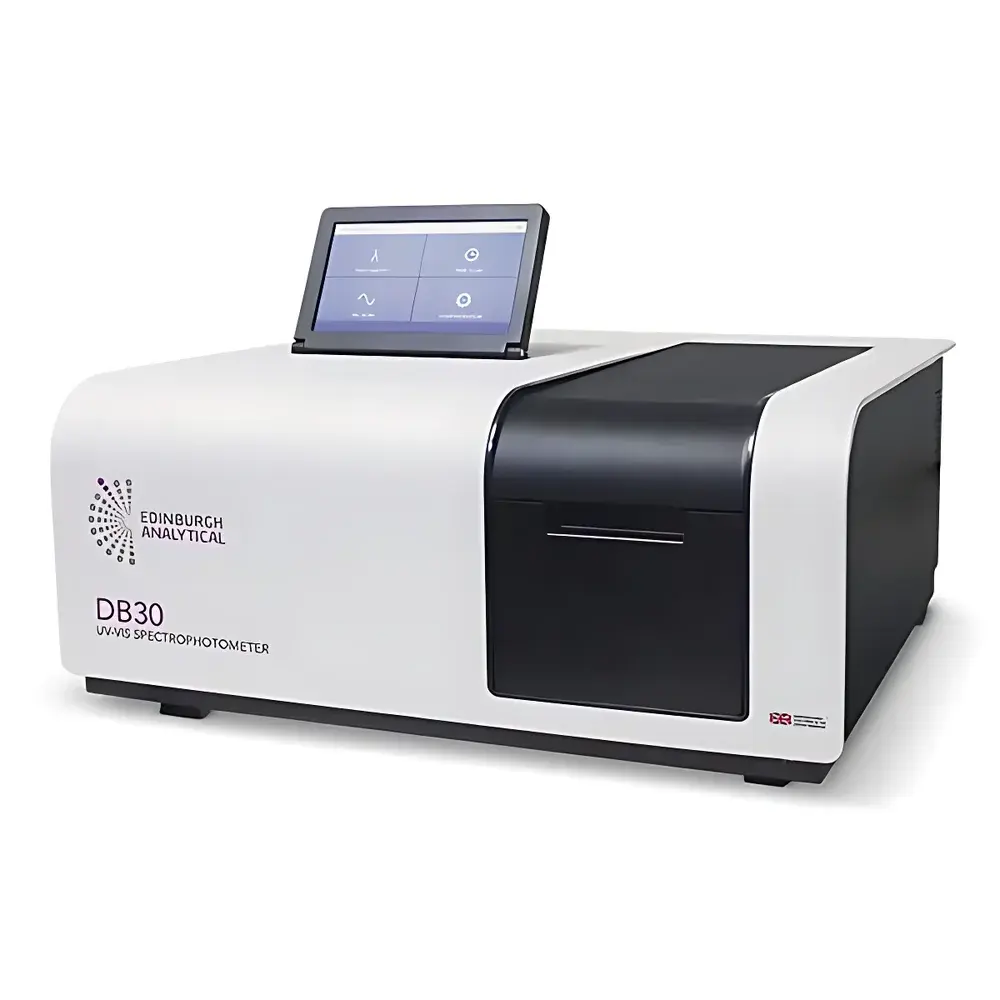
Edinburgh Analytical DB30 Real-Time Dual-Beam UV-Vis Spectrophotometer
| Brand | Edinburgh Analytical |
|---|---|
| Origin | United Kingdom |
| Manufacturer Type | Authorized Distributor |
| Origin Category | Imported Instrument |
| Model | DB30 |
| Instrument Architecture | Dual-Beam |
| Detector Type | Photodiode Array (PDA) |
| Wavelength Range | 190–1100 nm |
| Wavelength Accuracy | ±0.1 nm |
| Wavelength Repeatability | ±0.1 nm |
| Spectral Bandwidth | 0.5, 1.0, 1.5, 2.0, 4.0 nm |
| Stray Light | ≤0.1% |
| Automation Level | Automatic Wavelength Scanning |
| Scan Speed | Up to 6000 nm/min |
Overview
The Edinburgh Analytical DB30 Real-Time Dual-Beam UV-Vis Spectrophotometer is a precision optical instrument engineered for high-fidelity absorbance, transmittance, and reflectance measurements across the ultraviolet, visible, and near-infrared spectral regions (190–1100 nm). Utilizing a true real-time dual-beam architecture, the DB30 continuously compares sample and reference beam intensities at every wavelength point during scanning—eliminating time-based drift artifacts common in sequential single-beam systems. This design ensures exceptional photometric stability and measurement reproducibility, particularly critical for kinetic studies, multi-step assay protocols, and regulated quality control environments. The system integrates a high-resolution photodiode array (PDA) detector, enabling simultaneous acquisition of full spectra without mechanical wavelength scanning delays. Its robust optical bench, thermally stabilized monochromator, and precision slit mechanism collectively support rigorous analytical workflows in compliance with ISO/IEC 17025, ASTM E275, and USP spectrophotometric validation guidelines.
Key Features
- Real-time dual-beam optical path with active reference compensation for baseline stability over extended measurement durations
- Variable spectral bandwidth selection (0.5, 1.0, 1.5, 2.0, and 4.0 nm) to optimize resolution vs. signal-to-noise trade-offs per application requirement
- High-speed spectral acquisition up to 6000 nm/min, supporting rapid screening of compound libraries or time-resolved reaction monitoring
- Intuitive 7-inch capacitive touchscreen interface with embedded method editor, calibration manager, and real-time spectral overlay
- Auto-detecting accessory recognition: compatible with temperature-controlled cuvette holders, fiber-optic probes, integrating spheres, and micro-volume platforms
- Compact footprint (W × D × H: 320 × 420 × 220 mm) designed for space-constrained laboratories without compromising optical path length or thermal management
Sample Compatibility & Compliance
The DB30 accommodates standard 10-mm square quartz or glass cuvettes, as well as specialized formats including microcells (down to 50 µL), flow cells, and solid-sample reflectance accessories. All optical components comply with RoHS Directive 2011/65/EU and CE marking requirements for laboratory instrumentation. The instrument supports audit-ready operation under GLP and GMP frameworks through configurable user access levels, electronic signature capability, and full audit trail logging—including parameter changes, calibration events, and data export actions—in accordance with FDA 21 CFR Part 11 Annex 11 principles. Routine performance verification follows NIST-traceable standards (e.g., holmium oxide for wavelength accuracy, potassium dichromate for photometric linearity).
Software & Data Management
The DB30 operates with Edinburgh Analytical’s SpectraSuite™ v4.x software suite, delivered pre-installed on an integrated industrial-grade controller. The software provides quantitative analysis modules (single/multi-point calibration, kinetics fitting, derivative spectroscopy), spectral subtraction, and batch processing for up to 999 samples per sequence. Raw data are stored in vendor-neutral CSV and JCAMP-DX formats; method files include metadata such as operator ID, timestamp, instrument serial number, and environmental conditions (optional external sensor integration). Data integrity safeguards include automatic checksum validation upon file import/export and encrypted local database storage with optional network backup to secure NAS or LIMS endpoints.
Applications
The DB30 serves as a primary analytical platform across diverse sectors requiring trace-level quantification and spectral fingerprinting. In pharmaceutical development, it supports dissolution testing, excipient compatibility screening, and stability-indicating assays per ICH Q2(R2). In food and beverage QA/QC, it enables colorimetric determination of pigments (e.g., anthocyanins, carotenoids), nitrate/nitrite content, and adulterant detection. Academic and materials research labs utilize its high wavelength fidelity for bandgap estimation of nanomaterials, ligand-binding stoichiometry via titration spectroscopy, and enzymatic activity profiling using NAD(P)H or DCPIP indicators. Petrochemical applications include sulfur compound quantification and hydrocarbon saturation index calculation from aromatic absorption profiles.
FAQ
What wavelength calibration standards are recommended for routine verification?
Holmium oxide solution (in 10% perchloric acid) for 190–700 nm range verification and didymium glass filters for 700–1100 nm validation, both traceable to NIST SRM 2034 and SRM 2035.
Does the DB30 support compliance with pharmacopeial methods such as USP <857>?
Yes—the instrument meets all instrumental performance criteria specified in USP Chapter <857> for system suitability, including wavelength accuracy, photometric accuracy, resolution, and stray light limits, with documented IQ/OQ/PQ protocols available.
Can spectral data be exported directly to third-party statistical analysis packages?
Yes—CSV exports retain full wavelength-intensity pairs with metadata headers; native plug-ins for MATLAB, Python (via pandas and scipy), and R are provided in the software development kit (SDK).
Is remote operation supported for unattended overnight runs?
Remote access is enabled via secure HTTPS web interface or Ethernet-connected VNC session, with scheduled start/stop triggers and email alerts for completion or error conditions.
How frequently should the PDA detector be recalibrated?
Detector linearity and dark current offset are verified automatically at startup; full photometric calibration is recommended quarterly or after 200 hours of cumulative lamp operation, using certified neutral density filters and deuterium/halogen reference sources.




