
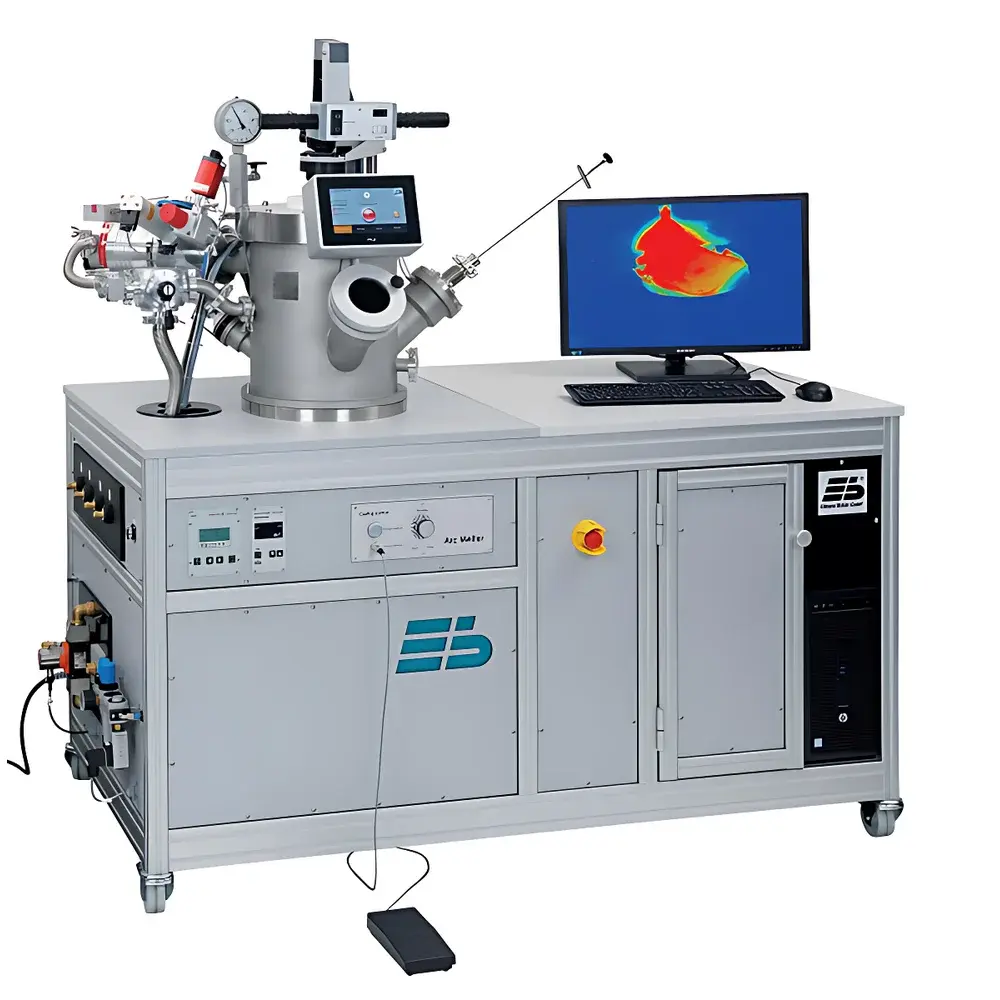
Edmund Büehler AM C500 Arc Melting Furnace
| Brand | Edmund Büehler |
|---|---|
| Origin | Germany |
| Model | AM C500 |
| Maximum Melting Capacity | 500 g |
| Maximum Casting Weight | 200 g |
| Melting Temperature | up to 3500 °C |
| Casting Temperature | up to 1800 °C |
| Vacuum Chamber | Water-Cooled Double-Walled High-Vacuum Chamber |
| Electrode | Motor-Driven Water-Cooled Tungsten Electrode |
| Control Interface | 5.8" PLC-Based Touchscreen Panel |
| Vacuum System | Integrated High-Vacuum Pumping & Pressure Monitoring |
| Optional Features | Suction Casting System (max. 148 mm billet length), In-Situ Sample Manipulator, Circulating Chiller, Real-Time Video Monitoring with Thermal State Color Coding, Automatic Vacuum/Atmosphere Cycling, Data Logging for Pressure, Current, and Voltage |
Overview
The Edmund Büehler AM C500 Arc Melting Furnace is a high-performance, laboratory-scale induction-free melting system engineered for precise synthesis and homogenization of refractory metals, intermetallics, and advanced alloy systems under controlled inert or vacuum atmospheres. Operating on the principle of direct-current arc discharge between a water-cooled tungsten electrode and the conductive sample, the furnace achieves localized energy densities sufficient to reach temperatures up to 3500 °C—enabling full melting of high-melting-point elements including tungsten, molybdenum, niobium, tantalum, and graphite-containing composites. Its double-walled, water-cooled stainless steel vacuum chamber maintains base pressures below 1 × 10⁻³ mbar (with optional turbomolecular pumping), ensuring minimal contamination during reactive metal processing. Designed for metallurgical research, nuclear materials development, and high-purity alloy prototyping, the AM C500 integrates robust thermal management, real-time process visibility, and deterministic automation—without reliance on external PCs.
Key Features
- Motor-driven, vertically adjustable water-cooled tungsten electrode with precise positioning above copper crucibles—enabling reproducible arc initiation via non-contact high-voltage pulsing.
- Integrated 5.8-inch PLC-based touchscreen HMI providing full control over vacuum sequencing, gas purging (Ar, He, N₂), arc current/voltage ramping, dwell timing, and emergency shutdown protocols.
- Double-jacketed vacuum chamber with integrated water cooling circuits and optical viewport (fused quartz, 80 mm diameter) for continuous visual monitoring of melt pool dynamics and solidification behavior.
- Modular crucible-and-mold support assembly compatible with standard copper molds (cylindrical and rectangular cross-sections); optional suction casting module supports billets up to 148 mm in length with controlled solidification rates.
- Onboard data acquisition system records vacuum pressure, arc current, arc voltage, and chamber temperature (via thermocouple inputs) with timestamped CSV export; optional video logging synchronized with thermal state color coding (e.g., blue → orange → white indicating increasing melt intensity).
- Self-contained high-power transformer unit (rated for continuous 15 kVA operation) coupled with active water cooling ensures stable arc stability and thermal repeatability across repeated runs.
Sample Compatibility & Compliance
The AM C500 accommodates conductive metallic and semi-metallic samples—including Ti-, Zr-, Nb-, Ta-, Mo-, W-, and Fe-based alloys—as well as carbon-containing compositions (e.g., TiC-reinforced composites). Non-conductive materials require conductive backing or pre-alloying. All internal wetted surfaces are electropolished 316L stainless steel or oxygen-free high-conductivity (OFHC) copper, compliant with ASTM F86 for surface finish in implant-grade metal processing environments. The system meets CE Machinery Directive 2006/42/EC and Low Voltage Directive 2014/35/EU requirements. Vacuum and atmosphere control logic adheres to ISO 14001-aligned operational safety protocols, and data logging functionality supports audit-ready documentation for GLP-compliant laboratories. Optional 21 CFR Part 11–compliant electronic signatures and audit trail modules are available upon request.
Software & Data Management
Operation is fully autonomous via embedded PLC firmware—no external PC required for routine vacuum cycling, arc ignition, or cooldown sequencing. Process parameters (e.g., pre-vacuum hold time, backfill gas composition, arc power profile) are stored as named recipes with user-defined access levels. All sensor data—including real-time pressure (capacitance manometer), arc current (Hall-effect transducer), and voltage (isolated differential amplifier)—are logged at configurable intervals (100 ms to 10 s) and archived locally on industrial-grade SD card storage. Exported datasets include metadata headers (operator ID, batch ID, timestamp, ambient conditions) and are natively compatible with MATLAB, Python (pandas), and JMP for statistical analysis of melt consistency, segregation indices, and thermal gradient correlations. Video streams (H.264 encoded) are time-stamped and indexed against sensor logs for synchronized failure mode analysis.
Applications
- Synthesis of master alloys for subsequent directional solidification or powder metallurgy feedstock preparation.
- Rapid compositional screening of multi-principal element alloys (MPEAs) and high-entropy alloys (HEAs) with tight stoichiometric control.
- Remelting and homogenization of arc-melted buttons prior to zone refining or single-crystal growth.
- Processing of oxygen-sensitive alloys (e.g., TiAl, Zr-based Laves phases) under ultra-high-purity argon or helium.
- In-situ manipulation of molten samples using optional robotic manipulator for quenching studies or multi-step casting experiments.
- Calibration reference material production where traceability to NIST-traceable thermocouples and pressure standards is required.
FAQ
What is the typical base vacuum level achievable without optional turbomolecular pumping?
Standard configuration achieves ≤1 × 10⁻³ mbar using a two-stage rotary vane pump and cold trap; turbomolecular upgrade enables ≤5 × 10⁻⁷ mbar.
Can the AM C500 operate under positive pressure with reactive gases such as hydrogen?
No—hydrogen service requires custom explosion-proof modifications and is not supported in standard configuration; only inert gases (Ar, He, N₂) are approved per EN 15649.
Is remote diagnostics or firmware updates supported?
Yes—Ethernet port enables secure SSH access for authorized service engineers; firmware updates require physical USB media and password-protected bootloader activation.
What maintenance intervals are recommended for the tungsten electrode and copper crucibles?
Electrode tip dressing every 20–30 melts depending on current density; crucibles inspected visually after each run and replaced after ~100 cycles or upon visible erosion >0.5 mm.
Does the system comply with FDA requirements for medical device material development?
Yes—when equipped with Part 11 add-on module, it supports electronic records, audit trails, and role-based access control aligned with 21 CFR Part 11 Subpart B.



