
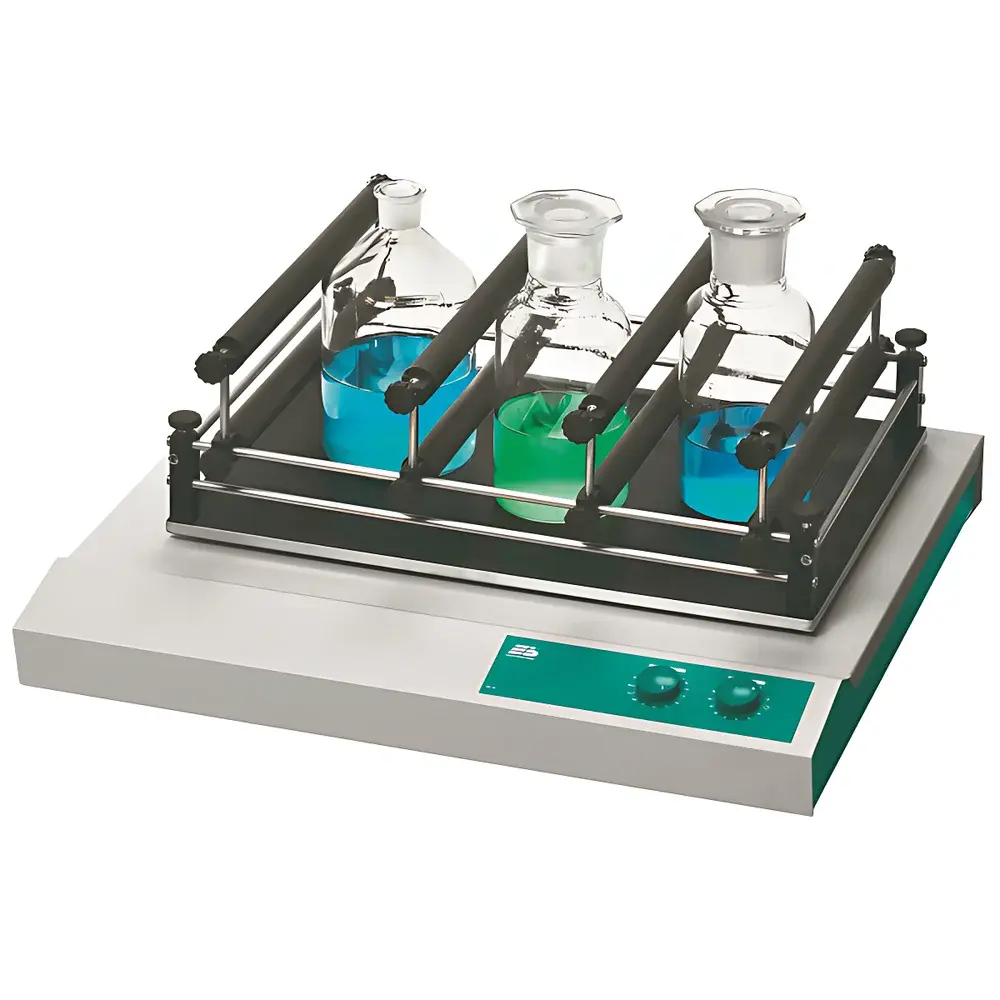
Edmund Büehler SM30 Universal Laboratory Shaker
| Brand | Edmund Büehler |
|---|---|
| Origin | Germany |
| Model | SM30 |
| Motion Types | Orbital (SM30 A), Reciprocating (SM30 B), Convertible Orbital/Reciprocating (SM30 C) |
| Control Type | Analog (Standard) or Digital Programmable (Smart Variant: SM30 A/B/C Smart) |
| Heating Option | Integrated Heated Platform (SM30 AT) |
| Platform | Stainless Steel Shaking Deck with Non-Slip Rubber Mat |
| Load Capacity | Up to 5 kg (Uniformly Distributed) |
| Compliance | CE, RoHS, ISO 9001 Manufacturing Environment |
Overview
The Edmund Büehler SM30 Universal Laboratory Shaker is a precision-engineered benchtop oscillation platform designed for reproducible mixing, suspension, and solubilization tasks in life science, microbiology, biochemistry, and pharmaceutical R&D laboratories. Built in Germany to stringent industrial quality standards, the SM30 operates on well-established mechanical oscillation principles—either orbital (centrifugal force-driven circular motion), reciprocating (linear horizontal back-and-forth displacement), or convertible dual-mode operation—enabling method flexibility across diverse sample formats including Erlenmeyer flasks, test tubes, microtiter plates, and culture bottles. Its robust aluminum-alloy chassis and brushless DC motor ensure continuous-duty performance with minimal thermal drift and long-term rotational stability. Unlike consumer-grade shakers, the SM30 integrates laboratory-grade mechanical damping and balanced drive geometry to minimize harmonic resonance and cross-contamination risk during extended incubation-mixing protocols.
Key Features
- Three configurable motion architectures: SM30 A (orbital), SM30 B (reciprocating), and SM30 C (manually switchable between both modes via mechanical coupling adjustment)
- Smart variants (SM30 A/B/C Smart) feature digital LED display of setpoint and real-time speed (rpm), programmable ramp-up/down profiles, and memory storage for up to 5 user-defined protocols—critical for optimizing dissolution kinetics of poorly soluble compounds or cell aggregation studies
- SM30 AT variant adds an integrated PTC-heated stainless steel deck (temperature range: ambient +5 °C to 60 °C, ±0.5 °C accuracy at 37 °C), enabling simultaneous shaking and controlled thermal activation without external incubators
- All models include a corrosion-resistant 304 stainless steel shaking platform (250 × 250 mm) and factory-installed non-slip silicone rubber mat; no additional clamps or universal holders are supplied by default—users select compatible accessories per application (e.g., flask clamps, microplate carriers)
- Motor control architecture supports uninterrupted 24/7 operation under rated load (≤5 kg); thermal overload protection and electromagnetic interference shielding comply with EN 61326-1 for laboratory EMC environments
Sample Compatibility & Compliance
The SM30 accommodates standard labware ranging from 15 mL conical tubes to 2 L Erlenmeyer flasks (with appropriate mounting hardware). Its low-vibration design meets ISO 20816-1 vibration severity criteria for laboratory equipment, ensuring compatibility with adjacent sensitive instrumentation (e.g., balances, spectrophotometers). The device conforms to EU directives CE 2014/30/EU (EMC), 2014/35/EU (LVD), and RoHS 2011/65/EU. While not certified as a medical device, its construction and documentation support GLP-compliant workflow integration—including audit-ready parameter logging when paired with optional RS232/USB data export modules (available for Smart and AT variants). No FDA 21 CFR Part 11–compliant electronic signature functionality is embedded natively; however, exported time-stamped .csv datasets may be imported into validated LIMS or ELN systems meeting regulatory requirements.
Software & Data Management
Smart and AT variants support ASCII-based serial communication (RS232 or USB virtual COM port) for bidirectional parameter exchange. OEM-provided PC software (Windows-compatible, no macOS/Linux drivers) enables remote configuration, real-time monitoring, and automated CSV log generation—including timestamped rpm, temperature (AT only), and elapsed runtime. All programmable settings are retained after power cycling. Firmware updates are performed via terminal command-line interface using standard terminal emulators (e.g., PuTTY). No cloud connectivity, mobile app, or proprietary SDK is provided; integration into enterprise lab infrastructure relies on standard COM port abstraction layers or OPC UA middleware.
Applications
- Cell culture maintenance: gentle suspension of adherent cell lines during passaging or transfection workflows
- Microbial growth enhancement: uniform aeration of aerobic bacterial or yeast cultures in baffled flasks
- Reagent preparation: homogenization of viscous buffers, antibody dilutions, or nanoparticle dispersions
- Dissolution testing: accelerated solubilization of crystalline APIs under controlled thermal-mechanical stress (particularly with SM30 AT)
- ELISA and immunoassay plate washing: consistent agitation during blocking and antibody binding steps
- Environmental sample processing: extraction of analytes from soil/water matrices using solvent-based shaking protocols
FAQ
Does the SM30 include tube racks or flask clamps?
No—shaking platforms ship with only the stainless steel deck and non-slip rubber mat. Accessories must be ordered separately based on vessel type and quantity.
Can the SM30 operate inside a CO₂ incubator?
Only the base analog models (SM30 A/B/C) are rated for ambient-temperature use. The SM30 AT’s heating element and electronics are not designed for humidified, high-CO₂ environments; operation inside incubators is not supported.
What is the maximum allowable unbalance mass?
The system tolerates ≤25 g radial mass asymmetry across the platform centerline. Users must ensure symmetrical loading—especially critical when operating at >200 rpm or with tall vessels.
Is calibration certificate included?
Factory calibration verification (speed and temperature for AT models) is documented in the shipping dossier. NIST-traceable recalibration services are available through authorized Edmund Büehler service centers on request.
How is firmware updated on Smart variants?
Via RS232 connection using terminal emulation software and manufacturer-supplied hex files; no over-the-air or drag-and-drop update mechanism exists.
Related Products




