
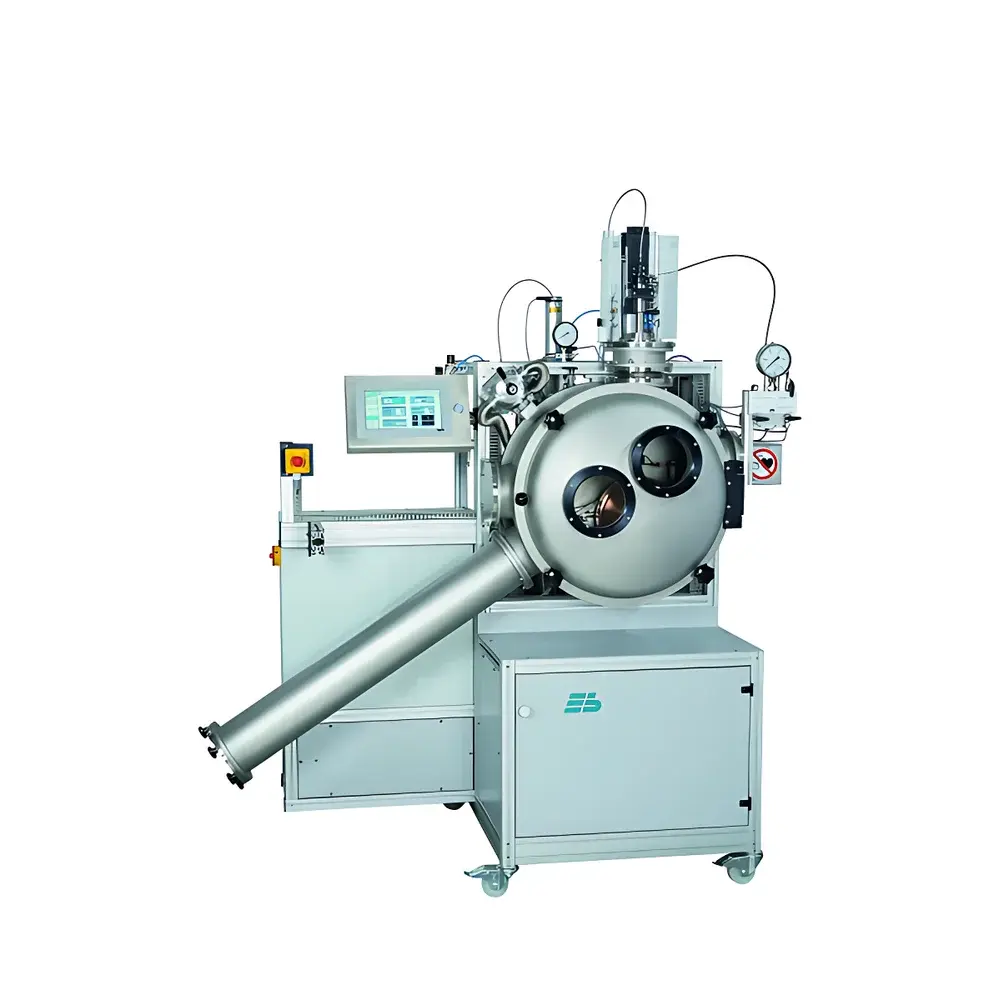
Edmund Bühler MSP60 Melt Spinning System
| Brand | Edmund Bühler |
|---|---|
| Origin | Germany |
| Model | MSP60 |
| Vacuum Chamber | High-vacuum compatible (≤1×10⁻⁵ mbar) |
| Copper Wheel Diameter | 250 mm (solid, optionally water-cooled) |
| Wheel Tilt Adjustment | Continuous angular control for optimized melt jet impingement |
| Crucible Options | 3-piece boron nitride crucible with adapter |
| RF Generator Power | 12 kW or 25 kW (configurable) |
| Temperature Monitoring | Pyrometer range 500–1700 °C (calibration traceable to NIST standards) |
| Melt Volume Capacity | 5–10 g per run |
| Cooling Rate | >10⁶ K/s (typical for amorphous ribbon formation) |
| Control Interface | Integrated touchscreen HMI with real-time display of wheel speed, RF power, melting duration, vacuum level, and pyrometer feedback |
| Auxiliary Systems | Recirculating chiller (required), compressed air supply (4–6 bar), turbo-molecular or diffusion pump train |
Overview
The Edmund Bühler MSP60 Melt Spinning System is a high-precision, laboratory-scale rapid solidification apparatus engineered for the reproducible fabrication of metallic glasses, metastable alloys, and nanocrystalline ribbons. Operating on the principle of planar flow casting (PFC), the system melts alloy feedstock inductively within a refractory crucible under high vacuum (≤1×10⁻⁵ mbar), then ejects the molten stream through a precision nozzle onto a rotating, water-cooled copper wheel. The extreme thermal gradient at the wheel surface—exceeding 10⁶ K/s—suppresses nucleation and enables glass formation in compositions otherwise prone to crystallization. Designed for materials science R&D labs, the MSP60 supports systematic parametric studies of quenching kinetics, interfacial heat transfer, and microstructure evolution in amorphous and ultrafine-grained systems.
Key Features
- 250 mm solid copper wheel with continuous tilt-angle adjustment (±15°) to optimize melt jet incidence angle and ribbon adhesion uniformity
- Integrated RF induction heating system (12 kW or 25 kW configurable) with impedance-matched coupling for stable, controllable melt generation
- Automated crucible positioning system (TPS) with dual-axis repeatability (< ±0.1 mm) for precise alignment between nozzle exit and wheel surface
- High-vacuum chamber equipped with turbomolecular pumping station (or diffusion pump option) and bake-out capability for oxygen-sensitive alloys (e.g., Fe-, Co-, Zr-based BMGs)
- Real-time pyrometric monitoring (500–1700 °C) with emissivity compensation and NIST-traceable calibration certificate included
- Touchscreen HMI control panel enabling synchronized operation of RF generator, wheel motor, vacuum gauges, pyrometer, and chiller interface
- Modular crucible support: standardized 3-piece boron nitride assembly with thermal expansion-matched adapter; optional fused quartz crucibles for low-reactivity melts
Sample Compatibility & Compliance
The MSP60 accommodates a broad spectrum of metallic systems—including Fe-, Ni-, Co-, Zr-, Mg-, and Al-based alloys—as well as intermetallic precursors and multicomponent bulk metallic glass formers. Its high-vacuum architecture meets ASTM F2658-20 requirements for inert-atmosphere processing of reactive metals. All vacuum components conform to ISO 286-2 (grade IT6 tolerances), and electrical subsystems comply with IEC 61000-6-4 (EMC emission limits). The system supports GLP-compliant operation via timestamped parameter logging (wheel speed, RF power, melt duration, vacuum pressure, temperature), with optional audit trail configuration aligned with FDA 21 CFR Part 11 Annex 11 principles for regulated environments.
Software & Data Management
The embedded control firmware records all operational parameters at 10 Hz resolution and exports time-synchronized datasets in CSV and HDF5 formats. Raw pyrometer signals are digitally filtered (Butterworth 2nd-order low-pass, fc = 10 Hz) prior to storage. Optional LabVIEW-based data acquisition add-on enables third-party integration with XRD, DSC, or SEM-EDS workflows. All system logs include ISO 8601 timestamps, operator ID fields, and checksum-verified metadata—ensuring full traceability from melt initiation to ribbon ejection. Backup archives are stored on internal SSD with automatic daily offload to network-mounted NAS via SMBv3.
Applications
- Rapid prototyping of amorphous soft magnetic ribbons (e.g., Metglas-type FeSiB, CoFeSiB) for high-frequency transformer cores
- Screening of glass-forming ability (GFA) in multicomponent alloy systems using thickness-controlled quenching trials
- Investigation of solidification under constrained geometry: effect of wheel roughness, nozzle-to-wheel gap, and melt superheat on ribbon morphology
- Production of precursor ribbons for subsequent devitrification studies (e.g., controlled annealing to nucleate α-Fe nanocrystals in Finemet analogs)
- Development of corrosion-resistant Zr-based metallic glasses for biomedical implant substrates
- In situ thermal profiling during melt ejection to validate interfacial heat transfer models (e.g., Rosenthal-type solutions)
FAQ
What vacuum level is required for processing oxygen-sensitive alloys such as Ti- or Mg-based systems?
The MSP60 achieves base pressures ≤1×10⁻⁵ mbar using a turbomolecular pump; for Ti/Zr melts, a pre-bake cycle (120 °C for 4 h) and leak-check protocol per ISO 20484 are recommended prior to loading.
Can the system be upgraded to support gas atomization or twin-roll casting modes?
No—the MSP60 is purpose-built for single-wheel melt spinning. Twin-roll configurations require separate hardware (e.g., Bühler MSP-Twin); gas atomization is incompatible with the chamber design.
Is the boron nitride crucible supplied with thermal cycling certification?
Yes—each BN crucible set undergoes 5-cycle thermal shock validation (25 °C → 1600 °C → 25 °C, 5 min dwell) and is accompanied by a material test report (MTR) per EN 10204 3.1.
How is wheel surface conditioning managed between runs?
The integrated abrasive polishing module uses diamond-impregnated pads (grit #400–#1200) actuated pneumatically; surface roughness (Ra) is verified post-polish via stylus profilometry (traceable to PTB standards).
Does the system meet electromagnetic compatibility requirements for installation in shared lab facilities?
Yes—RF shielding integrity is verified per CISPR 11 Group 2 Class A, and grounding continuity is tested to <100 mΩ per IEC 61000-6-2.



