
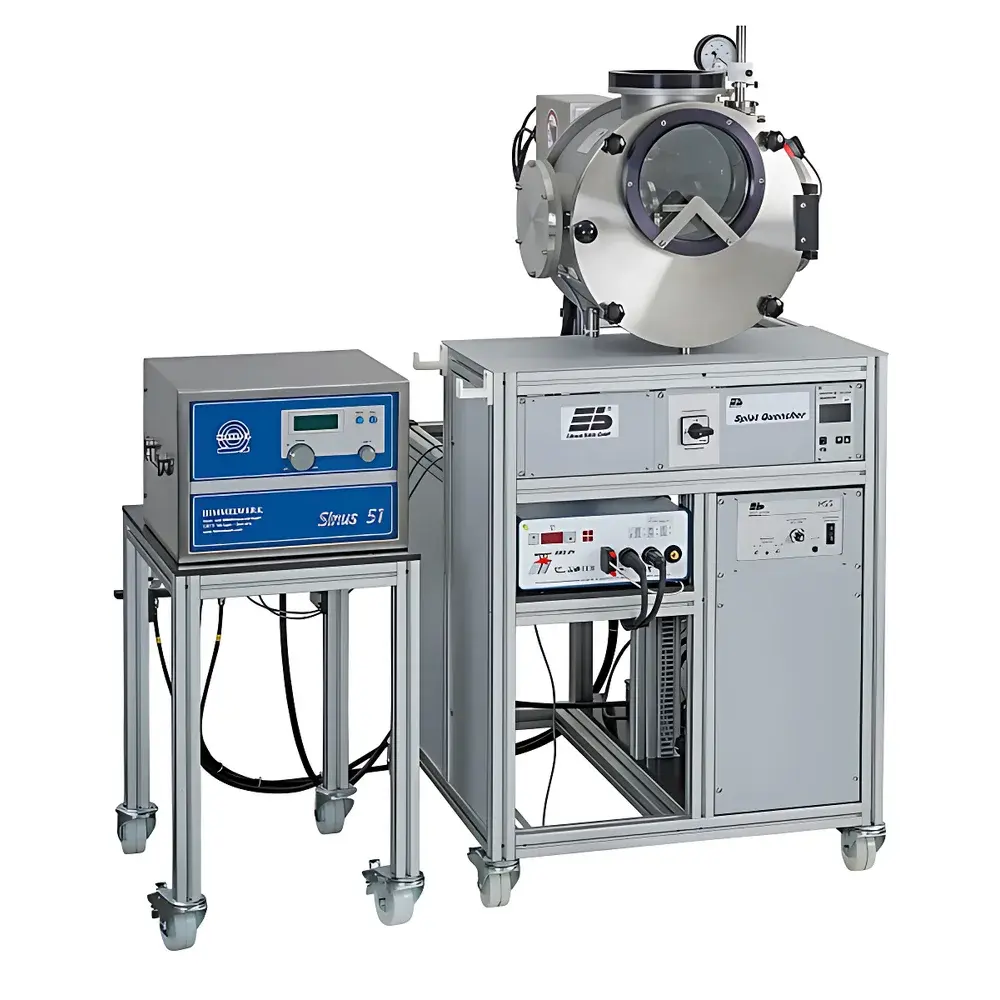
Edmund Bühler URQ Splat Quenching System
| Brand | Edmund Bühler |
|---|---|
| Origin | Germany |
| Model | URQ |
| Maximum Temperature | up to 2500°C |
| Generator Power | 5 kW |
| Generator Frequency | 500 kHz – 1 MHz |
| Vacuum Level | < 10⁻² – 10⁻⁵ mbar |
| Cooling Rate | up to 10⁶ K/s |
| Sample Mass | 80–200 mg (customizable) |
| Splat Thickness | 20–100 µm |
| Splat Diameter | Ø 10–30 mm |
| Copper Piston Diameter | Ø 30 mm (optional: Ø 25 mm or Ø 35 mm) |
| Electrical Supply | 400 V, 3-phase, 50/60 Hz (RF generator) |
| Dimensions (W × H × D) | 850 × 1500 × 750 mm |
Overview
The Edmund Bühler URQ Splat Quenching System is a high-precision, vacuum-compatible rapid solidification instrument engineered for the preparation of metastable metallic alloys and amorphous thin ribbons via melt-spinning-free splat cooling. Unlike conventional melt-spinning or twin-roll casting systems, the URQ employs electromagnetic levitation (EML) coupled with radio-frequency (RF) induction heating to achieve crucible-free melting of highly reactive, refractory, or oxygen-sensitive materials—such as Ti-, Zr-, Nb-, or Ta-based alloys—up to 2500°C. The molten sample is suspended in a high-vacuum environment (< 10⁻²–10⁻⁵ mbar), then accelerated toward a rapidly rotating, water-cooled copper piston where it impacts at controlled velocity and solidifies within microseconds. This process yields planar splats with exceptional thermal gradients and cooling rates exceeding 10⁶ K/s—enabling access to non-equilibrium microstructures, extended solid solubility, and glass-forming compositions not attainable through conventional casting.
Key Features
- Crucible-free RF induction melting (5 kW, 500 kHz–1 MHz) ensuring zero contamination from refractory linings or crucible dissolution
- High-vacuum chamber compatible with inert gas backfilling (Ar, He) for oxidation-sensitive alloy processing
- Precision-engineered copper piston (standard Ø 30 mm; optional Ø 25 mm or Ø 35 mm) with integrated high-flow water cooling for reproducible thermal extraction
- Adjustable sample mass range (80–200 mg), scalable for method development and small-batch alloy screening
- Modular RF generator and quench unit architecture enabling integration into larger metallurgical workflows or glovebox-coupled environments
- Robust mechanical design with vibration-damped baseplate and rigid alignment system to ensure consistent splat geometry and interfacial contact uniformity
Sample Compatibility & Compliance
The URQ accommodates a broad spectrum of conductive metallic feedstocks—including pure elements (e.g., Mo, W, Ni), intermetallic precursors, and multi-component master alloys—with no requirement for pre-alloyed rods or wires. Its levitation-based melting eliminates slag formation, segregation, and mold adhesion issues common in conventional casting. The system complies with ISO 14001 environmental management standards for energy-efficient operation and meets mechanical safety requirements per EN 61000-6-2 (EMC immunity) and EN 61000-6-4 (EMC emission). Vacuum components conform to ASTM F2711 specifications for ultra-high-vacuum flange integrity. While not certified for GMP production, the URQ supports GLP-compliant documentation protocols when paired with validated data acquisition software.
Software & Data Management
The URQ operates via a dedicated industrial PLC-based control interface with real-time monitoring of RF power output, chamber pressure, cooling water flow rate, and piston rotation speed (where applicable). All operational parameters are timestamped and logged in CSV format for traceability. Optional integration with LabVIEW™ or MATLAB® enables custom scripting for automated parameter sweeps (e.g., temperature ramping, pulse modulation, or multi-step quench sequences). Audit trails support FDA 21 CFR Part 11 compliance when configured with user authentication, electronic signatures, and write-protected archive storage—making the system suitable for regulated R&D environments in aerospace materials qualification or biomedical alloy development.
Applications
- Preparation of amorphous/nanocrystalline splats for XRD, TEM, and DSC structural analysis
- Thermophysical property mapping (e.g., liquidus/solidus determination, undercooling behavior) of refractory alloy systems
- Rapid screening of glass-forming ability (GFA) in Zr-, Pd-, or Fe-based bulk metallic glass precursors
- Investigation of phase selection kinetics under extreme non-equilibrium conditions (e.g., suppression of intermetallics, stabilization of metastable bcc phases)
- Feedstock generation for subsequent powder metallurgy routes, including laser powder bed fusion (LPBF) feedstock qualification
- Corrosion and oxidation resistance evaluation of ultra-fast-quenched surface layers in aggressive media (ASTM G31, G102)
FAQ
Can the URQ process non-conductive or ceramic materials?
No—the system relies on electromagnetic levitation and RF induction heating, both of which require electrical conductivity. It is designed exclusively for metallic and intermetallic feedstocks.
What vacuum pumping configuration is recommended for achieving ≤10⁻⁵ mbar?
A turbomolecular pump backed by a dry scroll pump is standard; cryogenic trapping is advised for reactive vapor species (e.g., Mg, Al evaporation).
Is remote operation supported?
Yes—Ethernet-enabled PLC control allows secure remote monitoring and parameter adjustment via authenticated VPN connection.
How is splat thickness repeatability ensured across runs?
By maintaining constant melt superheat, drop height, piston surface finish (Ra < 0.2 µm), and cooling water inlet temperature (±0.5°C), typical thickness variation is ±5 µm for fixed sample mass and geometry.
Does Edmund Bühler provide application support for alloy-specific optimization?
Yes—Bühler’s technical service team offers on-site or virtual commissioning, including levitation stability tuning, splat morphology calibration, and vacuum leak diagnostics.
Related Products



