
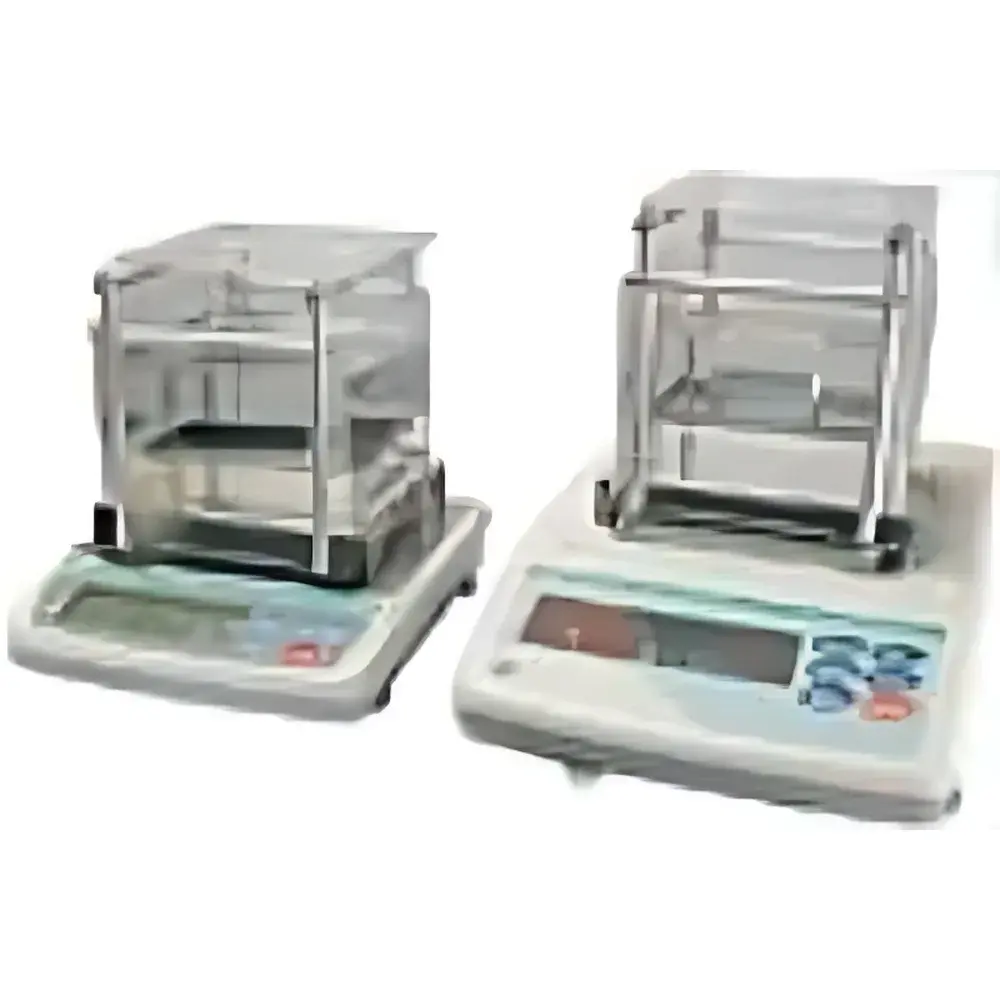
AND EK-300iD / GF-300D Density Determination Balance (Based on Archimedes’ Principle)
| Brand | A&D |
|---|---|
| Origin | Japan |
| Model | EK-300iD / GF-300D |
| Instrument Type | Buoyancy-Based Density Balance |
| Measurement Principle | Archimedes’ Principle |
| Weighing Capacity | 300 g (EK-300iD), 310 g (GF-300D) |
| Weighing Readability | 0.01 g (EK-300iD), 0.001 g (GF-300D) |
| Density Resolution | 0.001 g/cm³ |
| Display | Backlit LCD (16 mm character height, EK-iD series) |
| Stabilization Time | ≤1 s (GF-D series) |
| Internal Resolution | 1/10,000,000 |
| Environmental Response Modes | FAST / MID / SLOW |
| Calibration | Full-digital span calibration with user-adjustable reference weight input |
| Temperature Compensation | Direct water temperature or reference liquid density entry |
| Density Comparison Mode | Hi / OK / Lo alarm output (optional external relay module) |
| Auto Power-Off | Configurable after ≥10 min inactivity |
| Interface | RS-232C standard port |
| Software | WinCT v3.x (Windows-compatible, supports Excel/Office data export, statistical analysis, time-series logging, and chart-based visualization) |
| Compliance | Built-in GLP/GMP/ISO audit trail functions (date/time stamping, instrument ID, calibration history, operator ID, measurement statistics) |
Overview
The AND EK-300iD and GF-300D Density Determination Balances are precision laboratory instruments engineered for rapid, traceable, and operator-independent density measurement of solid, liquid, porous, and viscous samples—based strictly on Archimedes’ principle of buoyant force. Unlike conventional pycnometers or hydrometers requiring manual volumetric calculations, these balances integrate a high-stability weighing system with automated density computation logic to deliver direct digital readouts in g/cm³ without intermediate unit conversions. The EK-300iD model is optimized for routine industrial QC environments where robustness and intuitive operation are prioritized; the GF-300D variant delivers enhanced resolution (0.001 g readability) and sub-second stabilization for R&D labs requiring higher metrological rigor in polymer characterization, powder metallurgy, or advanced material development. Both models comply with ISO 2812-1 (paints and varnishes), ASTM D792 (plastics), ASTM D1505 (density of plastics by density gradient column), and USP (density of liquids), forming an integral part of validated workflows under GLP and GMP frameworks.
Key Features
- High-contrast backlit LCD (EK-iD series) or fluorescent display (GF-D series), featuring 16 mm character height for legibility in low-light production or lab settings.
- SHS (Super Hybrid Sensor) weighing mechanism in GF-D models ensures ≤1 s stabilization time and internal resolution up to 1/10,000,000, minimizing drift during suspended-weight measurements.
- Triple-stage environmental response adjustment (FAST/MID/SLOW) dynamically suppresses air-current and floor-vibration artifacts—critical when operating near HVAC vents or shared lab benches.
- One-touch solid and liquid density modes eliminate procedural ambiguity: no keypress required for liquid density readout; solids require only two sequential weighings (in air, then in immersion fluid).
- Full-digital span calibration allows user-defined reference mass input—essential for maintaining traceability when using non-standard calibration weights or verifying performance across extended service intervals.
- Real-time temperature compensation via direct water-temperature entry or custom reference liquid density value—reducing thermal expansion-induced error in aqueous density determinations to <±0.0005 g/cm³.
- Density comparison mode supports configurable upper/lower limits with visual (Hi/OK/Lo) and optional relay-based alarm outputs—enabling integration into inline quality gates or automated sorting systems.
- RS-232C interface and bundled WinCT software support bidirectional communication, real-time data streaming, statistical reporting (mean, SD, min/max), time-series logging for swelling/absorption kinetics, and native Excel export without third-party drivers.
Sample Compatibility & Compliance
These balances accommodate heterogeneous sample geometries without geometry-dependent correction factors: irregular solids (e.g., sintered metal parts), low-density foams (EVA, PU), granular powders (metal, ceramic, polymer), viscous liquids (resins, adhesives), and suspended particulates. Immersion fixtures include stainless-steel wire baskets, anti-static acrylic holders, and PTFE-coated hooks—ensuring chemical compatibility with solvents, acids, and caustics. All firmware modules adhere to FDA 21 CFR Part 11 requirements for electronic records and signatures when paired with WinCT’s audit-trail-enabled configuration. Calibration logs, measurement histories, and operator credentials are timestamped and cryptographically unalterable—fully supporting ISO/IEC 17025 accreditation audits and pharmaceutical process validation protocols.
Software & Data Management
WinCT v3.x provides a validated Windows-native platform for data integrity and regulatory compliance. It captures raw weight values, computed densities, environmental parameters (temperature, humidity), and operator metadata in encrypted .wct binary files—exportable as CSV or directly into Excel worksheets. Statistical modules calculate repeatability (RSD), confidence intervals (95% CI), and trend deviations across batches. Time-series acquisition enables dynamic analysis of moisture uptake (ASTM D570), dimensional stability (ISO 293), or porosity evolution (ASTM C20). When connected to AD-8121B thermal printers, reports include full GLP headers: instrument serial number, calibration due date, certified reference standard ID, and digital signature fields—all compliant with ISO 15197 and EU Annex 11 expectations.
Applications
The EK-300iD/GF-300D platforms serve cross-industry density verification needs: determining specific gravity of injection-molded automotive components (PP, ABS, PC blends); quantifying void content in carbon-fiber prepregs (ASTM D3171); validating bulk density of lithium-ion cathode powders (NMC, LFP); monitoring density shifts in curing epoxy resins; certifying compliance of cosmetic emulsions per ISO 11047; and verifying alloy composition consistency in aerospace-grade aluminum forgings. In food science, they support density-based authenticity screening of honey, olive oil, and fruit juices per Codex Alimentarius standards. Educational labs utilize them for teaching fundamental fluid statics and material property interrelationships.
FAQ
What density measurement standards does this instrument support?
It complies with ASTM D792, ASTM D1505, ISO 2812-1, ISO 1183, USP , and JIS K 7112—covering plastics, paints, pharmaceutical liquids, and general-purpose materials.
Can it measure the density of porous or absorbent materials?
Yes—using the dual-weighing method with surface-tension-reducing agents (e.g., ethanol or surfactant solutions) and vacuum impregnation accessories (sold separately), enabling accurate skeletal density determination per ASTM D5550.
Is the WinCT software validated for regulated environments?
WinCT v3.x includes IQ/OQ documentation templates, electronic signature support, and 21 CFR Part 11-compliant audit trails—qualified for use in FDA-inspected facilities and ISO 13485 medical device manufacturing.
How is calibration traceability maintained?
Each unit ships with NIST-traceable calibration certificates. Full-digital span calibration permits revalidation using customer-owned Class M1 or better weights, with all calibration events permanently recorded in the internal log.
Does the instrument support automatic temperature compensation for non-aqueous liquids?
Yes—users may input any reference liquid density at a specified temperature, allowing accurate density calculation for solvents such as toluene, acetone, or ethylene glycol across defined thermal ranges.



