
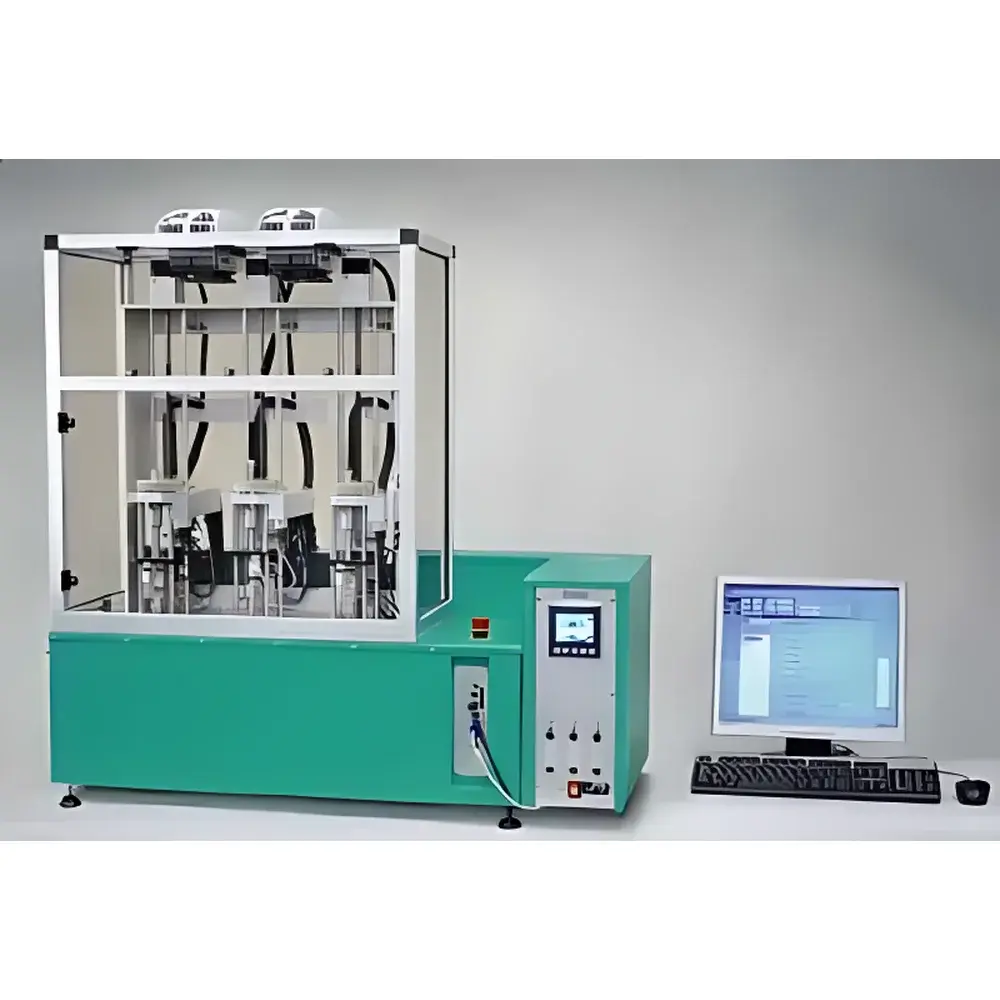
ELASTOCON EB 18-II-3 Automated Stress Relaxation and Creep Tester
| Brand | ELASTOCON |
|---|---|
| Origin | Sweden |
| Model | EB 18-II-3 |
| Temperature Range | +40 to +200 °C (HT option: +300 °C) |
| Temperature Stability | ±0.5 °C (40–200 °C), ±1.0 °C (201–300 °C) |
| Temperature Uniformity | ±0.25 °C |
| Temperature Sensor | Pt 100, 1/3 DIN |
| Number of Test Stations | 3 |
| Force Range (Compression) | 0–1000 N (optional: 100 / 500 / 1500 N) |
| Force Resolution | 0.1 N (compression), 0.01 N (tension) |
| Force Accuracy | ±0.2 N (typical, depending on range) |
| Displacement Resolution | 0.0001 mm |
| Displacement Accuracy | ±0.003 mm |
| Crosshead Speed | 0.1–200 mm/min |
| Platen Diameter | 50 mm |
| Airflow Velocity | <0.001 m/s |
| Air Exchange Rate | 3–20 cycles/hour |
| Power Supply | 220–240 V / 1 / 50 Hz or 110–120 V / 1 / 60 Hz |
| Power Consumption | 900 W |
| Dimensions (W×D×H) | 1170 × 500 × 1220 mm |
| Weight | 151 kg |
| Compliance Standards | ISO 188 Method A, ISO 3384-1, ISO 6914, ISO 899 |
Overview
The ELASTOCON EB 18-II-3 Automated Stress Relaxation and Creep Tester is a precision-engineered instrument designed for standardized viscoelastic characterization of elastomeric and thermoplastic materials under controlled thermal conditions. It operates on the fundamental principles of linear and non-linear viscoelasticity, enabling quantitative measurement of time-dependent mechanical responses—including stress decay under constant strain (stress relaxation) and strain accumulation under constant load (creep)—across defined temperature intervals. The system features three independent test stations housed within a thermally insulated enclosure constructed from anodized aluminum profiles and impact-resistant polycarbonate panels. Integrated Peltier-based cooling and high-efficiency forced-air circulation ensure precise thermal management, maintaining uniform chamber conditions critical for reproducible ISO-compliant testing. Each station employs servo-controlled electromechanical actuation for bidirectional compression and tension, eliminating hydraulic or pneumatic dependencies and supporting high-resolution displacement control down to 0.0001 mm.
Key Features
- Three fully independent test stations with individual motorized actuation, enabling parallel execution of heterogeneous test protocols without cross-interference.
- Servo-driven compression/tension mechanism with dual-range force resolution: 0.1 N for compression, 0.01 N for tension—optimized for both high-force rubber compounds and low-force soft polymers.
- Thermally stabilized test chamber with active cooling and programmable air exchange (3–20 cycles/hour), achieving ±0.25 °C spatial uniformity and long-term stability of ±0.5 °C over 40–200 °C (±1.0 °C up to 300 °C with HT option).
- Pt 100 Class 1/3 DIN temperature sensors integrated at multiple spatial locations for real-time thermal mapping and closed-loop feedback control.
- Stainless steel platens (50 mm diameter) and corrosion-resistant aluminum structural components ensure dimensional stability and long-term mechanical integrity in demanding laboratory environments.
- Comprehensive safety architecture including overload protection, emergency stop circuitry, and interlocked transparent polycarbonate enclosure compliant with EN 61000-6-2/6-4 EMC standards.
Sample Compatibility & Compliance
The EB 18-II-3 accommodates standard test specimens per ISO 3384-1 (rubber compression set), ISO 188 Method A (heat aging with compression), ISO 6914 (creep of vulcanized rubber), and ISO 899 (plastics creep). Specimen geometries include cylindrical, dumbbell, and disc formats with thicknesses ranging from 2 mm to 25 mm. The system supports preconditioning cycles, multi-step thermal ramps, and dwell periods required by ASTM D1414, ASTM D3330, and ISO 11357-3 for dynamic mechanical analysis correlation. All hardware and firmware configurations meet essential requirements for GLP-compliant environments, including audit-trail-capable parameter logging and user-access-level controls aligned with FDA 21 CFR Part 11 expectations for electronic records.
Software & Data Management
Control and analysis are executed via ELASTOCON’s proprietary Windows-based software suite, featuring intuitive workflow configuration, real-time graphical monitoring, and automated report generation in PDF or Excel format. The software implements full traceability: every test file embeds metadata including operator ID, calibration timestamp, environmental logs (temperature, airflow), and raw force/displacement/time arrays sampled at ≥100 Hz. Exported datasets conform to ASTM E1447 and ISO/IEC 17025 data integrity guidelines. Optional integration with LIMS platforms is supported via secure RESTful API endpoints with TLS 1.2 encryption and OAuth 2.0 authentication.
Applications
- Quantification of compression set recovery kinetics in automotive sealing systems exposed to elevated temperatures.
- Evaluation of creep compliance in thermoplastic elastomer (TPE) gaskets used in medical device housings per ISO 10993-1 biocompatibility protocols.
- Accelerated aging studies of silicone elastomers under sustained compressive load, aligned with ISO 188 Method A for shelf-life prediction.
- Comparative assessment of crosslink density effects on stress relaxation behavior in EPDM and nitrile rubber formulations.
- Validation of finite element models (FEM) for polymer component deformation under static loading, using experimentally derived Prony series coefficients.
FAQ
What ISO standards does the EB 18-II-3 directly support?
The instrument is configured and validated for ISO 188 Method A, ISO 3384-1, ISO 6914, and ISO 899; full compliance documentation—including uncertainty budgets and verification reports—is provided with each delivery.
Can the system perform simultaneous creep and stress relaxation tests on different materials?
Yes—each of the three stations operates independently, allowing concurrent execution of distinct test types (e.g., creep on Station 1, stress relaxation on Station 2, and compression set on Station 3) under identical or divergent thermal profiles.
Is calibration traceable to national metrology institutes?
Force and displacement transducers are calibrated using NIST-traceable reference standards; temperature uniformity verification follows ISO/IEC 17025-accredited procedures performed annually by ELASTOCON-certified service engineers.
Does the software support 21 CFR Part 11 compliance for regulated industries?
Yes—the software includes electronic signatures, role-based access control, immutable audit trails, and data encryption options required for pharmaceutical and medical device quality systems.
What maintenance intervals are recommended for long-term accuracy?
Biannual verification of thermal uniformity and force calibration is advised; annual inspection of servo drive alignment and platen surface flatness ensures continued adherence to ISO 3384-1 geometric tolerances.





