
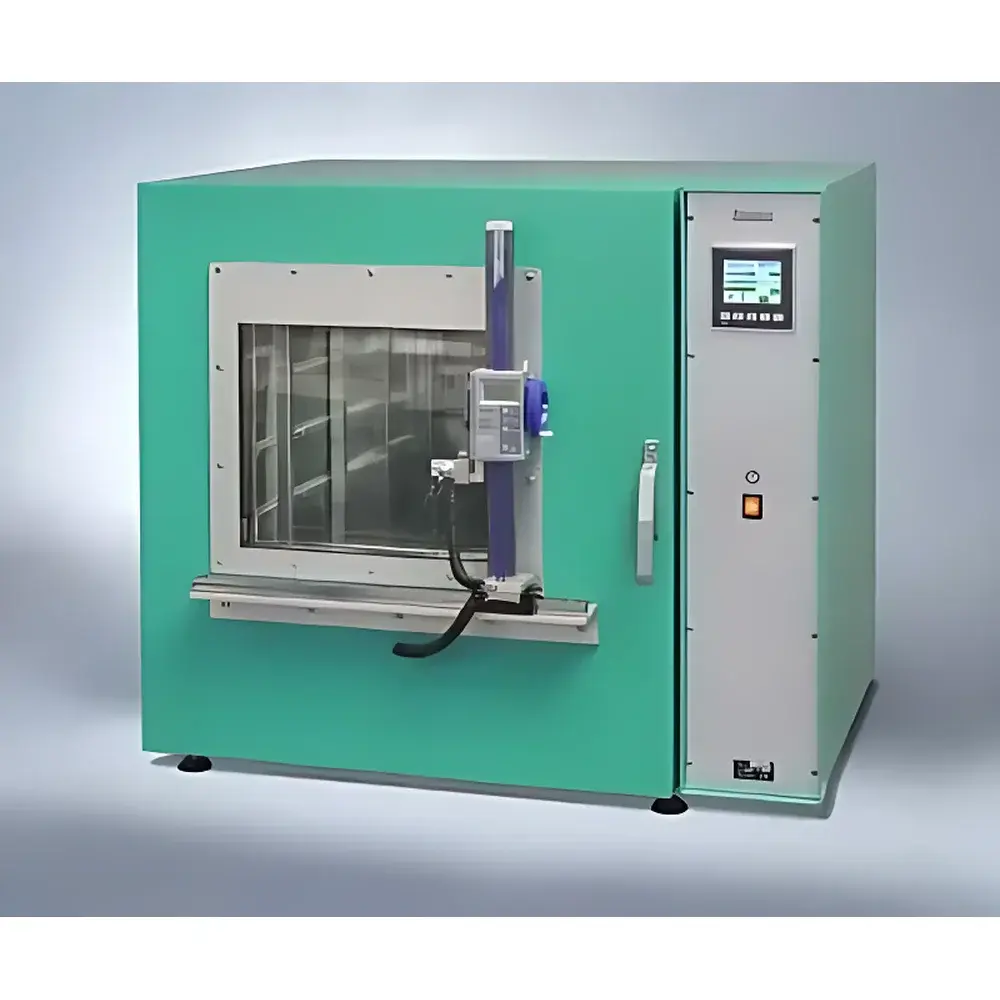
ELASTOCON EB 24 Film Creep Tester
| Brand | ELASTOCON |
|---|---|
| Origin | Sweden |
| Model | EB 24 |
| Temperature-Controlled Aging Chamber Base | EB 10-II |
| Air Exchange Rate | 14 cycles/hour |
| Viewing Window Dimensions | 370 × 300 mm |
| Specimen Capacity | 10 strips (25 × 100 mm) suspended via hooks |
| Load Application | Dual standard weights (1.3 kg and 2.3 kg) |
| Digital Measurement System | Laser-guided linear scale with 0.01 mm resolution |
| Maximum Elongation Range | 300 mm |
| Data Interface | RS-232 or USB to PC |
| Output Format | Raw displacement values exportable to CSV/Excel for creep strain calculation and time-dependent curve fitting |
Overview
The ELASTOCON EB 24 Film Creep Tester is a dedicated mechanical testing instrument engineered for the quantitative evaluation of time-dependent viscoelastic deformation in thin polymeric films, elastomeric sheets, and flexible packaging materials under controlled thermal and atmospheric conditions. Built upon the thermally stable and ISO-compliant aging chamber platform EB 10-II, the EB 24 integrates a precision laser-guided digital measurement system to capture dimensional changes over extended durations—typically ranging from hours to weeks—under constant uniaxial tensile load. Its operational principle follows classical uniaxial creep testing methodology: specimens are clamped vertically, subjected to standardized static loads (1.3 kg or 2.3 kg), and monitored for elongation as a function of time at defined temperature and air exchange conditions (14 air changes per hour). This configuration ensures reproducible environmental exposure while minimizing convective disturbance near the specimen zone—a critical requirement for low-modulus, high-elongation materials where ambient drift can significantly affect measurement fidelity.
Key Features
- Thermally integrated design based on the ELASTOCON EB 10-II aging chamber, compliant with ISO 188 and ASTM D573 for accelerated aging environments
- Laser-aligned digital linear scale with 0.01 mm resolution and 300 mm full-scale travel, enabling traceable, operator-independent displacement acquisition
- Optimized specimen geometry support: accommodates ten 25 mm × 100 mm test strips mounted simultaneously via calibrated suspension hooks
- Standardized dual-load configuration using certified stainless-steel weights (1.3 kg and 2.3 kg), corresponding to nominal stress levels aligned with ISO 37 and ISO 891-2 for thin-section tensile testing
- Large front viewing window (370 × 300 mm) fabricated from heat-resistant borosilicate glass, permitting real-time visual monitoring without chamber interruption
- Direct serial or USB data interface for automated timestamped displacement logging; output compatible with Microsoft Excel, MATLAB, and Python-based curve-fitting workflows
Sample Compatibility & Compliance
The EB 24 is validated for use with thermoplastic films (e.g., LDPE, PP, PET), thermoplastic elastomers (TPEs), vulcanized rubber sheets, and laminated barrier structures common in medical packaging and food-grade applications. Specimens must conform to ISO 527-3 Type 1BA geometry (25 mm width, 100 mm gauge length) to ensure uniform stress distribution and minimize edge effects. The system supports testing across temperatures from ambient to +70 °C, with thermal uniformity maintained within ±0.5 °C per IEC 60068-3-5. Air exchange control (14 cycles/hour) meets requirements for oxidative aging protocols per ASTM D865 and ISO 1431-1. All mechanical components—including load hangers and clamping fixtures—are constructed from corrosion-resistant anodized aluminum and passivated stainless steel to prevent catalytic degradation during long-term exposure.
Software & Data Management
The EB 24 does not include proprietary software but delivers ASCII-formatted time-stamped displacement data via configurable serial/USB output. Users implement custom analysis pipelines in validated platforms such as Excel (with built-in creep model templates), MATLAB Curve Fitting Toolbox, or Python (SciPy optimize.curve_fit). Exported datasets contain three columns: elapsed time (s), absolute displacement (mm), and optional channel ID for multi-specimen tracking. For regulated environments (e.g., ISO 13485-certified medical device manufacturing or FDA-regulated packaging validation), raw data files may be archived with electronic signatures and audit trails using third-party LIMS or ELN systems compliant with 21 CFR Part 11. No internal storage or cloud upload functionality is embedded—ensuring full data sovereignty and alignment with GLP/GMP documentation integrity standards.
Applications
- Creep compliance and retardation spectrum analysis of pressure-sensitive adhesives (PSAs) used in transdermal patches
- Long-term dimensional stability assessment of shrink films and stretch hooding materials under simulated warehouse conditions
- Comparative ranking of polymer film formulations for automotive interior trim, where prolonged creep leads to visible sagging or delamination
- Supporting ASTM D2990 Annex A2 for time–temperature superposition modeling of amorphous thermoplastics
- Validation of shelf-life predictions for sterile barrier systems per ISO 11607-1, particularly where creep-induced seal creep may compromise microbial ingress resistance
FAQ
What standards does the EB 24 comply with for creep testing?
The EB 24 implements core elements of ISO 891-2 (tensile testing of plastic films), ISO 37 (vulcanized rubber), and ASTM D2990 (creep and creep rupture of plastics), though final test method adherence depends on user-defined protocol execution.
Can the system apply loads other than 1.3 kg and 2.3 kg?
No—the EB 24 is mechanically configured only for the two certified weights supplied. Custom loading requires external force application and voids factory calibration traceability.
Is temperature ramping supported?
No—EB 24 operates exclusively under isothermal conditions. Temperature profiling requires integration with external programmable ovens and independent validation.
How is measurement uncertainty quantified?
Systematic uncertainty derives from laser scale linearity (±0.02 mm over 300 mm, per manufacturer calibration certificate) and weight mass tolerance (±0.1 %). Combined standard uncertainty for creep strain is typically ≤0.05 % at 100 mm extension.
Does the unit meet IP or NEMA enclosure ratings?
The EB 24 is designed for laboratory benchtop use only (IEC 61000-6-3 EMC class B) and carries no ingress protection rating; it must be operated in dry, non-corrosive indoor environments.





