
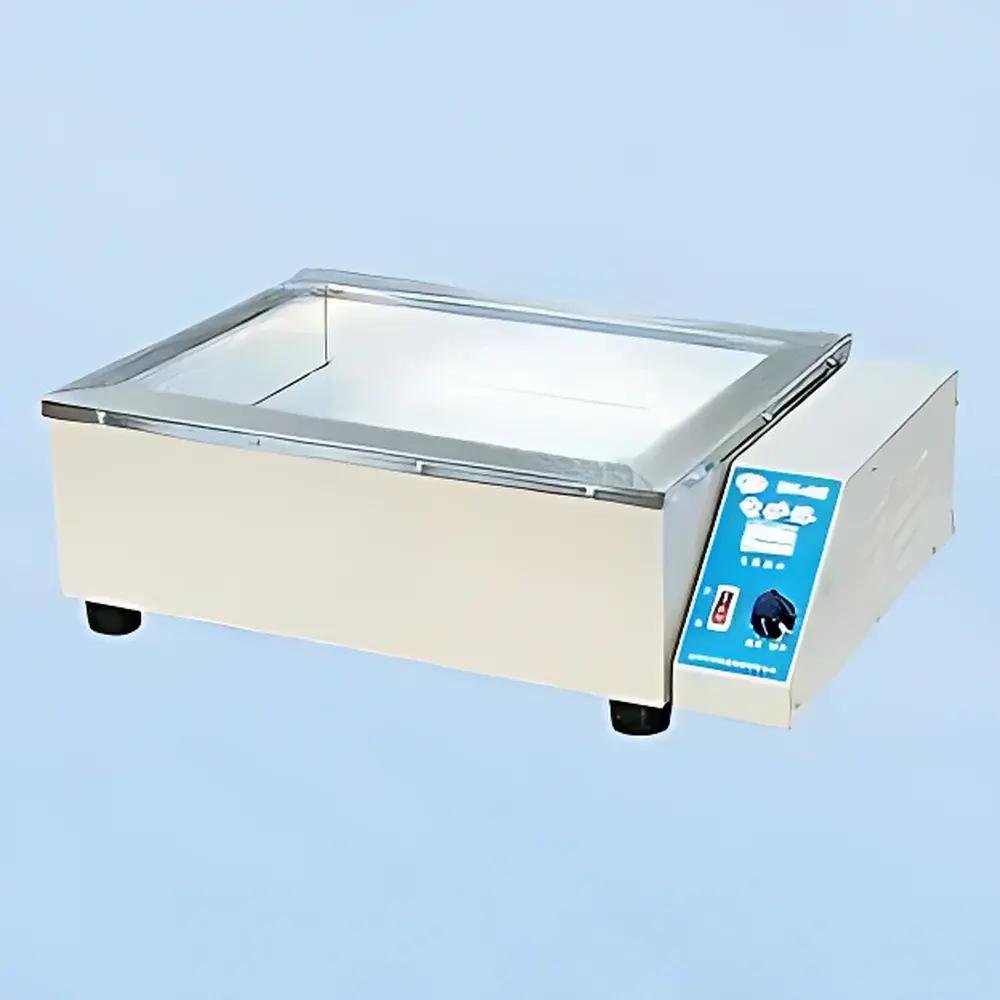
Electric Sand Bath
| Dimensions | 400 × 300 mm |
|---|---|
| Heating Power | 3 kW |
| Max Operating Temperature | 400 °C |
| Input Voltage | AC 220 V / 50 Hz |
| Construction | Cold-rolled steel housing with powder coating |
Overview
The Electric Sand Bath DK-3 is a precision-engineered, conduction-based laboratory heating device designed for uniform, flameless thermal treatment of samples in analytical, preparative, and quality control workflows. Unlike open-flame or oil-bath systems, this unit employs a fully enclosed resistive heating element embedded beneath a thermally stable sand medium—typically high-purity silica sand—to deliver consistent, controllable heat transfer via conduction. The sand layer acts as both thermal mass and diffuser, minimizing localized hot spots and enabling stable temperature maintenance across the entire working surface. Engineered for reliability in routine lab environments, the DK-3 operates within a calibrated range of ambient to 400 °C, making it suitable for applications requiring precise, non-oxidizing, and contamination-free heating—such as solvent evaporation, sample digestion pre-treatment, melting point determination support, and controlled drying of heat-sensitive materials.
Key Features
- Robust mechanical architecture: Cold-rolled steel enclosure with electrostatic powder coating ensures long-term corrosion resistance and structural integrity under continuous thermal cycling.
- Dual-material work chamber: Available with either electropolished stainless steel or acid-resistant cast steel construction—both treated with passivation or enamel coating to withstand repeated exposure to acidic vapors and cleaning agents.
- Enclosed heating system: Hermetically sealed tubular heating elements eliminate open flames, reduce fire risk, and prevent direct contact between electrical components and the sand medium—enhancing operational safety and service life.
- Thermal performance: Achieves rapid ramp-up (≤15 min to 300 °C from ambient) and maintains ±2 °C temperature stability at setpoint under no-load conditions, verified per internal calibration protocol.
- Control flexibility: Standard configuration includes a microprocessor-based digital temperature controller with PID algorithm, adjustable setpoint resolution of 1 °C, and over-temperature cut-off protection. Optional RS-485 interface supports integration into centralized lab monitoring systems.
Sample Compatibility & Compliance
The DK-3 accommodates standard laboratory glassware—including beakers (up to 1000 mL), Erlenmeyer flasks, crucibles, and digestion tubes—without requiring custom fixtures. Its flat, dimensionally stable sand bed (400 × 300 mm) provides broad surface contact for even heat distribution across irregularly shaped vessels. The unit complies with IEC 61010-1:2010 for electrical safety in laboratory equipment and meets EMC requirements per EN 61326-1:2013. While not classified as a GLP/GMP-certified instrument per se, its repeatable thermal profile, traceable controller calibration, and audit-ready operational logs (when equipped with data logging firmware) support compliance with ISO/IEC 17025:2017 clause 6.4.3 regarding equipment suitability and verification.
Software & Data Management
The standard microcontroller supports real-time temperature display, setpoint programming, and automatic shut-down after user-defined dwell time. When configured with optional firmware upgrade, the unit enables timestamped temperature logging at 10-second intervals via USB-C or RS-485 connection. Exported CSV files include column headers compliant with LIMS ingestion standards (e.g., “Timestamp_UTC”, “Setpoint_C”, “Actual_Temp_C”, “Status_Flag”). Audit trail functionality records all parameter changes—including operator ID input (via alphanumeric keypad)—satisfying documentation requirements aligned with FDA 21 CFR Part 11 Annex 11 principles for electronic records in regulated environments.
Applications
- Pre-concentration of aqueous extracts prior to HPLC or GC analysis
- Controlled drying of filter papers, gravimetric precipitates, or lyophilized intermediates
- Thermal conditioning of reference standards in metrology labs
- Support heating for ASTM D92 (flash point), D86 (distillation), and USP <721> (melting range) test preparations
- Stabilization of reaction mixtures during slow-addition synthesis protocols where oil bath viscosity or flammability poses risk
FAQ
What is the maximum recommended sand depth for optimal thermal uniformity?
A sand layer of 40–50 mm is empirically validated to balance heat transfer efficiency and thermal inertia—shallower depths risk uneven heating; deeper layers increase warm-up time without measurable improvement in stability.
Can the DK-3 be used with alternative granular media such as aluminum oxide or ceramic beads?
Yes—though silica sand is specified for its predictable specific heat (0.84 J/g·K) and low thermal conductivity (1.3 W/m·K); substitution requires recalibration and validation of surface temperature homogeneity per ISO 17025 clause 5.4.2.
Is external calibration of the temperature sensor traceable to NIST standards supported?
The integrated PT100 sensor is factory-calibrated against a Fluke 724 dry-block calibrator referenced to NIST-traceable standards; users may perform field verification using a secondary calibrated probe inserted into designated sensor port.
Does the unit meet CE marking requirements for export to the European Economic Area?
Yes—the DK-3 carries CE marking under the Low Voltage Directive (2014/35/EU) and EMC Directive (2014/30/EU), with technical documentation available upon request for customs or regulatory review.



