
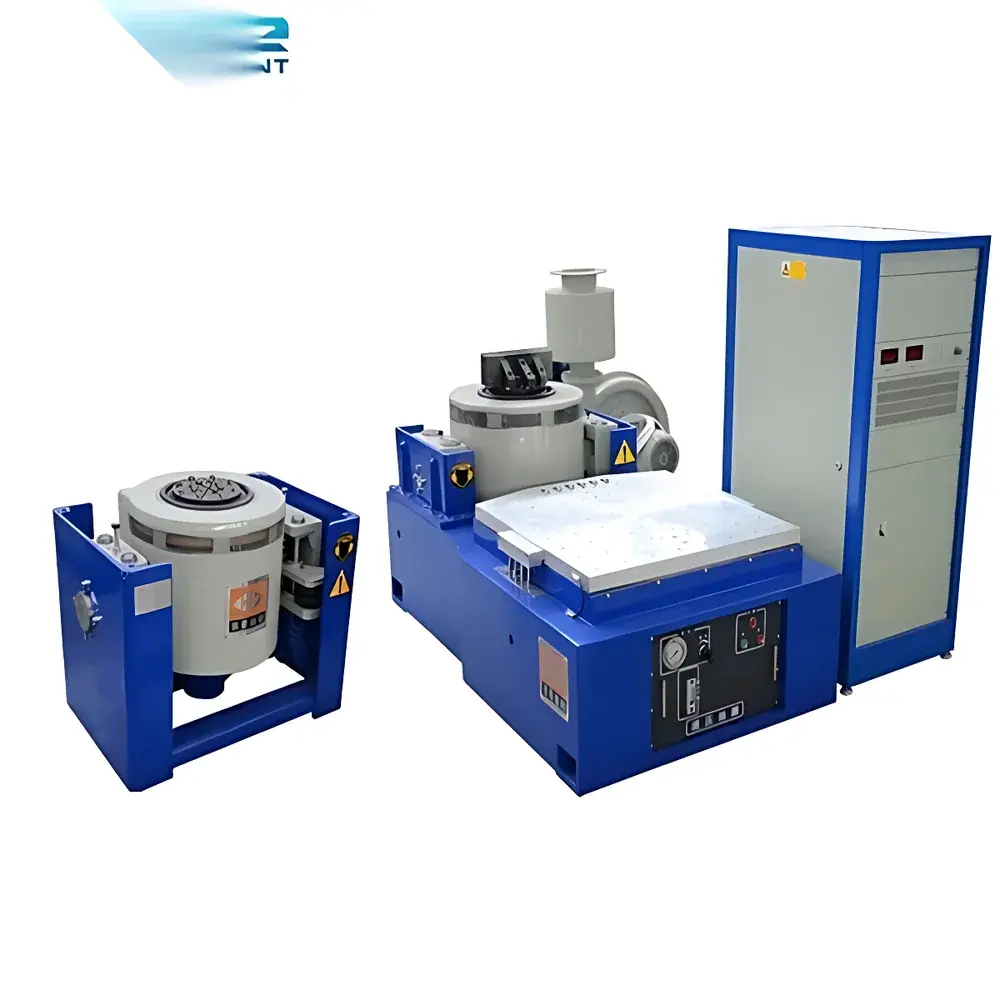
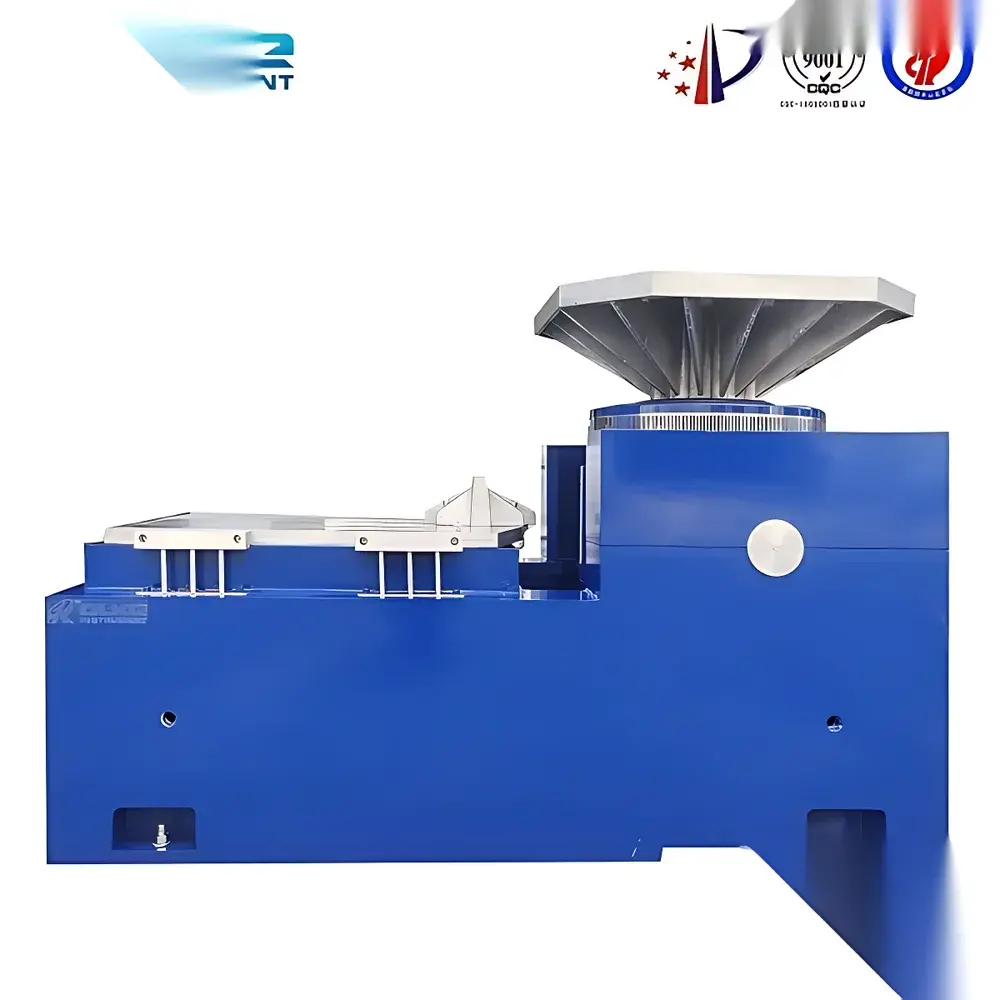
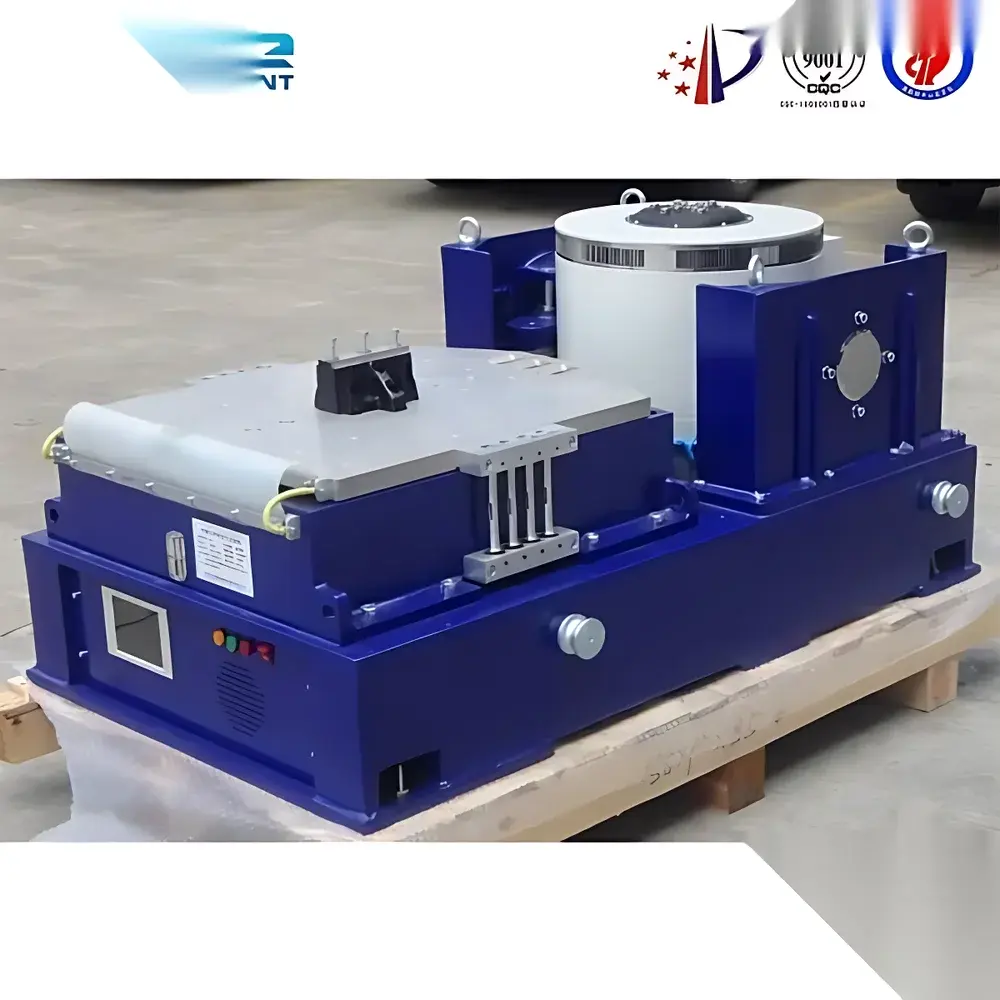
Electric Vibration Testing System – Model ETS-5000 Series
| Brand | OEM / Custom-Built |
|---|---|
| Origin | Imported |
| Manufacturer Type | Authorized Distributor |
| Price | USD 21,500 (FOB) |
| Frequency Range | 1–5000 Hz |
| Max. Load Capacity | 150 kg |
| Adjustable Amplitude | 0–5 mm peak-to-peak |
| Acceleration Range | 0–20 g |
| Drive Power | 2.2 kW |
| Input Voltage | 220 V, 50 Hz |
| Vibration Axes | Vertical (Y), Horizontal (X/Z), or Triaxial (X/Y/Z) |
| Waveform | Sine (half/full cycle), programmable |
| Sweep & Logarithmic Modes | 3-directional sweep profiles with 15-segment frequency stepping |
| Programmable Test Sequences | Up to 15 user-defined segments with independent time/frequency/acceleration/amplitude settings |
| Control Interface | Integrated digital controller + optional PC-based software with real-time waveform monitoring, data logging, and report generation (compliant with ISO 10816, ASTM D999, IEC 60068-2-6, MIL-STD-810H) |
Overview
The Electric Vibration Testing System – Model ETS-5000 Series is a high-fidelity electrodynamic shaker platform engineered for precision mechanical stress simulation in laboratory and production-line environments. Based on electromagnetic force generation (Lorentz principle), it delivers controlled sinusoidal, swept-sine, and programmable vibration profiles across a wide dynamic range—enabling accurate replication of real-world transport, operational, and environmental excitation spectra. Designed to meet the structural integrity validation requirements of automotive Tier-1 suppliers, medical device manufacturers, electronics OEMs, and packaging R&D labs, this system supports standardized test protocols including random vibration per ISO 16750-3, shock response spectrum (SRS) analysis, fatigue life estimation per ASTM E1823, and modal excitation for resonance identification. Its closed-loop feedback architecture ensures amplitude and acceleration fidelity within ±2% linearity over the full operating bandwidth (1–5000 Hz), with thermal stability maintained via forced-air cooling and integrated over-temperature protection.
Key Features
- Electrodynamic shaker head with neodymium magnet assembly and low-inductance voice coil—optimized for high force-to-mass ratio and minimal harmonic distortion.
- Digital servo controller with intuitive rotary interface and LED status indicators; fully sealed enclosure rated IP54 for dust/moisture resistance in factory-floor deployment.
- Triaxial vibration capability: independent or coupled excitation along X (horizontal longitudinal), Y (vertical), and Z (horizontal lateral) axes—configurable via front-panel toggle or remote command.
- True 5 mm peak-to-peak displacement at low frequencies (≤50 Hz), mechanically decoupled from base motion to eliminate parasitic translation and ensure traceable boundary conditions.
- Zero-load acoustic signature <45 dBA at 1 m distance—achieved through precision-balanced armature, laminated yoke design, and active damping compensation—reducing ambient noise interference during long-duration endurance tests.
- Programmable multi-segment testing: up to 15 discrete frequency-amplitude-acceleration-time steps per test sequence, supporting complex duty-cycle simulations such as start-stop engine vibration or road-profile emulation.
- Standard analog/digital I/O (0–10 V, TTL) and Ethernet (TCP/IP) interfaces for integration into automated test cells and MES systems; compatible with LabVIEW™, MATLAB® Simulink®, and Python-based control frameworks.
Sample Compatibility & Compliance
The ETS-5000 accommodates specimens up to 150 kg mass on standard 450 × 450 mm or 500 × 500 mm aluminum inertial tables (anodized, tapped M6). Optional slip-table adapters and isolation mounts enable flat-panel, PCB-level, and component-scale mounting configurations. All system firmware and controller logic are designed to support GLP-compliant audit trails—including user login timestamps, parameter change logs, and test execution records—with optional 21 CFR Part 11 electronic signature modules available upon request. The system conforms to electromagnetic compatibility standards EN 61326-1 and safety requirements per EN 61000-6-2, while vibration output profiles comply with ISO 2041 (vibration and shock—vocabulary), ISO 5347 (transducer calibration), and USP for pharmaceutical packaging qualification.
Software & Data Management
The optional ETS-Control Suite v4.2 provides full PC-based test orchestration, real-time FFT spectral visualization, time-history waveform capture (up to 100 kS/s), and automated pass/fail evaluation against user-defined thresholds. Data export formats include CSV, HDF5, and UFF58—ensuring interoperability with MATLAB, ANSYS Mechanical, and Minitab for downstream statistical analysis. Built-in report templates generate PDF outputs compliant with internal QA documentation workflows, including test ID, operator name, environmental conditions (optional external sensor inputs), raw data checksums, and signature fields. All software binaries undergo annual penetration testing and are signed with SHA-256 cryptographic certificates to satisfy ITAR and corporate cybersecurity policies.
Applications
- Automotive: Component-level durability validation per GMW14872, Ford CETP 00.00-L-467, and VW 80101; battery module vibration screening prior to thermal cycling.
- Electronics: PCB solder joint fatigue assessment under resonant excitation; connector retention force verification after broadband shake testing.
- Medical Devices: ISO 13485-compliant vibration qualification of infusion pumps, ventilator housings, and sterilization tray assemblies.
- Packaging: ASTM D4169 distribution cycle simulation—drop impact pre-conditioning followed by variable-frequency vibration exposure.
- Materials Science: Dynamic modulus measurement via forced oscillation at sub-resonant frequencies; creep-recovery behavior under cyclic loading.
- Acoustics R&D: Structural-borne noise path analysis using accelerometer arrays synchronized with shaker drive signals.
FAQ
What is the maximum payload capacity without performance derating?
The system maintains full specification compliance (±2% amplitude accuracy, ≤0.5% THD) up to 150 kg on the 500 × 500 mm table. For payloads exceeding 100 kg, we recommend specifying the heavy-duty suspension option (part #ETS-HDS-01) to preserve resonant mode separation.
Is third-party calibration certification included?
Yes—each unit ships with NIST-traceable calibration certificate (ISO/IEC 17025 accredited lab), covering force, displacement, and acceleration transducers at three frequencies (10 Hz, 100 Hz, 1000 Hz). Annual recalibration services are available under service contract SLA-ETS-3Y.
Can the system perform random vibration testing?
Not natively—the ETS-5000 is optimized for deterministic waveforms (sine, swept-sine, programmable step sequences). For true Gaussian random vibration, we recommend the companion ETS-RND-2000 add-on module, which integrates a dedicated DSP engine and PSD synthesis capability per ISO 10816-3.
What external sensors are required to verify actual displacement or acceleration?
A calibrated laser Doppler vibrometer (LDV) or Class 1 piezoelectric accelerometer (e.g., PCB 352C33) is required for metrological validation. The system includes analog input channels for direct sensor signal acquisition and real-time overlay in ETS-Control Suite.
Does the controller support remote diagnostics and firmware updates?
Yes—via secure SSH tunnel over Ethernet. Firmware updates are digitally signed and validated before installation; diagnostic logs can be exported in Syslog format for centralized SIEM ingestion.



