
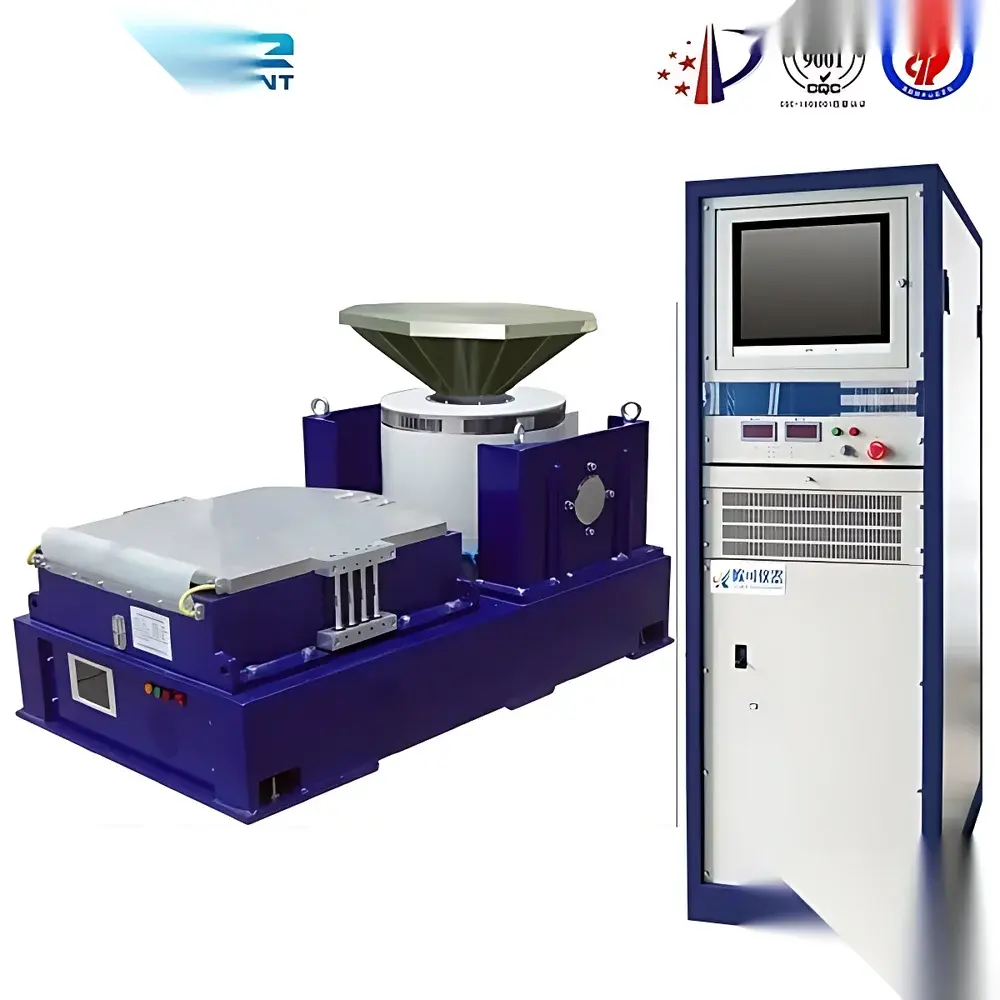
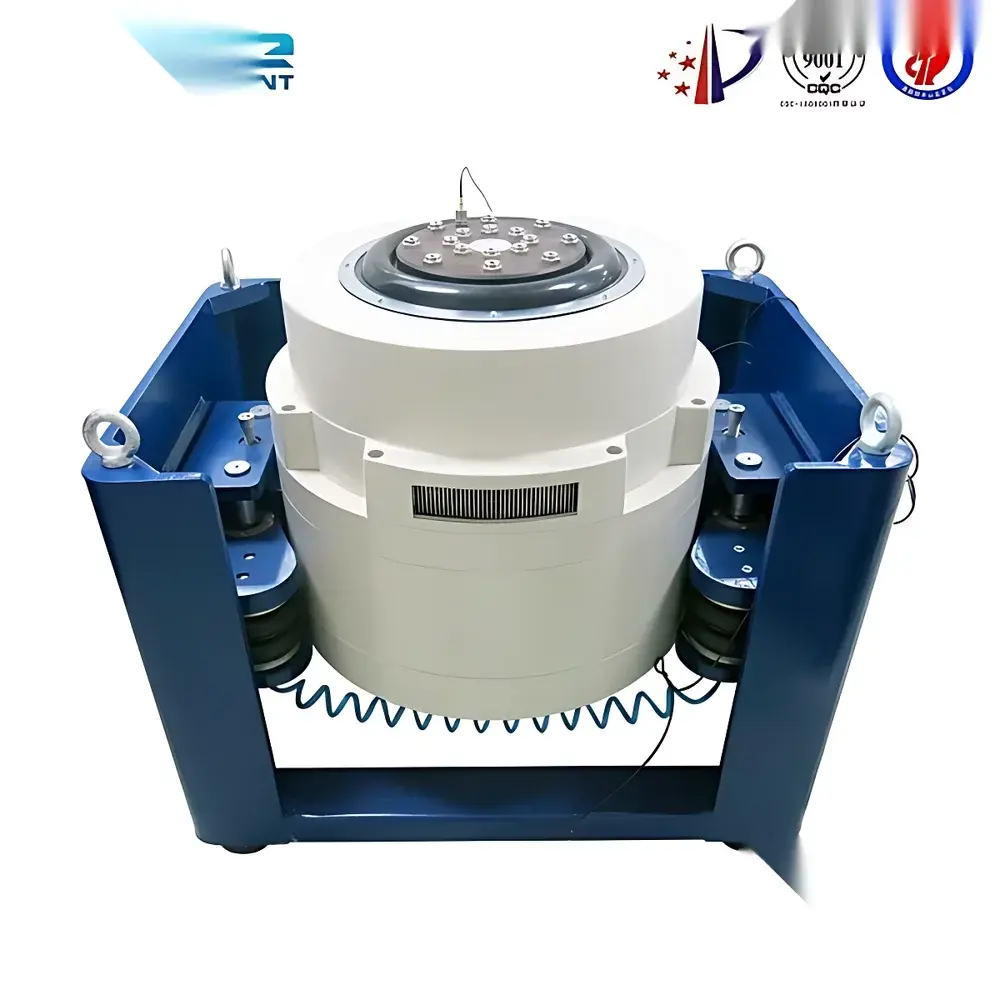
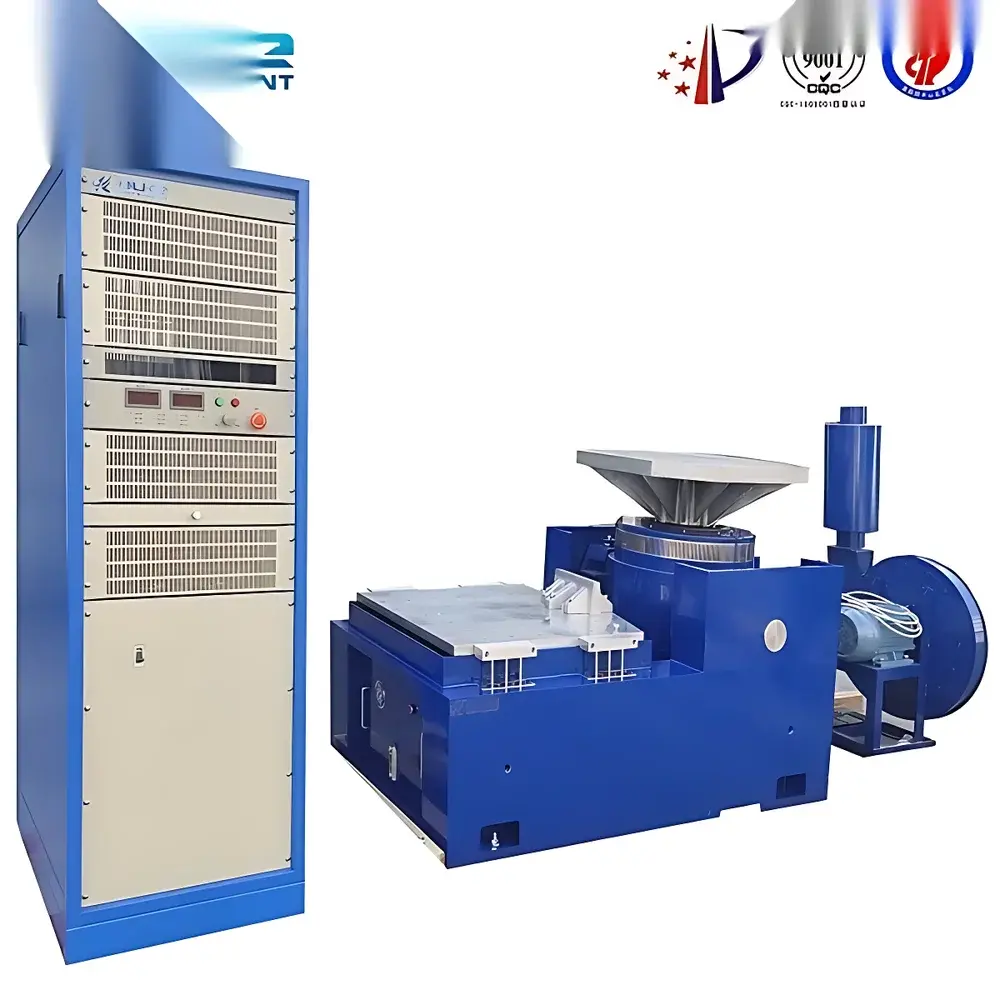
Electrodynamic Vibration Test System
| Brand | Other Brands |
|---|---|
| Origin | Imported |
| Manufacturer Type | Authorized Distributor |
| Price | USD 21,500 (FOB) |
| Moving Mass | 18 kg |
| Table Diameter | 280 mm |
| Max Eccentric Moment | 300 N·m |
| Dimensions (Shaker) | 990 × 990 × 790 mm |
| Weight (Shaker) | 1600 kg |
| Frequency Range | 5–3000 Hz |
| Rated Sinusoidal Force | 14.2 kN |
| Rated Random Force (RMS) | 14.2 kN RMS |
| Max Acceleration | 784 m/s² (80 g) |
| Max Velocity | 2.00 m/s |
| Max Displacement (p-p) | 51 mm |
| Max Payload | 300 kg |
| Power Amplifier Output | 20 kVA |
| Amplifier Dimensions | 550 × 1700 × 800 mm |
| Amplifier Weight | 390 kg |
| Amplifier Type | Switching Mode |
| Total System Power Requirement | 28 kVA |
| Compliance | GB/T 2423.1–2001, GB/T 2423.2–2001, GB/T 2423.3–1993, GB/T 2423.10–1999, JJG 190–1997 |
Overview
The Electrodynamic Vibration Test System is a high-performance, servo-controlled shaker platform engineered for rigorous environmental simulation and mechanical stress screening of aerospace components, electronic assemblies, precision instruments, and advanced materials. Based on electromagnetic force generation principles—where controlled current through voice-coil actuators interacts with a permanent magnetic field to produce precise, repeatable inertial forces—the system delivers broadband dynamic excitation across 5–3000 Hz. Its design adheres to fundamental vibration mechanics standards, enabling both closed-loop sinusoidal sweeps and wideband random profile testing under defined acceleration, velocity, and displacement constraints. The system is configured for laboratory-grade reliability in qualification-level testing per MIL-STD-810, IEC 60068, and harmonized national standards, supporting deterministic and stochastic test protocols required for product validation, failure mode analysis, and durability assessment.
Key Features
- High-force electrodynamic shaker with 14.2 kN rated sinusoidal and RMS random output capacity, optimized for high-fidelity waveform reproduction up to 3000 Hz
- Robust moving mass architecture (18 kg armature) coupled with a 280 mm diameter horizontal table, rated for 300 N·m eccentric moment tolerance to ensure stability under off-center loading
- Full-range dynamic envelope: 784 m/s² (80 g) peak acceleration, 2.00 m/s maximum velocity, and 51 mm peak-to-peak displacement—enabling low-frequency high-displacement and high-frequency high-acceleration test profiles
- 20 kVA switching-mode power amplifier with integrated thermal management, delivering stable voltage/current response with low harmonic distortion (<1.5% THD at full load)
- Modular mechanical interface: ISO 1302-compliant mounting flange (M10 threaded holes on 200 mm bolt circle), compatible with standard slip tables, head expanders, and thermal chambers
- Structural integrity verified via finite element analysis (FEA); base frame designed to minimize resonance coupling below 5 Hz and support static loads up to 300 kg without deformation
Sample Compatibility & Compliance
The system accommodates a broad spectrum of test specimens—from PCB subassemblies and MEMS sensors to avionics enclosures and automotive control modules—provided they meet the 300 kg payload limit and center-of-gravity alignment requirements. Mounting adaptability supports both direct bolt-down configurations and isolation-based fixtures for multi-axis or combined environment (e.g., temperature-vibration) testing when integrated with environmental chambers. Regulatory alignment includes full traceability to GB/T 2423 series (equivalent to IEC 60068-2), covering low-temperature (GB/T 2423.1), high-temperature (GB/T 2423.2), damp heat (GB/T 2423.3), and shock/vibration (GB/T 2423.10) test methods. Calibration procedures follow JJG 190–1997 (Vibration Shaker Verification Regulation), ensuring metrological validity for internal quality audits and third-party certification submissions.
Software & Data Management
Control and data acquisition are executed via industry-standard real-time vibration controller software compliant with IEEE 1057 and ISO/IEC 17025 traceability frameworks. The system supports dual-loop feedback (acceleration + displacement) with programmable control algorithms—including Sine, Random, Shock, Sine-on-Random, and Field Data Replication modes. All test sessions generate time-synchronized digital records with embedded metadata (test ID, operator, timestamp, calibration status, hardware configuration). Audit trails comply with GLP and GMP documentation requirements; raw data exports adhere to ASAM MDF4 and HDF5 formats for interoperability with MATLAB, Python, and CAE post-processing tools. Firmware updates and calibration certificates are digitally signed and version-controlled, satisfying FDA 21 CFR Part 11 electronic record retention criteria.
Applications
- Aerospace: Structural screening of satellite subsystems, launch vehicle avionics, and UAV airframes per MIL-STD-810H Method 514.8
- Electronics Manufacturing: Board-level reliability verification for solder joint fatigue, connector integrity, and component delamination under random vibration spectra
- Automotive R&D: NVH characterization of ECU housings, battery modules, and ADAS sensor mounts using road-simulated PSD profiles
- Materials Science: Dynamic modulus and damping coefficient measurement of viscoelastic polymers and composites via forced oscillation testing
- Quality Assurance Labs: In-process qualification of medical device enclosures, industrial controllers, and telecom infrastructure per IEC 60950-1 and UL 60950-1
FAQ
What is the recommended maintenance interval for the shaker’s suspension and armature assembly?
Annual inspection and lubrication of flexure bearings and voice-coil alignment verification are advised, with full recalibration required every 12 months or after 2000 operational hours.
Can this system be integrated with an environmental chamber for combined temperature-vibration testing?
Yes—compatible with standard 200 mm and 300 mm port chambers; requires optional thermal isolation interface and cold/hot shaker cable kits (not included).
Does the controller support remote operation and network-based monitoring?
The embedded controller features Ethernet TCP/IP interface, RESTful API access, and OPC UA server support for integration into factory MES and LabVantage systems.
Is third-party calibration certification available upon delivery?
Factory calibration is performed per JJG 190–1997 and includes NIST-traceable accelerometer sensitivity verification; ISO/IEC 17025-accredited calibration reports are available as an optional service.
What safety interlocks are implemented to prevent over-stress during operation?
Hardware-based limiters monitor real-time acceleration, velocity, displacement, and coil temperature; automatic shutdown triggers if any parameter exceeds 105% of setpoint or if amplifier fault codes are detected.



