
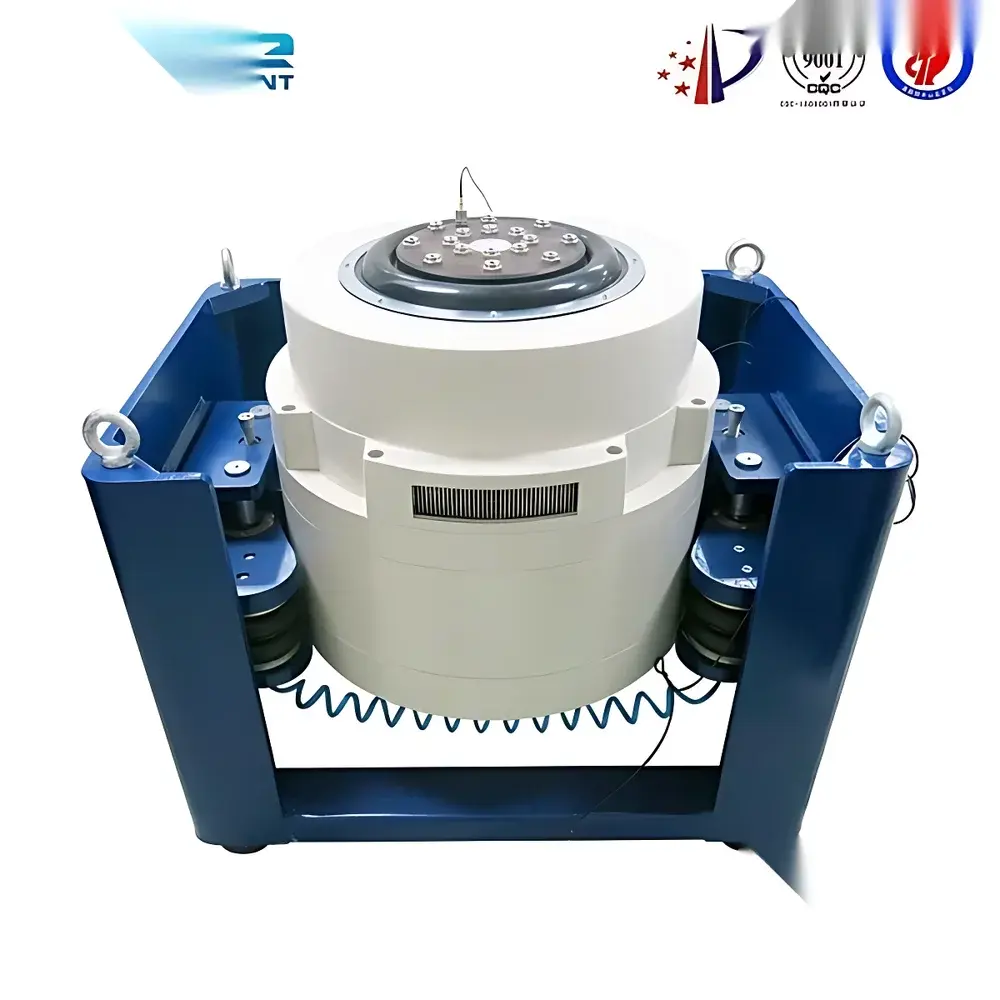
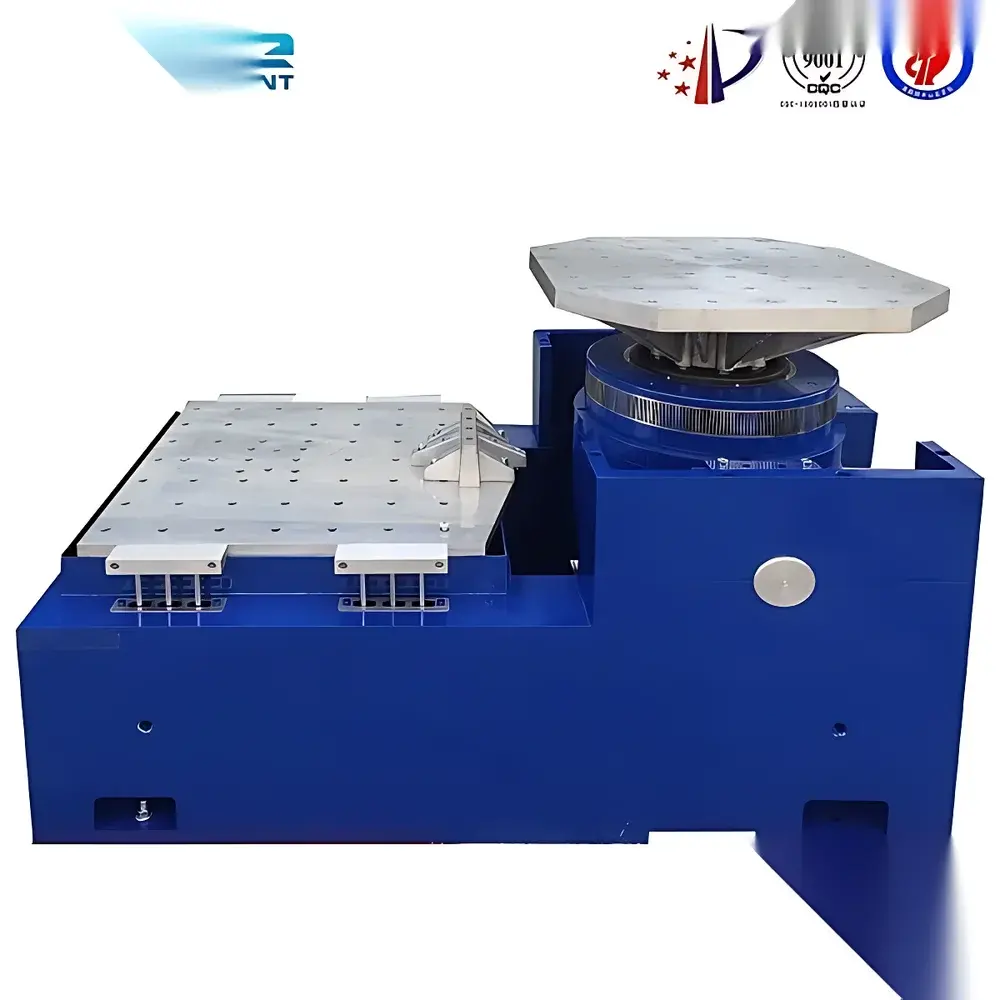
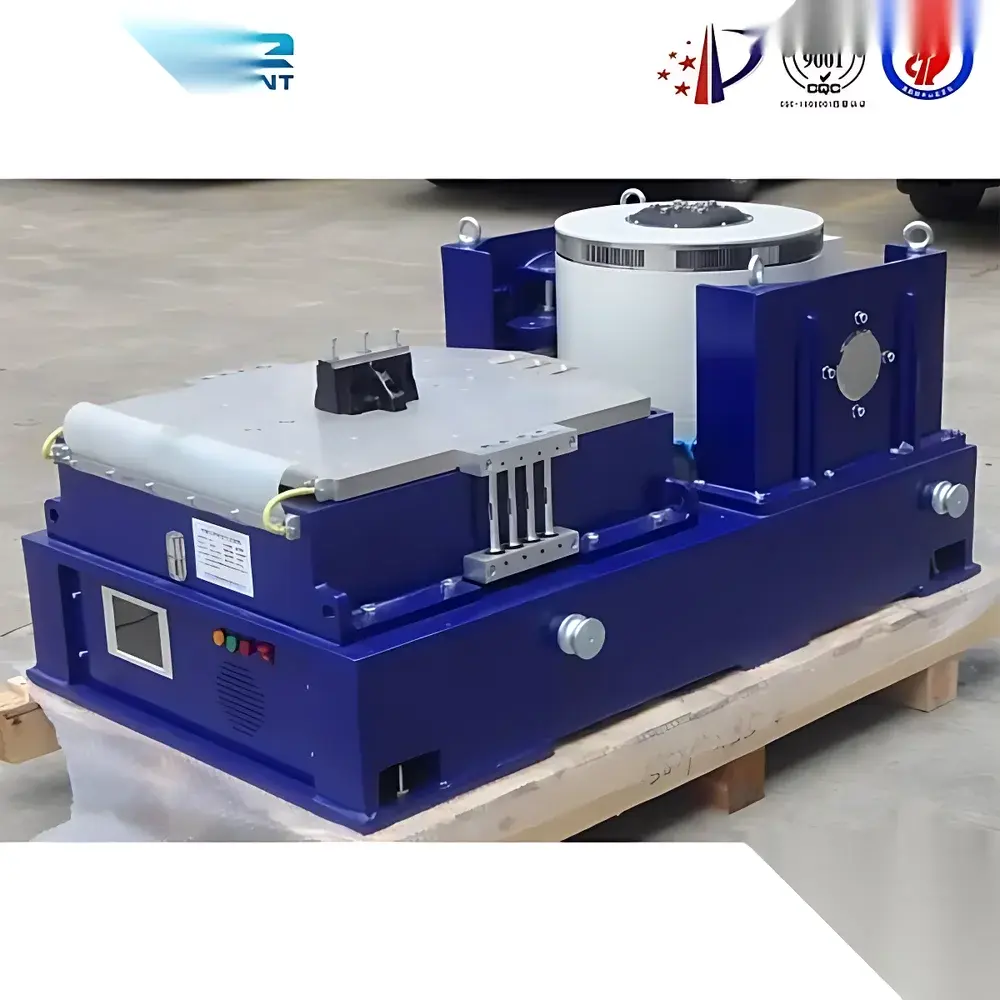
Electrodynamic Vibration Test System – Heavy-Duty Shaker with Dual-Magnetic-Circuit Architecture
| Brand | OEM / Custom-Branded |
|---|---|
| Origin | Imported |
| Supplier Type | Authorized Distributor |
| Price | USD 21,500 (FOB) |
| Max. Sinusoidal & Random Force | 19,600 N (2,000 kgf) |
| Frequency Range (Vertical) | 5–3,000 Hz |
| Rated Acceleration (No Load) | 980 m/s² (100 g) |
| Rated Velocity | 1.85 m/s |
| Peak-to-Peak Displacement | 51 mm |
| Maximum Payload | 300 kg |
| Moving Mass | 22 kg |
| Continuous Operation Time | 20 h |
| Operating Environment | 0–40 °C, ≤90% RH (at 25 °C) |
Overview
The Electrodynamic Vibration Test System is a high-performance shaker engineered for rigorous mechanical shock and vibration testing in compliance with international standards including ISO 10816, IEC 60068-2-6, MIL-STD-810H, and ASTM D999. Based on the fundamental principle of Lorentz force actuation—where current-carrying conductors in a static magnetic field generate controlled mechanical motion—the system delivers precise, repeatable excitation across broad frequency and amplitude domains. Its dual-magnetic-circuit design minimizes flux leakage while maximizing electromagnetic efficiency, enabling stable operation at full-rated force without thermal derating. The system is configured for vertical orientation by default but supports 90° horizontal rotation via an integrated ear-axis mounting structure, facilitating multi-axis test sequencing without reconfiguration downtime.
Key Features
- Dual-magnetic-circuit actuator architecture with low magnetic leakage and compact mechanical footprint, optimized for thermal management and long-term stability.
- Swing-arm guidance system combined with axial air-spring suspension ensures exceptional lateral load resistance and waveform fidelity—even at maximum payload and full 51 mmp-p displacement.
- High-reliability voice coil fabricated using aerospace-grade materials and precision winding techniques, rated for >20,000 hours MTBF under continuous rated conditions.
- Center-load pneumatic isolator with proprietary structural reinforcement enhances low-frequency response (<10 Hz) and extends usable displacement range without compromising stiffness.
- Ear-axis suspension incorporates linear-motion guides and isolation springs to decouple internal actuator vibrations from external support structures, minimizing cross-talk and improving test integrity.
- Integrated switching-mode power amplifier (Class D) achieves ≥90% electrical-to-mechanical conversion efficiency, reducing cooling demand and operational energy consumption versus traditional linear amplifiers.
- Soft-start functionality, programmable slew-rate limiting, and real-time over-temperature/over-current protection ensure safe ramp-up and fault resilience during automated test sequences.
Sample Compatibility & Compliance
The system accommodates payloads up to 300 kg on its standard 600 × 600 mm moving table. For oversized or geometrically complex units under test (UUTs), optional extended tables—engineered with modal analysis and finite-element validation—are available in aluminum honeycomb, magnesium alloy, or steel-reinforced composite configurations. Custom fixture design services include dynamic balancing, transmissibility mapping, and uniformity verification per ISO 5344 Annex B. All mechanical interfaces comply with DIN 45672-2 and IEEE 344 requirements for acceleration uniformity (<±1.5 dB over central 75% area) and lateral motion suppression (<5% of axial acceleration). The system meets CE marking requirements for EMC (EN 61326-1) and safety (EN 61000-3-12), and supports GLP/GMP audit trails when paired with compliant control software.
Software & Data Management
Control and analysis are performed via a standards-compliant real-time operating system (RTOS) platform supporting IEEE 1451.4 TEDS sensor integration, closed-loop PID and MIMO control algorithms, and hardware-accelerated FFT processing. The embedded software suite includes preconfigured test profiles for sine sweep, random vibration (PSD synthesis), shock pulse (half-sine, trapezoidal), and mixed-mode testing. Data logging adheres to ASTM E2565-22 format, with timestamped raw time-history files (.tdms or .uff), spectral matrices, and pass/fail reporting templates exportable to CSV, XML, or PDF. Optional FDA 21 CFR Part 11 compliance package provides electronic signature capability, audit trail logging, and role-based access control for regulated environments.
Applications
This shaker is deployed across aerospace component qualification (e.g., avionics box shake-down per DO-160 Section 8), automotive ECUs and battery modules (ISO 16750-3), industrial electronics reliability screening (HALT/HASS), packaging integrity validation (ASTM D4728), and defense subsystem environmental stress screening (ESS). Its high acceleration capability (100 g) and wide bandwidth make it suitable for resonant dwell testing, fatigue life assessment of solder joints, and structural modal analysis of printed circuit assemblies (PCBAs). The system’s low-distortion output (<3% THD at 100 g, 1 kHz) ensures fidelity in high-fidelity simulation of transportation-induced vibration spectra.
FAQ
What is the maximum allowable payload for extended-table configurations?
Extended tables are validated for payloads up to 250 kg at full displacement; static load capacity remains 300 kg with reduced stroke limits.
Does the system support real-time control loop updates at 20 kHz?
Yes—the digital signal processor (DSP) core operates at 40 kHz sampling with sub-5 µs control latency, enabling high-bandwidth feedback stabilization.
Can third-party control software (e.g., Vibration Research VR9500) interface with this shaker?
Native Ethernet/IP and IEEE-488 (GPIB) interfaces support interoperability with major commercial controllers; driver libraries (NI LabVIEW, MATLAB Instrument Control Toolbox) are provided.
Is low-frequency performance below 10 Hz validated with inertial mass compensation?
Yes—integrated accelerometer-based force feedback and adaptive mass compensation algorithms maintain ±0.5 dB amplitude accuracy down to 5 Hz.
What maintenance intervals are recommended for the air-spring suspension system?
Air spring diaphragms require inspection every 2,000 operating hours; full replacement is advised at 10,000 hours or after exposure to ambient humidity >90% RH for >72 consecutive hours.



