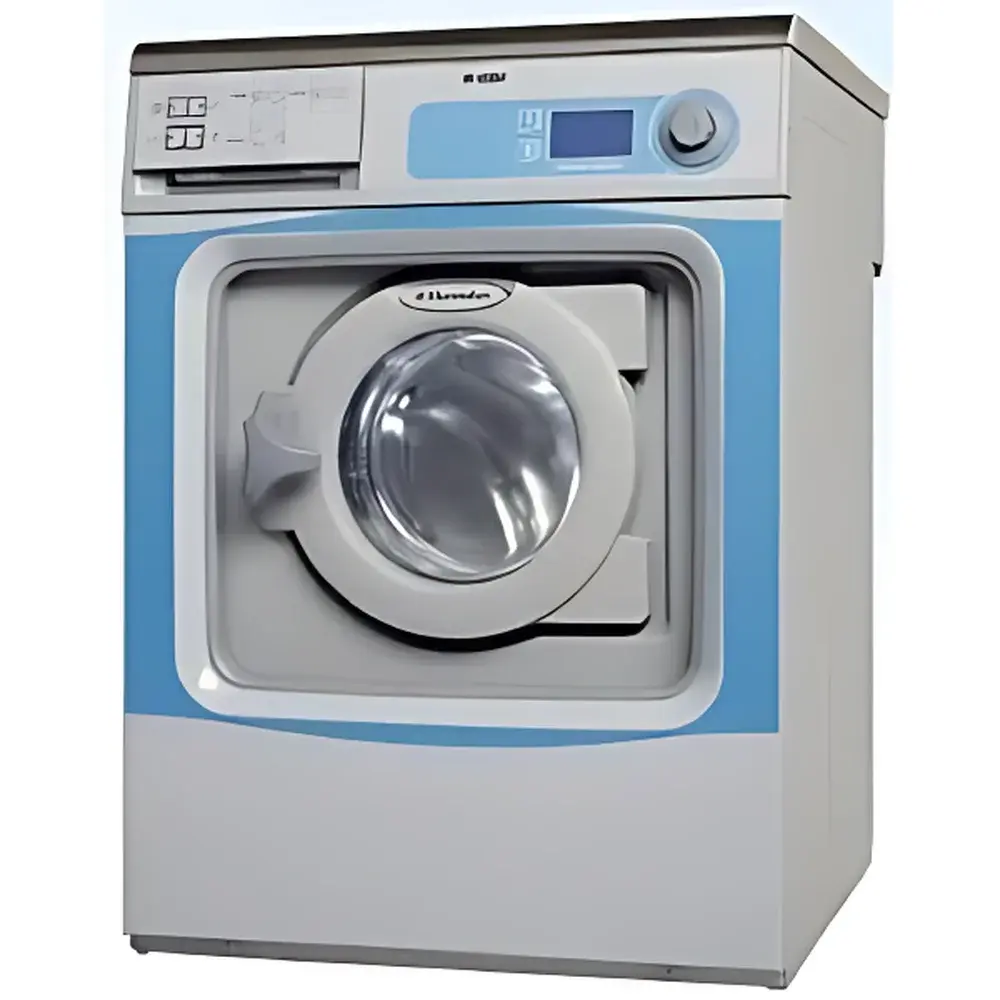
Electrolux W555H ISO-Compliant Color Fastness & Dimensional Stability Washing Machine
| Brand | Electrolux |
|---|---|
| Origin | Sweden |
| Model | W555H |
| Application Standard | ISO 5077, ISO 6330, BS EN 25077 / 26330, IEC 60456 |
| Load Capacity | 6 kg |
| Drum Type | Front-loading Horizontal Rotating Drum |
| Power Supply | AC 380–400 V, 50 Hz, 4.4 kW |
| Dimensions (W×D×H) | 595 × 680 × 850 mm |
| Weight | 105 kg |
| Water Level Control | Dual-level + weight-based volumetric dosing |
| Controller | Clarus™ Electronic Programmable Controller |
| Compliance | Fully aligned with H&M MRSL, M&S Protocol P1/P1A/P3A/P12/P91/P99/P99A/P134, IWSTM-31, GB/T 8629 |
Overview
The Electrolux W555H is a precision-engineered, ISO-compliant laboratory washing machine designed exclusively for textile color fastness and dimensional stability testing in accredited R&D laboratories, quality control departments, and third-party testing facilities. Unlike domestic or industrial laundry equipment, the W555H operates under strictly defined mechanical, thermal, and hydrodynamic parameters mandated by international test standards—including ISO 5077 (dimensional change), ISO 6330 (washing procedures), BS EN 25077/26330, IEC 60456, and GB/T 8629. Its primary function is to replicate standardized domestic laundering cycles with metrological repeatability, enabling objective evaluation of fabric shrinkage, dye migration (color bleeding), pilling propensity, and detergent efficacy. As an officially designated reference machine for global apparel brands—including H&M and Marks & Spencer—the W555H serves as a benchmark instrument in method validation, inter-laboratory comparison studies, and GLP-compliant test reporting.
Key Features
- Clarus™ programmable electronic controller with preloaded, audit-trail-capable test programs aligned to M&S P1–P134, IWSTM-31, and H&M MRSL Annex 4 protocols.
- Front-loading stainless-steel drum (304 grade) with minimal annular gap between inner and outer cylinders—optimized for precise water-to-fabric ratio control and reduced reagent consumption.
- Dual-mode water dosing system: calibrated volumetric measurement combined with real-time load-weight feedback ensures ±1% accuracy in liquor ratio (LR) across all cycle phases.
- High-torque, variable-speed drive enabling programmable agitation profiles (e.g., 52 rpm ±2 rpm during wash phase; 800 rpm ±10 rpm during spin extraction).
- Suspended drum architecture with dynamic balancing—eliminates need for structural anchoring while maintaining <0.2 mm radial runout at full spin speed (max 1000 rpm).
- Integrated thermal management: PID-controlled heater with ±0.5°C stability across 20–60°C operational range; compliant with ISO 6330 temperature tolerance requirements.
- Automated detergent dispensing module with dual-compartment reservoirs for sequential delivery of main wash and rinse additives.
Sample Compatibility & Compliance
The W555H accommodates flat fabric specimens (woven/knitted), garment assemblies (including seam-integrated samples), and leather substrates up to 6 kg total mass—within the strict specimen-to-liquor ratio limits defined in ISO 6330 Table 3. All test cycles are traceable to original standard annexes, with firmware validated against ISO/IEC 17025 clause 5.9 (method validation) and ASTM D276-22 Annex A1 (instrument qualification). The unit bears CE marking per Machinery Directive 2006/42/EC and EMC Directive 2014/30/EU. Full compliance documentation—including factory calibration certificates, uncertainty budgets for water volume and temperature, and software verification reports—is supplied with each unit. It meets FDA-relevant data integrity expectations for electronic records (21 CFR Part 11 readiness via optional Clarus™ Audit Log Module).
Software & Data Management
The Clarus™ controller supports Ethernet and RS-232 interfaces for integration into LIMS environments. Test logs include timestamped metadata: cycle ID, start/stop time, actual vs. setpoint temperature, drum RPM profile, water volume delivered, detergent dosage, and error flags (e.g., imbalance detection, heater timeout). Raw data export is available in CSV and XML formats compatible with statistical process control (SPC) platforms. Optional Clarus™ Validation Pack provides IQ/OQ documentation templates aligned with ISO/IEC 17025 and GMP Annex 11 requirements, including electronic signature support and role-based access control.
Applications
- ISO 5077-compliant dimensional stability assessment of cotton, polyester, wool, and blended textiles after repeated washing.
- Color fastness to washing (ISO 105-C06) and color fastness to perspiration (ISO 105-E04) specimen preconditioning.
- Validation of eco-friendly detergent formulations under M&S P99A and ZDHC MRSL v3.1 criteria.
- Inter-laboratory round-robin trials coordinated by AATCC, SATRA, or SGS for method harmonization.
- Development of smart textile coatings requiring controlled mechanical stress exposure without thermal degradation.
FAQ
Is the W555H suitable for ISO 105-C06 color fastness testing?
Yes—when operated with the ISO 6330 Program 2A (40°C, 30 min, 1200 rpm spin) and paired with adjacent multifiber fabric (M&F), it satisfies all mechanical parameter requirements for C06 assessment.
Can the Clarus™ controller be validated for GLP audits?
Yes—the optional Clarus™ Validation Pack includes documented IQ/OQ protocols, traceable calibration records, and electronic audit trail configuration meeting OECD GLP Principles and ISO/IEC 17025:2017 clause 7.11.
Does the unit comply with Chinese national standard GB/T 8629?
Yes—Program codes GB-1 through GB-7 are pre-installed and verified against GB/T 8629-2017 Annex B, including specified water levels, temperatures, and drum rotation sequences.
What maintenance intervals are recommended for ISO-certified operation?
Daily: drum inspection and drain filter cleaning. Quarterly: torque calibration of drive motor and verification of water meter linearity (±0.5% FS). Annually: full thermocouple recalibration and Clarus™ firmware integrity check per manufacturer’s service bulletin SB-W555H-2023-04.
Related Products