
Electromagnetic Swept-Frequency Vibration Shaker System
| Key | Table Surface Dimensions: 350×350 / 500×500 / 750×750 / 1000×1000 mm |
|---|---|
| Shaker Body Dimensions (Vertical) | 500×200×500 mm |
| (Horizontal) | 500×250×500 mm |
| Vibration Axes | Vertical (Y) + Horizontal (X) |
| Frequency Range | 1–3000 Hz, Resolution: 0.01 Hz |
| Peak-to-Peak Displacement | 0–5 mm adjustable |
| Maximum Load Capacity | 75 kg |
| Peak Sinusoidal Force | 1500 kgf (≈14.7 kN) |
| Maximum Acceleration | ≤20 g |
| Waveform | Sine (full- or half-wave) |
| Programmable Test Segments | 15 |
| Sweep Modes | Linear, Logarithmic, Step, Octave |
| Time Setting Range | 0–999,999 s |
| Power Consumption | 3.8 kW |
| Input Voltage | 380 V ±20%, 3-phase |
| Rated Current | 10 A |
| Operating Temperature | −10°C to +60°C, Humidity ≤95% RH (non-condensing) |
| Recommended Ambient | ≤28°C with adequate ventilation |
Overview
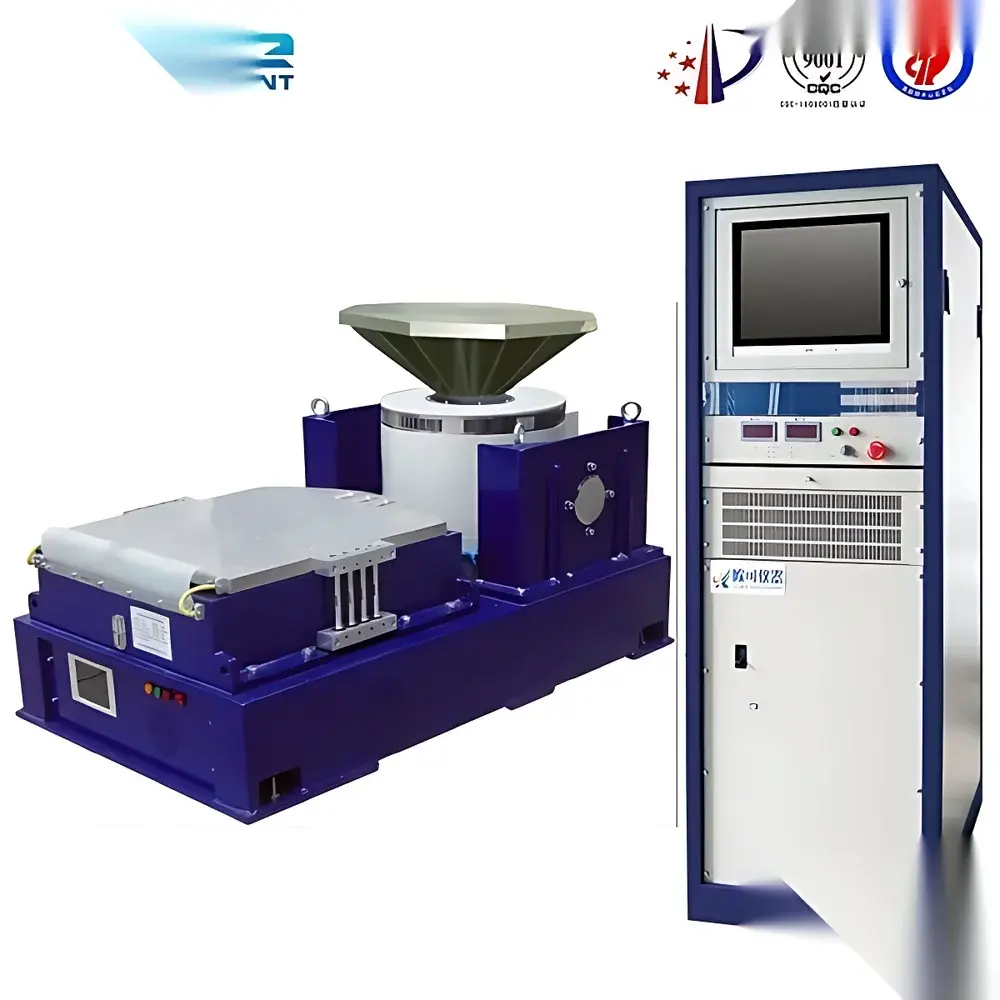
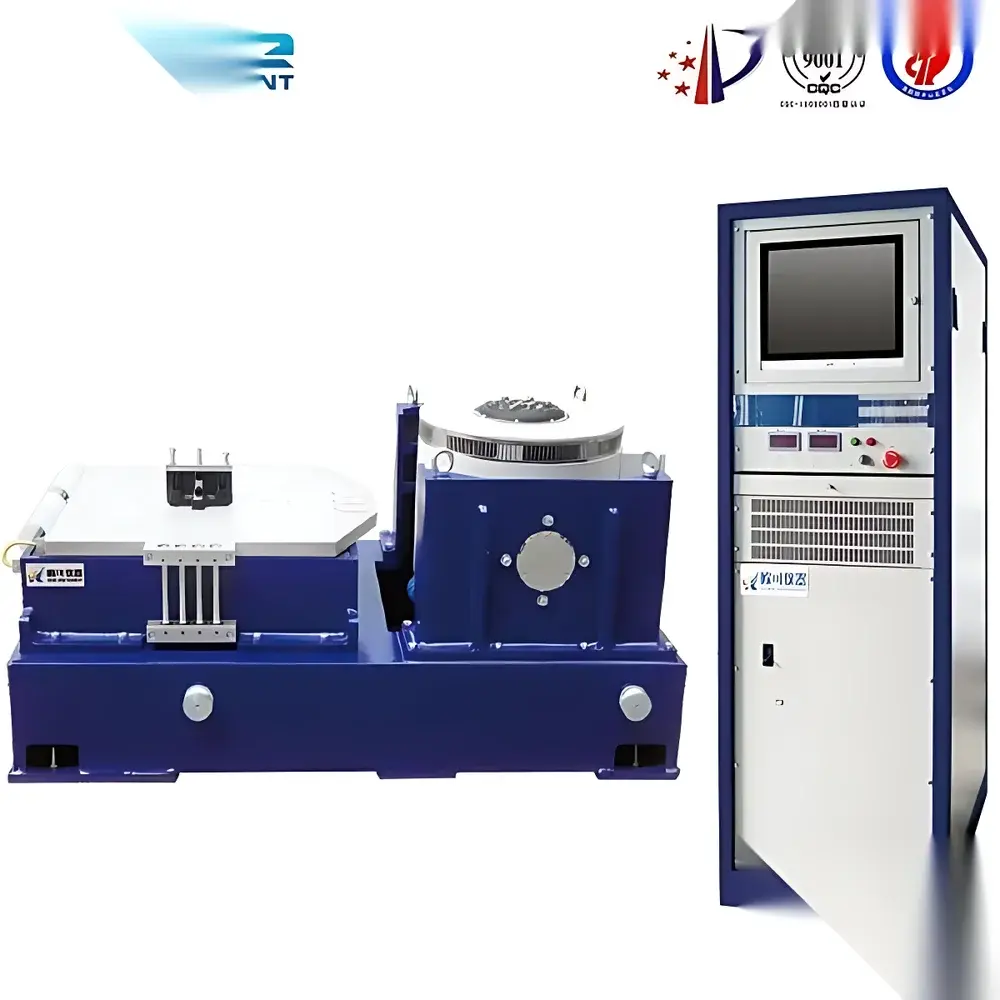
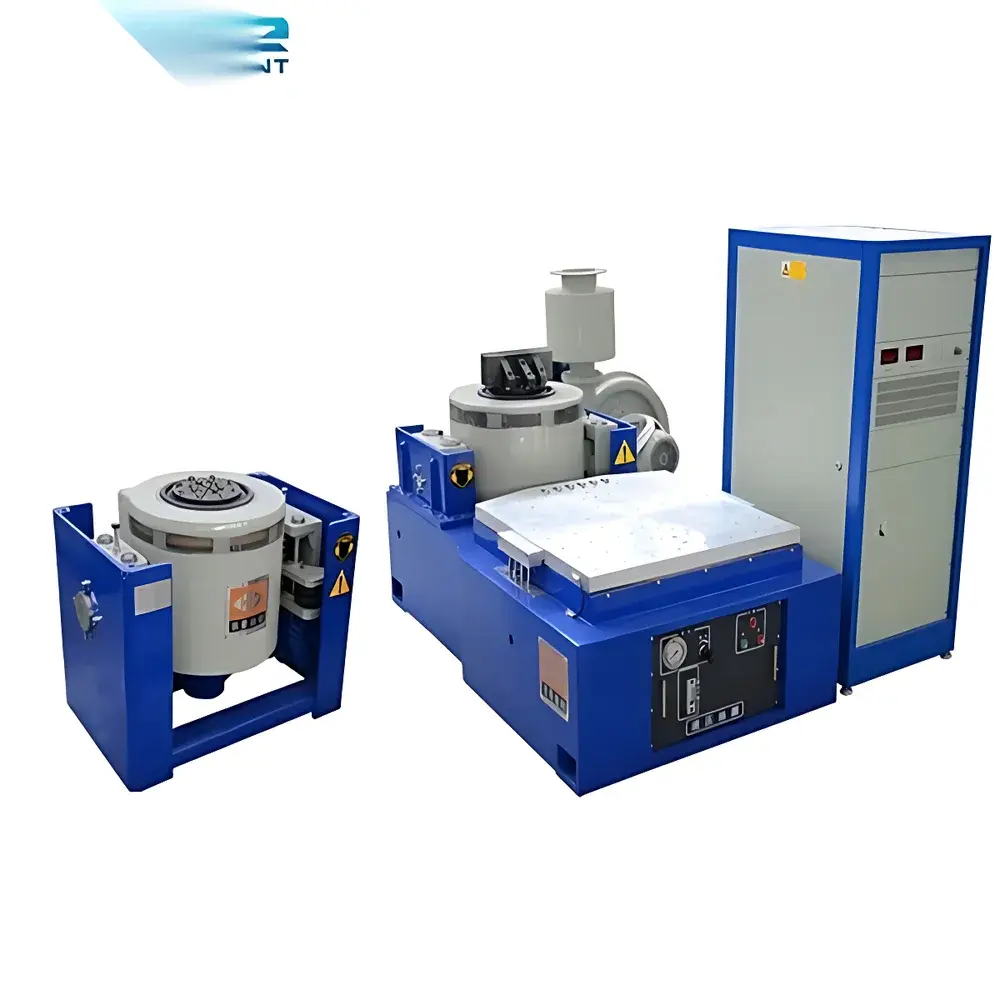
The Electromagnetic Swept-Frequency Vibration Shaker System is a precision-engineered electrodynamic vibration test platform designed for rigorous mechanical stress evaluation of components, assemblies, and packaged goods under controlled dynamic loading conditions. Based on electromagnetic force generation via voice-coil actuation, the system delivers high-fidelity sinusoidal excitation across a broad frequency spectrum (1–3000 Hz), enabling compliance with international vibration testing standards including ISO 10816, IEC 60068-2-6, MIL-STD-810H Method 514.8, and ASTM D999. Its dual-axis capability—simultaneous or independent vertical (Y-axis) and horizontal (X-axis) excitation—supports realistic simulation of multi-directional transport and operational environments. The shaker’s rigid aluminum alloy table (standard configurations: 350×350 mm to 1000×1000 mm) features a 25-hole M10 threaded pattern and four centrally located 70-mm-long hook slots for secure fixture mounting and load restraint—critical for maintaining test integrity at peak acceleration levels up to 20 g and displacement amplitudes up to 5 mmp-p.
Key Features
- Wide-frequency electromagnetic actuation with real-time digital frequency resolution of 0.01 Hz across 1–3000 Hz range
- Programmable multi-segment test sequences (up to 15 segments per profile), supporting fixed-frequency dwell, linear/logarithmic sweep, octave-based stepping, and user-defined time–frequency trajectories
- High-force output: 1500 kgf (14.7 kN) peak sinusoidal thrust, engineered for reproducible high-g testing with minimal harmonic distortion
- Integrated displacement, acceleration, and velocity monitoring—fully compliant with closed-loop control requirements per ISO 16063-21
- Robust thermal management architecture with forced-air cooling and overtemperature protection, sustaining continuous operation at rated 3.8 kW power input
- Standardized mechanical interface: M10 threaded array and reinforced hook slots ensure compatibility with industry-standard fixtures, slip tables, and isolation mounts
- Configurable power input: 380 V ±20%, three-phase, compatible with industrial-grade distribution systems worldwide
Sample Compatibility & Compliance
This vibration shaker accommodates test specimens weighing up to 75 kg—including electronic enclosures, automotive ECUs, aerospace avionics modules, medical device housings, and consumer electronics packaging. Its modular table sizing (350 mm to 1000 mm square) allows optimization for footprint-constrained laboratories while maintaining structural rigidity and modal suppression above 3 kHz. All operational modes—including sine sweep, resonant dwell, and programmable step profiles—meet traceability and audit requirements under GLP and GMP frameworks. Data logging supports FDA 21 CFR Part 11-compliant electronic signatures when paired with validated control software. Calibration certificates are traceable to NIST or equivalent national metrology institutes, and system verification follows ISO 16063-41 procedures.
Software & Data Management
The system operates via an embedded real-time controller interfaced with PC-based vibration test software (Windows OS). The software provides intuitive graphical programming of complex test profiles—including nested sweeps, amplitude ramping, and conditional logic triggers—and exports time-synchronized waveform data in IEEE Std 1159-compliant CSV and UFF 58 formats. Built-in FFT analysis, resonance search, and transmissibility mapping support root-cause failure analysis. Audit trails record all parameter changes, operator logins, and calibration events with timestamped metadata. Optional integration with LabVIEW™ or MATLAB® enables custom algorithm development for predictive maintenance validation and modal parameter extraction.
Applications
- Environmental stress screening (ESS) of printed circuit board assemblies (PCBAs) and solder joint reliability assessment
- Transport simulation testing per ISTA 3A/3E and ASTM D4169 for logistics packaging qualification
- Resonance detection and mode shape identification in structural dynamics studies
- Vibration fatigue life prediction using Miner’s rule and PSD-based damage accumulation models
- Qualification testing of military-grade hardware per MIL-STD-810H, Method 514.8 (vibration)
- Pre-compliance EMC bracket vibration testing to avoid resonant coupling during radiated emissions scans
FAQ
What is the maximum payload mass the shaker can handle without compromising performance?
The system is rated for a maximum inertial load of 75 kg, assuming uniform mass distribution and proper center-of-gravity alignment within the table’s geometric center. Exceeding this limit may reduce usable stroke, increase harmonic distortion, and void calibration validity.
Can the shaker perform random vibration testing?
This model is optimized for deterministic sinusoidal excitation (swept, stepped, and programmed sine). Random vibration capability requires optional hardware upgrades—including a dedicated power amplifier with broadband noise generation and real-time DSP control—which are available as configurable add-ons.
How is frequency–amplitude–acceleration interdependence managed during test setup?
The system enforces the fundamental kinematic relationship: amax = 0.002 × f² × D, where amax is peak acceleration in g, f is frequency in Hz, and D is peak-to-peak displacement in mm. Software automatically validates input combinations against this equation and alerts users to physically unrealizable settings.
Is remote operation supported?
Yes—Ethernet (TCP/IP) and RS-232 interfaces enable full command-and-control from networked workstations. Secure remote access complies with IEEE 802.1X authentication protocols and supports TLS 1.2 encrypted data transmission.
What maintenance intervals are recommended?
Routine inspection of suspension flexures, coil alignment, and cooling airflow should occur every 500 operational hours. Annual recalibration—including force transducer linearity verification and accelerometer sensitivity cross-check—is required to maintain ISO/IEC 17025 accreditation eligibility.



