
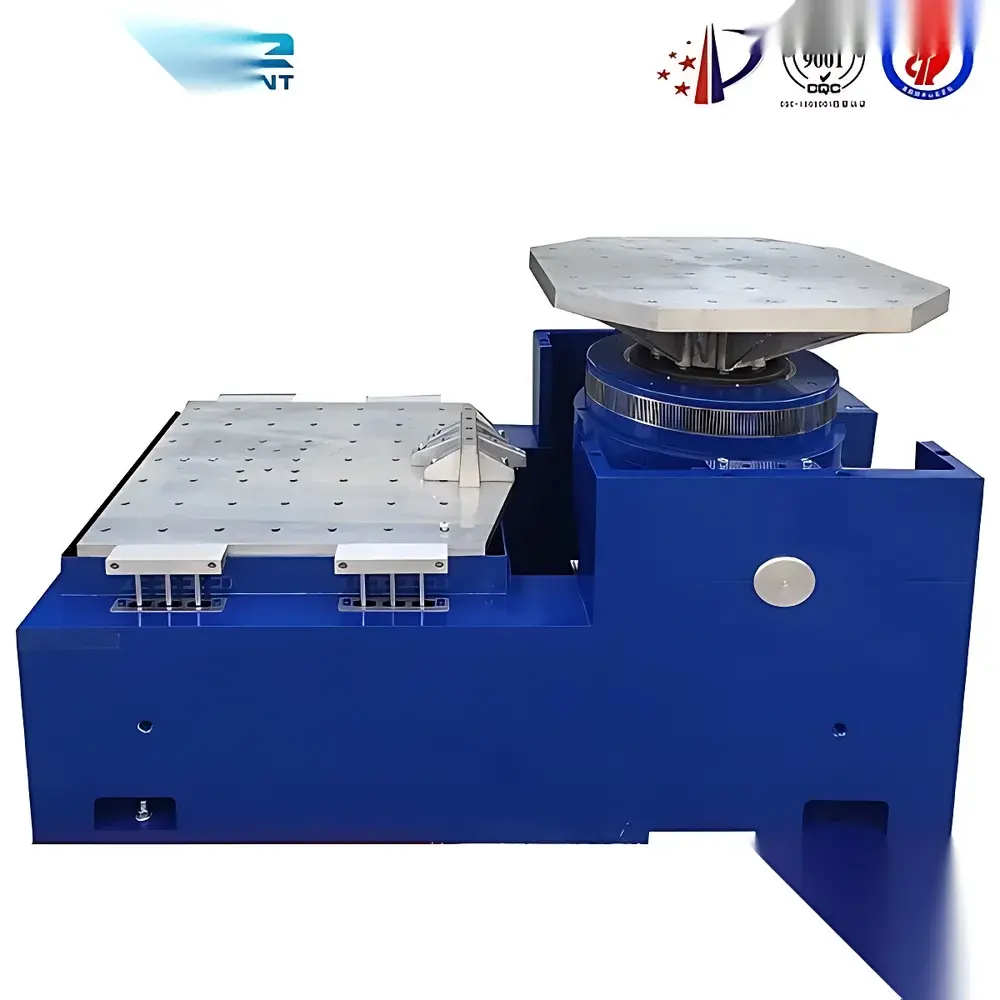
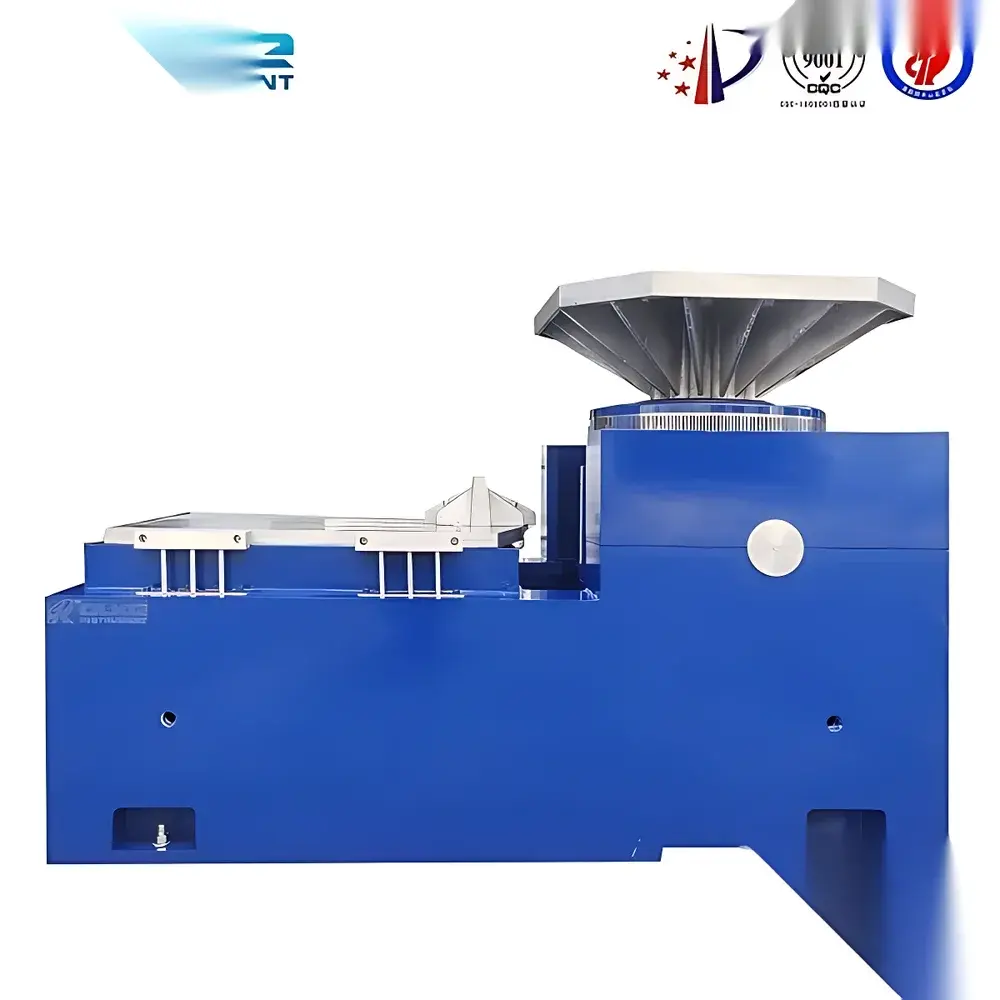
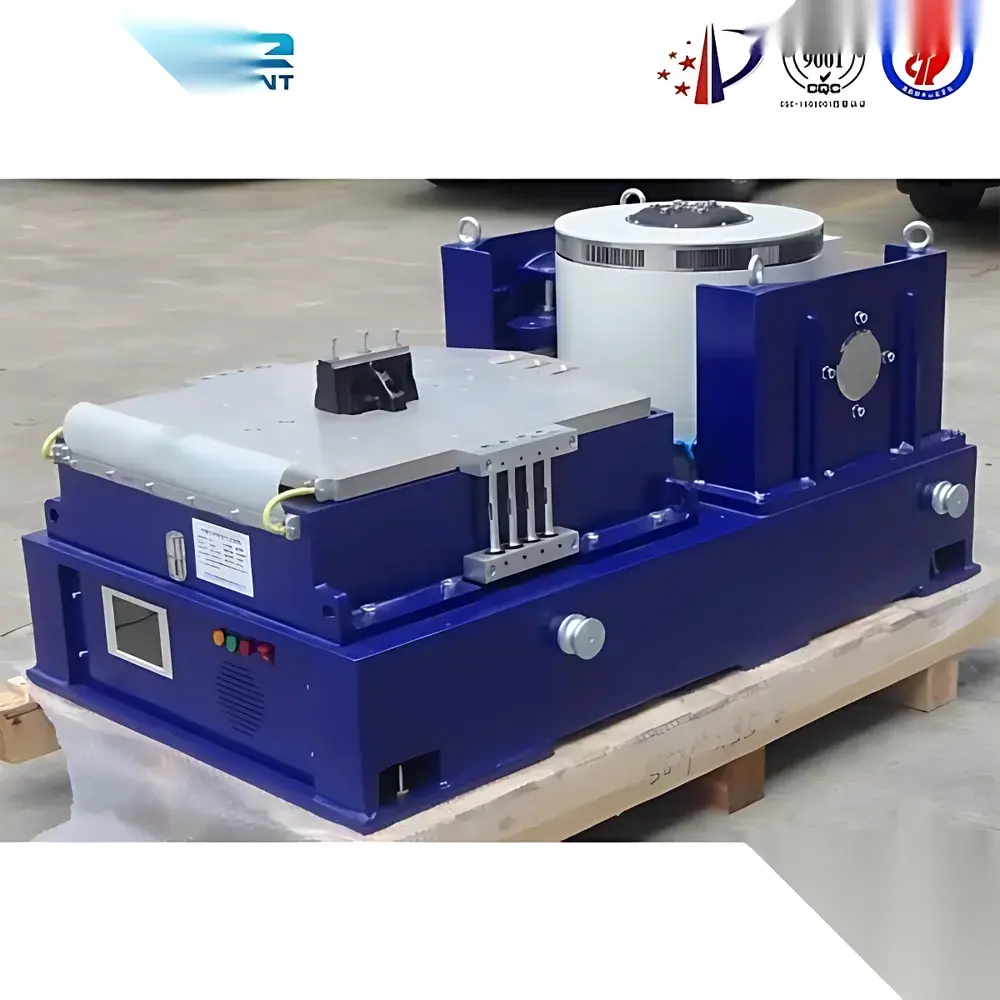
Electromagnetic Swept-Frequency Vibration Test System
| Brand | OEM |
|---|---|
| Origin | Imported |
| Manufacturer Type | Authorized Distributor |
| Price | USD 21,500 (FOB) |
| Frequency Range | 1–5000 Hz (±0.01 Hz resolution) |
| Max Load Capacity | 100 kg |
| Peak Force | 2000 kgf |
| Table Size | 500 × 500 × 6 mm (L×W×H) |
| Table Mounting | 25 × M10 threaded holes + 16 × hook slots (70 mm length) |
| Motion Axes | 6-DOF synchronized or selectable 1–3 axis operation |
| Waveforms | Sine (half/full), multi-stage random, road profile simulation, logarithmic sweep, programmable step/segment profiles (15-segment max) |
| Control Modes | Fixed-acceleration sweep, fixed-amplitude sweep, harmonic倍频, linear/logarithmic sweep, time-controlled dwell, amplitude & acceleration modulation |
Overview
The Electromagnetic Swept-Frequency Vibration Test System is a high-fidelity electrodynamic shaker platform engineered for rigorous environmental simulation of mechanical and electromechanical components under transport and operational vibration stress. Based on Lorentz-force actuation principles, the system delivers precise, repeatable sinusoidal, random, and transient excitations across a broad frequency spectrum — from sub-Hz startup conditions up to 5000 Hz — enabling compliance testing per IEC 60068-2-6, ISO 10326, MIL-STD-810H Method 514.8, and ASTM D999. Its rigid 6-degree-of-freedom (6-DOF) mechanical architecture supports both single-axis and fully coupled multi-axis excitation, replicating real-world dynamic loading scenarios encountered during ground transportation, aerospace handling, and in-service field deployment. The system is validated for continuous 2,160-hour (3-month) unattended operation with thermal and mechanical stability maintained within ±0.5% amplitude deviation and ±0.01 Hz frequency resolution.
Key Features
- Electrodynamic actuator with high-efficiency rare-earth magnet assembly and low-thermal-resistance voice coil for sustained high-force output (2000 kgf peak) and minimal power dissipation
- Programmable 6-DOF motion control: independent or synchronized excitation across vertical (Z), lateral (Y), longitudinal (X), roll, pitch, and yaw axes — configurable via hardware interlock or software-defined coupling matrices
- Multi-mode waveform generation: full-cycle and half-cycle sine, multi-stage Gaussian random, synthesized road-surface profiles (e.g., Belgian block, cobblestone, washboard), logarithmic sweep (1:10 or 1:100 decade rates), and user-defined segment-based profiles (up to 15 programmable steps)
- Real-time closed-loop control with digital signal processor (DSP)-based feedback: simultaneous regulation of acceleration, velocity, displacement, and force using integrated IEPE accelerometers and laser Doppler vibrometer (LDV) interface capability
- Modular table design: 500 × 500 mm stainless steel surface with 25 × M10 tapped holes (ISO standard spacing) and 16 × reinforced hook slots (70 mm depth) for secure fixture mounting and load restraint
- Thermally stabilized amplifier and controller cabinet with forced-air cooling, EMI-shielded cabling, and redundant safety interlocks compliant with EN 61000-6-2/6-4 and UL 61010-1
Sample Compatibility & Compliance
This vibration test system accommodates specimens ranging from small PCB assemblies (<100 g) to automotive ECUs, battery modules, and avionics enclosures (up to 100 kg). Fixture adaptability is ensured through standardized mounting interfaces and optional inertial mass compensation algorithms. The system meets functional requirements for qualification per IPC-A-610 (electronic assemblies), SAE J1211 (automotive electronics), and DO-160G Section 8 (avionics vibration). Full traceability is supported via GLP/GMP-compliant audit trails, including timestamped parameter logs, sensor calibration certificates (NIST-traceable), and test report generation aligned with ISO/IEC 17025 documentation standards. Optional FDA 21 CFR Part 11-compliant electronic signature and data integrity modules are available for regulated pharmaceutical and medical device validation protocols.
Software & Data Management
Control and analysis are executed via the VIBRO-PRO v5.2 software suite, a Windows-based application supporting dual-mode operation: standalone front-panel control or networked remote supervision via Ethernet/IP or Modbus TCP. The software provides real-time FFT spectral monitoring (1600-line resolution), PSD estimation (per IEEE 1003.1), transmissibility mapping, and shock response spectrum (SRS) synthesis. All test sequences — including swept-sine, random, and hybrid profiles — are stored as XML-based configuration files with version control and SHA-256 hash verification. Raw time-history data is saved in ASAM MDF 4.1 format for interoperability with MATLAB, Python (SciPy), and commercial CAE tools such as ANSYS Mechanical and LMS Test.Lab. Automated report generation includes pass/fail evaluation against user-defined acceptance thresholds and export to PDF, CSV, or HTML with embedded metadata (operator ID, calibration date, environmental chamber status).
Applications
- Transportation simulation: Replication of truck, rail, and air cargo vibration environments per ISTA 3A, 3E, and 3H protocols
- Electromechanical reliability screening: Detection of solder joint fatigue, connector fretting, capacitor microphonics, and MEMS sensor drift under broadband excitation
- Structural dynamics characterization: Modal survey support via impact hammer correlation and operating deflection shape (ODS) analysis
- Automotive component validation: Testing of ADAS cameras, radar housings, infotainment displays, and EV battery pack mounts under combined sine-random-torque profiles
- Defense & aerospace: Environmental stress screening (ESS) of mission-critical subsystems prior to HALT/HASS campaigns
- Quality assurance labs: In-process vibration endurance verification for consumer electronics, industrial sensors, and IoT edge devices
FAQ
What standards does this system support out-of-the-box?
IEC 60068-2-6 (sinusoidal), ISO 10326-1 (random), MIL-STD-810H Method 514.8 (transportation), ASTM D999 (packaging), and SAE J1211 (automotive electronics) test profiles are preloaded and editable.
Can the system perform simultaneous multi-axis random vibration?
Yes — the 6-DOF controller supports true correlated random excitation across all axes using cross-power spectral density (CPSD) matrix input, with coherence control down to 0.95 over 20–2000 Hz.
Is third-party calibration included with delivery?
Each unit ships with NIST-traceable factory calibration certificate for force, acceleration, and displacement channels, valid for 12 months; ISO/IEC 17025 accredited recalibration services are available on annual contract.
What is the maximum payload for 5000 Hz operation?
At 5000 Hz, the usable payload is reduced to 15 kg to maintain mechanical integrity and control fidelity; full 100 kg capacity is rated for frequencies ≤1000 Hz.
Does the system support hardware-in-the-loop (HIL) integration?
Yes — EtherCAT and CAN FD interfaces are available for real-time synchronization with external controllers, enabling closed-loop HIL testing of active suspension systems or vibration cancellation algorithms.



