
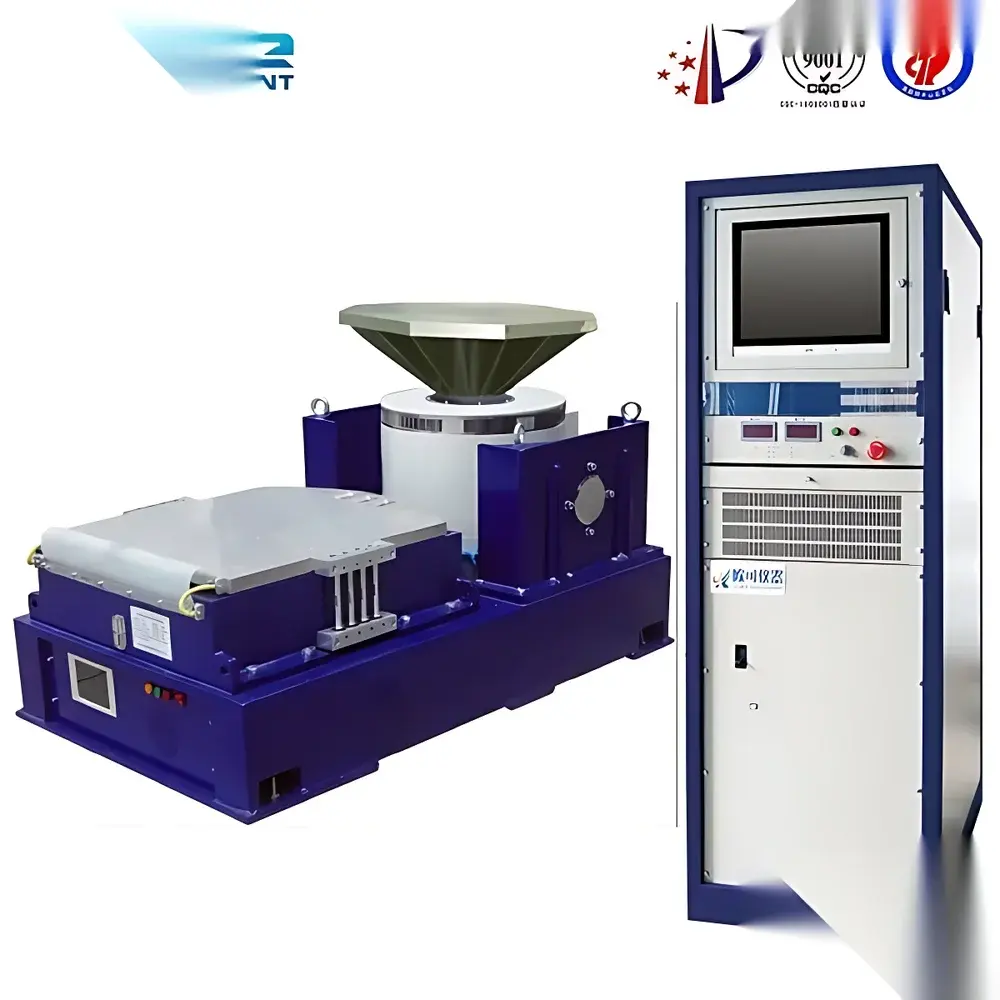
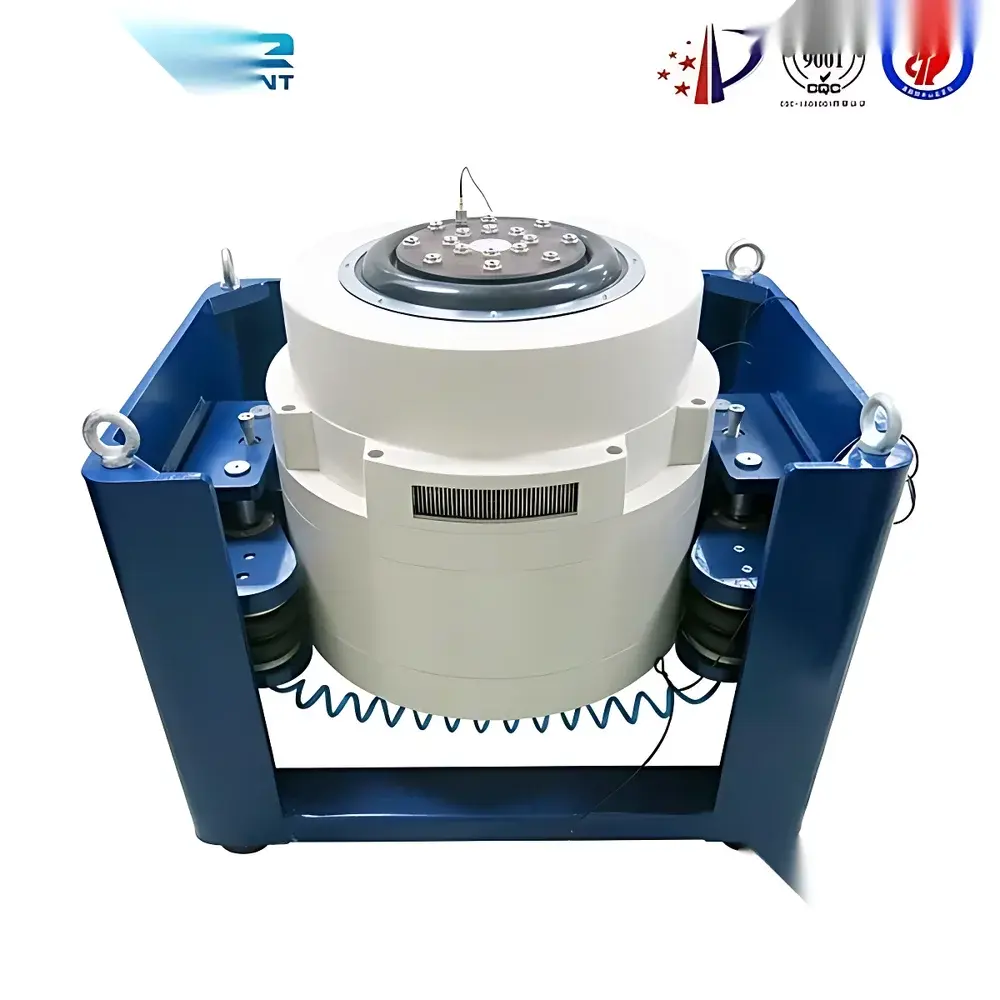
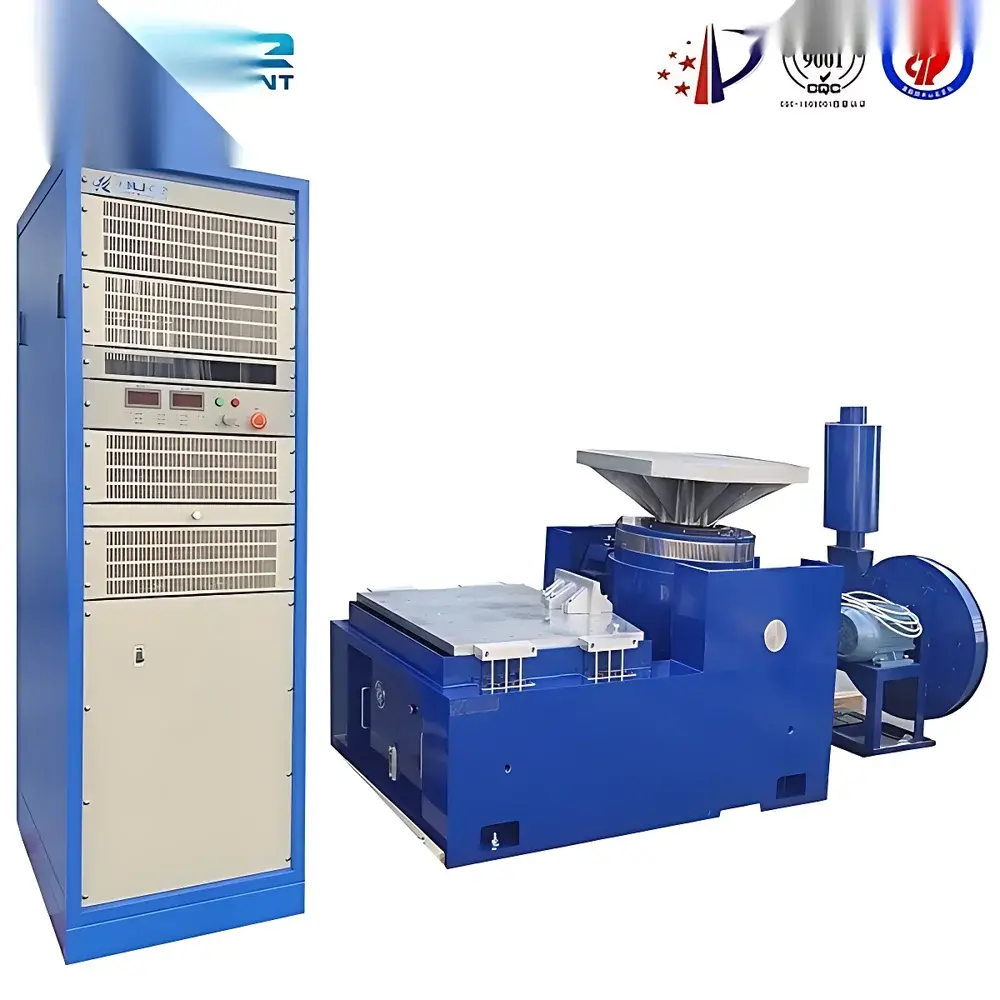
Electromagnetic Vibration Shaker System
| Brand | OEM / Custom Brand |
|---|---|
| Origin | Imported |
| Manufacturer Type | Authorized Distributor |
| Load Capacity Options | 25 kg / 50 kg / 75 kg / 100 kg |
| Table Surface | 350 × 350 mm (customizable) |
| Vibration Axis | Vertical and/or Horizontal (selectable) |
| Frequency Range | 1–600 Hz / 1–3000 Hz / 1–5000 Hz (model-dependent) |
| Peak-to-Peak Displacement | 0–5 mm (adjustable, 5 mm max) |
| Maximum Acceleration | <20 g |
| Waveform | Sinusoidal |
| Frequency Resolution | 0.01 Hz |
| Frequency Accuracy | ±0.1 Hz |
| Test Duration Range | 0–9999 h / min / sec (programmable) |
| Drive Power Supply | AC 220 V / 50 Hz or AC 380 V / 50 Hz |
Overview
The Electromagnetic Vibration Shaker System is a precision-engineered electrodynamic shaker platform designed for controlled sinusoidal vibration testing in R&D laboratories, quality assurance departments, and production validation environments. Based on Lorentz force actuation principles—where current-carrying coils interact with a static magnetic field to generate highly repeatable, broadband mechanical excitation—the system delivers calibrated acceleration, displacement, and velocity profiles across defined frequency spectra. It is purpose-built to replicate real-world mechanical stress conditions encountered during transportation, handling, and operational service life, enabling engineers to assess structural integrity, fatigue resistance, resonant behavior, and functional reliability of electronic assemblies, automotive ECUs, aerospace subcomponents, medical devices, and consumer electronics.
Key Features
- Four-point synchronous electromagnetic excitation ensures uniform modal energy distribution across the 350 × 350 mm rigid aluminum test table—minimizing nodal distortion and supporting high-fidelity response measurement.
- Digitally synthesized sinusoidal waveform generation with <0.1 Hz frequency accuracy and 0.01 Hz resolution enables precise resonance tracking and narrow-band dwell testing per ISO 10816 and IEC 60068-2-6 requirements.
- Programmable sweep and fixed-frequency test sequences—including multi-segment time-defined profiles—support complex test standards such as MIL-STD-810H Method 514.8 and GB/T 2423.10–2019 without external scripting.
- Integrated amplitude prediction algorithm and continuous analog amplitude control allow rapid, non-disruptive adjustment of displacement (0–5 mm p-p) and acceleration (<20 g) within closed-loop operation.
- EMI-hardened control architecture with active noise cancellation circuitry eliminates coupling from ambient electromagnetic fields—critical for testing sensitive RF modules, MEMS sensors, and low-noise amplifiers.
- Non-magnetic, electrostatic-dissipative table surface prevents unintended charge accumulation or magnetic interference—ensuring compatibility with Hall-effect sensors, magnetometers, and magnetic storage components.
Sample Compatibility & Compliance
The system accommodates test specimens up to 100 kg (depending on selected model variant), with configurable mounting interfaces including threaded inserts, T-slots, and vacuum-adhesion options for low-mass or irregularly shaped samples. It conforms to major international vibration test standards including GB/T 2423.10 (China), IEC 60068-2-6 (IEC), ISO 10816 (vibration severity assessment), and ASTM D999 (transportation simulation). Its control firmware supports audit-ready test logging with timestamped parameter sets, user authentication, and tamper-evident data export—facilitating GLP-compliant documentation and FDA 21 CFR Part 11 readiness when paired with validated software extensions.
Software & Data Management
Control and analysis are managed via a Windows-based host application supporting real-time FFT spectrum monitoring, waterfall plot generation, and transmissibility curve computation. All test definitions—including sweep rates, dwell durations, amplitude profiles, and safety limits—are stored in encrypted project files with version history. Raw acceleration/displacement time-series data are exported in IEEE-compliant CSV or MATLAB .mat formats. Optional API integration (TCP/IP or USB CDC) allows synchronization with third-party DAQ systems, environmental chambers, or automated test sequencers in Industry 4.0 production lines.
Applications
- Resonance search and mode shape identification for PCB-level component layout optimization.
- Transportation simulation per ISTA 3A/3E protocols to validate packaging robustness.
- Accelerated life testing of solder joints, connectors, and thermal interface materials under cyclic mechanical stress.
- Functional verification of inertial sensors, gyroscopes, and accelerometers under controlled vibratory bias.
- Qualification testing of avionics enclosures, satellite subsystems, and UAV propulsion modules per DO-160 Section 8.
- Root cause analysis of micro-crack propagation in ceramic substrates and polymer composites using phase-resolved vibration response mapping.
FAQ
What vibration standards does this shaker system support out-of-the-box?
It natively implements test profiles defined in GB/T 2423.10–2019, IEC 60068-2-6, and ISO 10816–1. Custom sweep/dwell sequences can be configured to meet MIL-STD-810H, DO-160G, or customer-specific internal specifications.
Can the system perform random vibration testing?
No—this is a dedicated sinusoidal shaker platform. Random vibration capability requires a separate controller and power amplifier configuration not included in the base system.
Is the test table compatible with slip-table or seismic mass extension kits?
Yes—standardized M6 and 1/4″-20 threaded mounting patterns enable mechanical integration with commercially available slip tables, reaction masses, and multi-axis shaker stacks.
How is calibration traceability maintained?
Each unit ships with a NIST-traceable accelerometer calibration certificate (per ISO 17025-accredited lab), and annual verification procedures follow ISO 16063-21 for electrodynamic shakers.
What safety interlocks are implemented?
Hardware-enforced emergency stop (E-stop) circuitry, over-acceleration cutoff, thermal overload protection on voice coil, and table displacement limit switches are integrated into the drive electronics—complying with EN 61000-6-2 and EN 61000-6-4 immunity requirements.



