
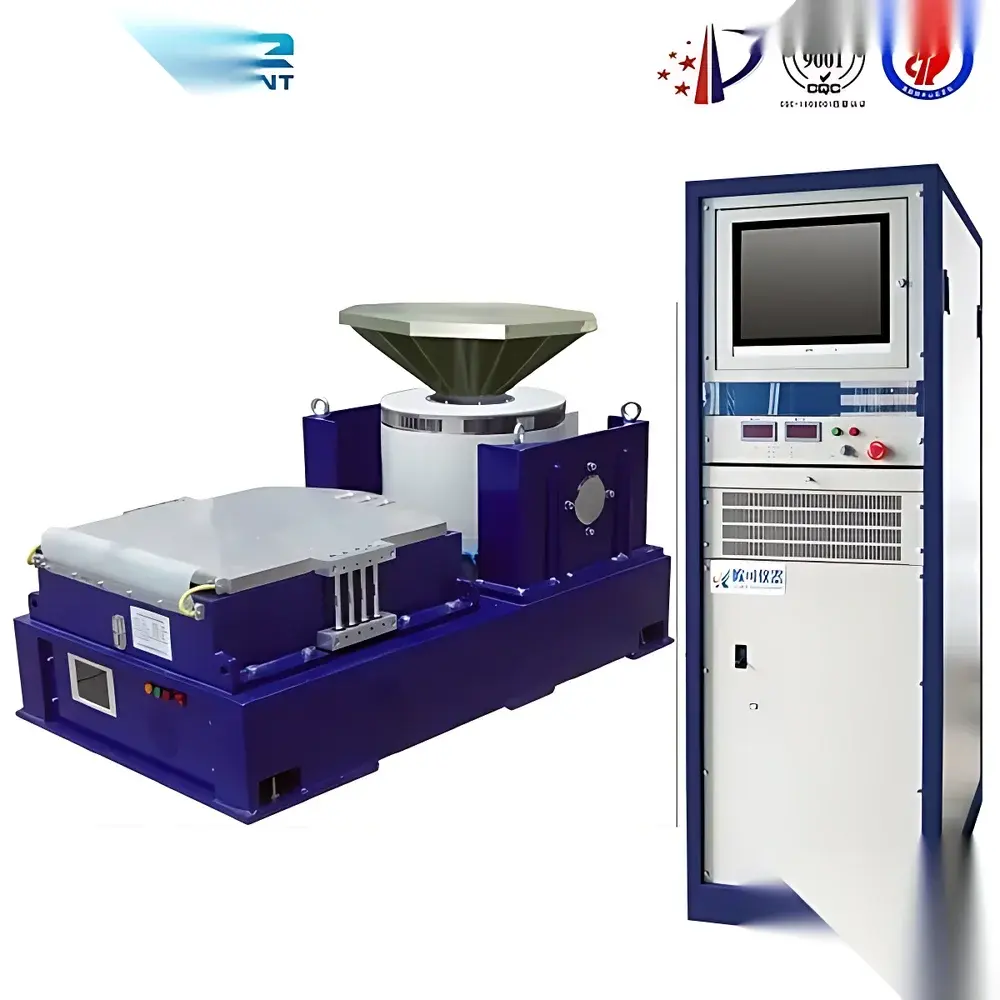
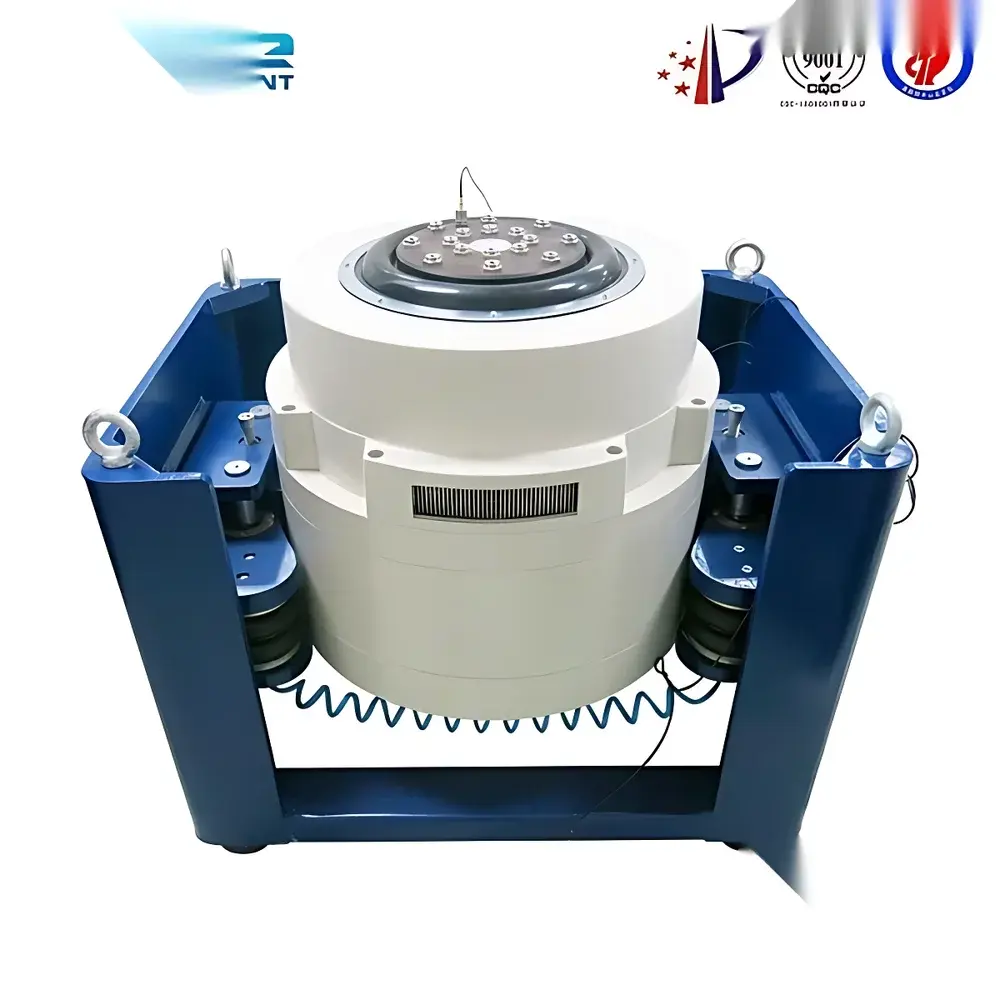
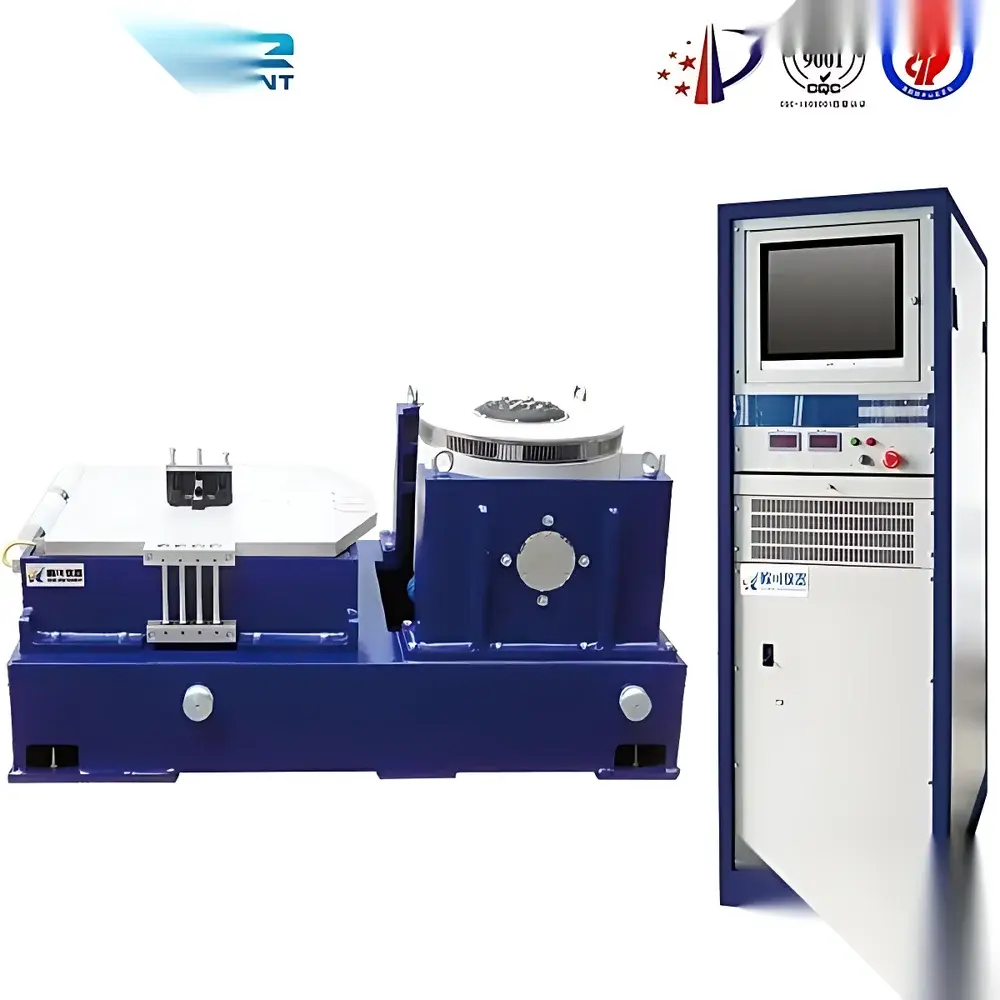
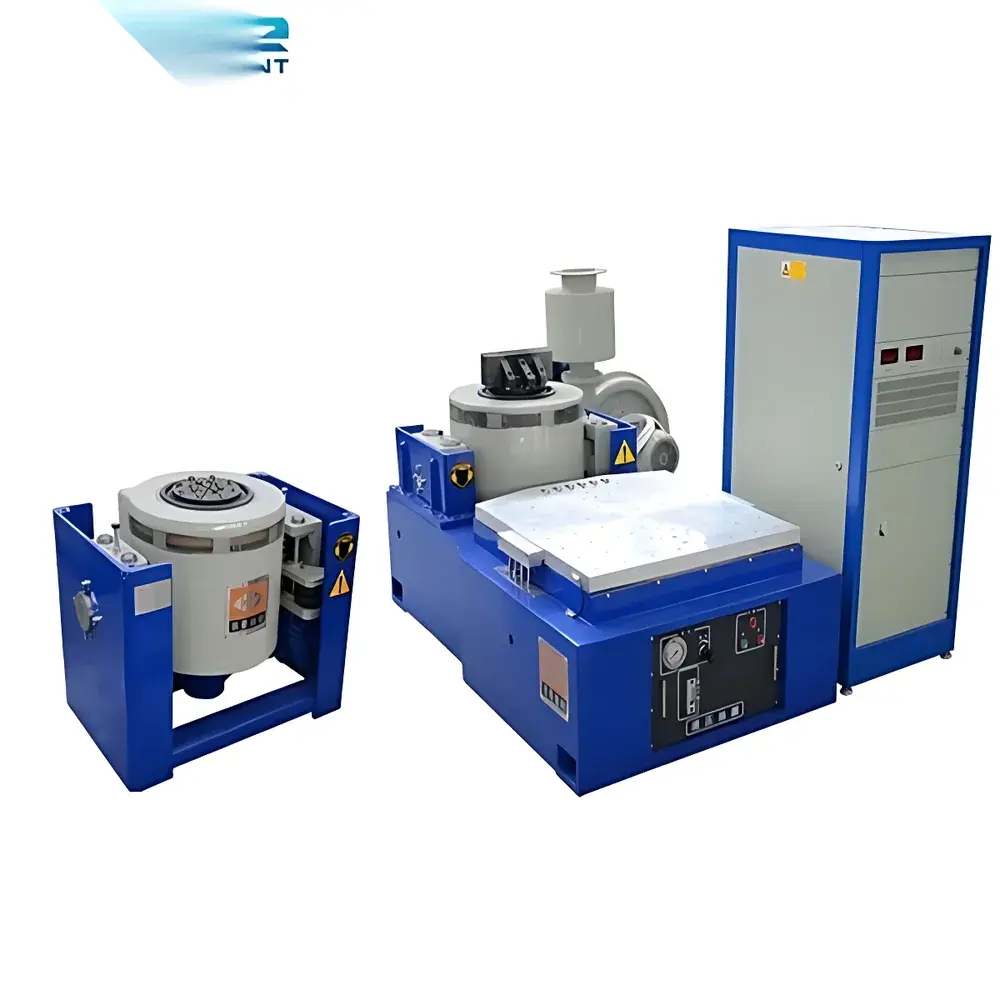
Electromagnetic Vibration Shaker System with Integrated Sensor Interface
| Brand | Other Brands |
|---|---|
| Origin | Imported |
| Manufacturer Type | Authorized Distributor |
| Frequency Range | 5–3000 Hz |
| Rated Sinusoidal/Random Force | 14.2 kN |
| Max. Acceleration | 784.98 m/s² |
| Max. Velocity | 2.00 m/s |
| Max. Displacement | 51 mm p-p |
| Payload Capacity | 300 kg |
| Moving Mass | 18 kg |
| Armature Diameter | Ø280 mm |
| Allowable Eccentric Moment | 300 N·m |
| Amplifier Output Power | 20 kVA |
| System Power Requirement | 28 kVA |
| Shaker Body Weight | 1600 kg |
| Amplifier Weight | 390 kg |
| Dimensions (Shaker) | 990 × 990 × 790 mm |
| Dimensions (Amplifier) | 550 × 1700 × 800 mm |
| Compliance | GB/T 2423.1–2001, GB/T 2423.2–2001, GB/T 2423.3–1993, GB/T 2423.10–1999, JJG 190–1997 |
Overview
The Electromagnetic Vibration Shaker System with Integrated Sensor Interface is a high-performance electrodynamic vibration testing platform engineered for rigorous environmental simulation and dynamic mechanical characterization. Operating on the principle of Lorentz force actuation—where controlled current through voice-coil windings interacts with a static magnetic field to generate precise, repeatable inertial excitation—the system delivers calibrated acceleration, velocity, and displacement waveforms across a broad frequency spectrum (5–3000 Hz). Designed for laboratory-grade reliability and metrological traceability, it serves as a core instrument in qualification testing workflows for aerospace components, avionics modules, automotive ECUs, semiconductor packaging, and high-reliability electronic assemblies. Its integrated sensor interface supports real-time acquisition of acceleration, force, and displacement signals from industry-standard IEPE and charge-output transducers, enabling closed-loop control and synchronized multi-channel data logging.
Key Features
- High-force electromagnetic shaker with 14.2 kN rated sinusoidal and random output, optimized for both low-frequency high-displacement and high-frequency high-acceleration test profiles.
- Robust moving system featuring an 18 kg armature mass and Ø280 mm horizontal mounting surface, engineered to maintain modal integrity under dynamic loading up to 300 kg payload.
- Thermally stable power amplifier delivering 20 kVA continuous output in switch-mode architecture, with active cooling and over-temperature/over-current protection circuits compliant with IEC 61000-4-3 immunity requirements.
- Structural rigidity ensured by a 1600 kg base frame with 300 N·m allowable eccentric moment tolerance—critical for minimizing parasitic rocking modes during off-center loading.
- Full compliance with national metrological verification standard JJG 190–1997 and environmental testing standards GB/T 2423.1–2001 (cold), GB/T 2423.2–2001 (dry heat), GB/T 2423.3–1993 (damp heat), and GB/T 2423.10–1999 (vibration).
- Modular sensor interface supporting simultaneous connection of acceleration, force, and displacement transducers with configurable gain, filtering, and anti-aliasing settings.
Sample Compatibility & Compliance
This shaker system accommodates rigidly mounted specimens ranging from miniature PCBs and MEMS devices to large-scale enclosures and structural subassemblies. Mounting adaptability is achieved via standardized threaded inserts (M8/M10) on the Ø280 mm armature surface, compatible with industry-standard slip tables and head expanders. The system meets essential safety and electromagnetic compatibility (EMC) requirements per GB 4793.1 and IEC 61326-1. For regulated industries—including medical device manufacturing and defense electronics—the platform supports audit-ready operation when paired with validated controller software that maintains full traceability of test parameters, calibration history, and run logs in accordance with GLP and GMP principles.
Software & Data Management
When operated with certified vibration control software (e.g., VibrationVIEW or m+p VibControl), the system enables real-time spectrum editing, profile-based random, sine, shock, and fatigue testing, along with automated pass/fail evaluation against user-defined thresholds. All acquired sensor data—including time-history waveforms, PSD spectra, and transmissibility functions—are timestamped and stored in HDF5 or UFF58 formats for interoperability with MATLAB, Python (SciPy), and LabVIEW environments. Audit trail functionality—including operator ID, parameter changes, and calibration certificate references—is retained per FDA 21 CFR Part 11 requirements when configured with electronic signature support.
Applications
- Aerospace: Qualification testing of satellite subsystems, inertial navigation units, and launch vehicle avionics per MIL-STD-810H Method 514.8.
- Automotive: Durability validation of ADAS sensors, battery management systems, and infotainment modules under road-simulation spectra.
- Electronics Manufacturing: Screening of solder joint integrity, connector reliability, and component-level resonance identification per IPC-9701A.
- Materials Science: Dynamic modulus and damping characterization of viscoelastic polymers and composite laminates using controlled-strain harmonic excitation.
- Academic Research: Experimental modal analysis (EMA) and operational deflection shape (ODS) studies requiring high-fidelity excitation repeatability and phase coherence.
FAQ
What types of sensors are supported by the integrated interface?
The system provides BNC and LEMO connectors for IEPE accelerometers (4 mA constant current supply), charge-mode piezoelectric transducers (with external charge amplifiers), and LVDT displacement sensors—all configurable via front-panel DIP switches or remote command protocol.
Is the shaker suitable for high-frequency random vibration testing above 2000 Hz?
Yes—its mechanical design and magnetic circuit optimization ensure flat response and minimal distortion up to 3000 Hz, verified by third-party modal analysis and accelerometer reciprocity calibration.
Can the system be integrated into an existing environmental test chamber?
It is compatible with standard vertical and horizontal chamber configurations via optional thermal isolation mounts and feedthrough interfaces for signal and power routing.
Does the amplifier require dedicated three-phase utility power?
Yes—the 28 kVA total system demand necessitates a dedicated 380 VAC ±10%, 50/60 Hz three-phase supply with proper grounding and harmonic filtering per IEEE 519.
How is calibration traceability maintained?
Annual calibration follows ISO/IEC 17025 procedures using NIST-traceable reference accelerometers and laser vibrometers; certificates include uncertainty budgets and sensitivity drift assessments.



