
Electromagnetic Vibration Test System
| Brand | OEM / Third-Party Manufacturer |
|---|---|
| Origin | Imported |
| Supplier Type | Authorized Distributor |
| Price | USD 21,000 (FOB) |
| Display | 5.7-inch color TFT LCD touchscreen |
| Data Storage | Internal 128 KB SRAM with lithium backup + optional CF card expansion |
| Programmability | 20 user-defined test programs, up to 99 segments per program, max 999 loops per program |
| Control Modes | Programmed cycling mode and steady-state mode |
| Environmental Resolution | Temperature ±0.1 °C, Relative Humidity ±0.1 %RH, Time ±1 min |
| Data Logging | Continuous timestamped recording of setpoints and actual values (temperature, RH) at configurable intervals |
| Compliance Support | GLP-compliant audit trail capability via optional printer or CF export |
Overview
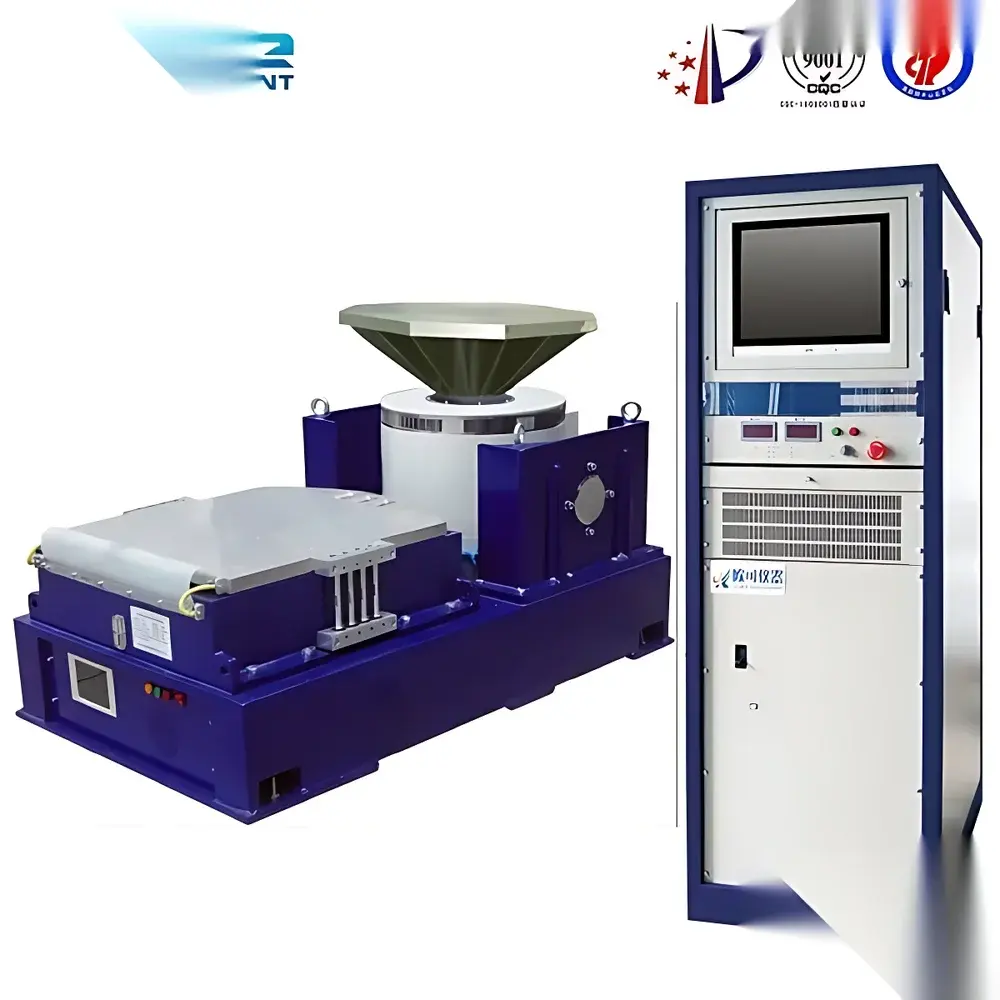
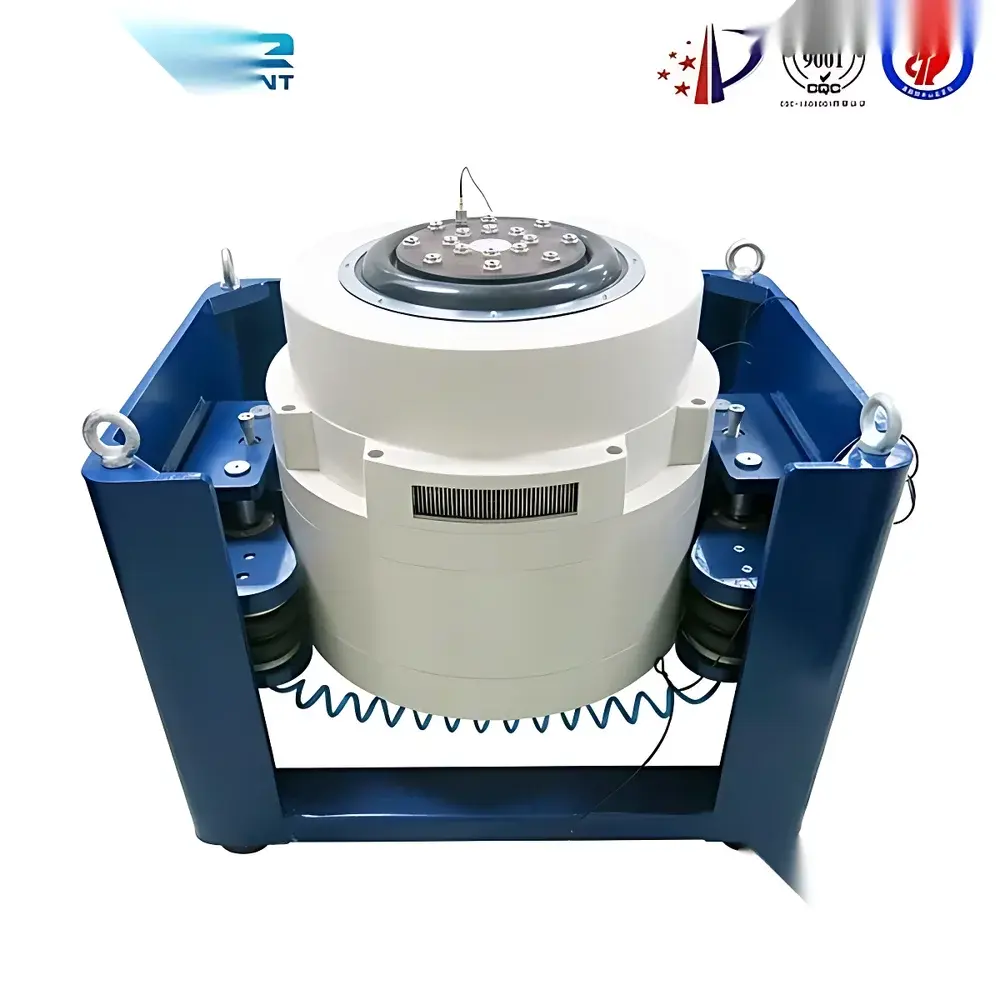
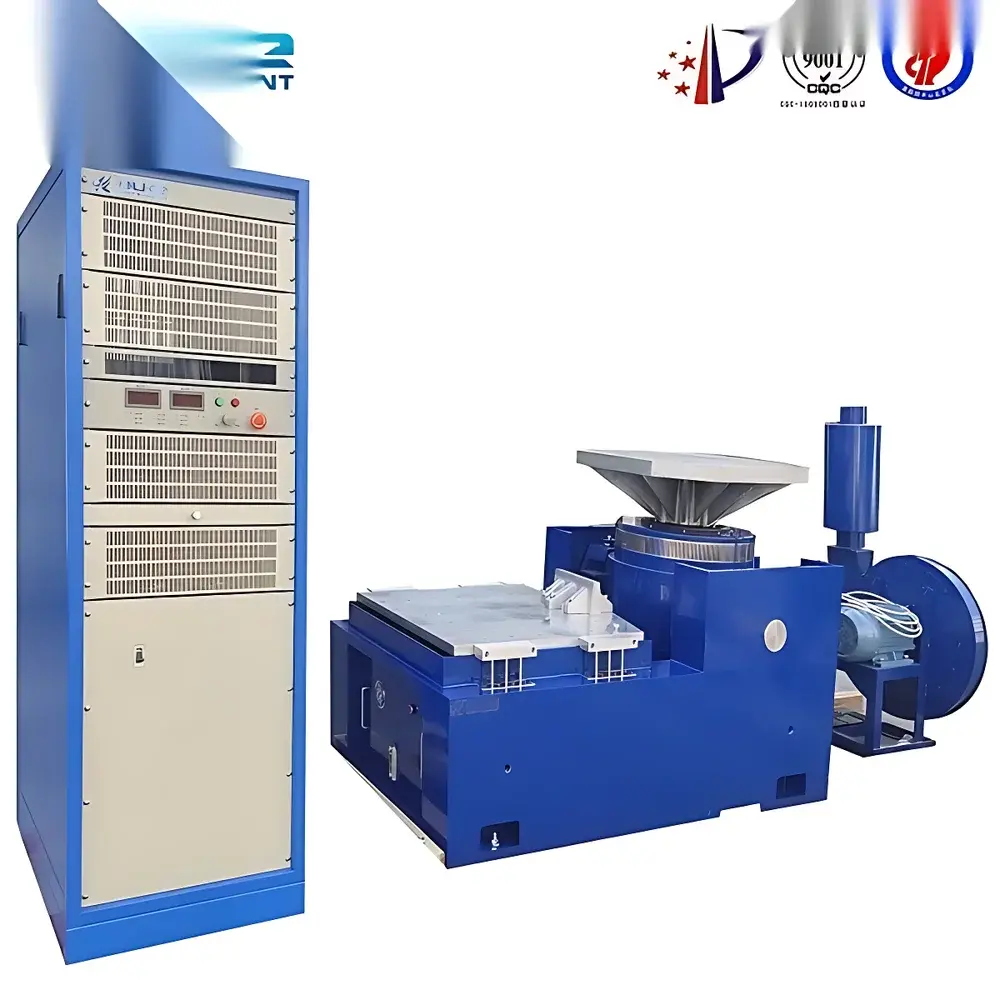
The Electromagnetic Vibration Test System is a precision-engineered electrodynamic shaker platform designed for controlled mechanical excitation of specimens under defined thermal and humidity conditions. Unlike hydraulic or servo-hydraulic systems, this system employs a voice-coil electromagnetic actuator operating on Lorentz force principles—ensuring high linearity, rapid response, and minimal harmonic distortion across its operational frequency range (typically 5 Hz to 3,000 Hz). It integrates environmental conditioning (temperature and relative humidity control) with real-time vibration stimulus, enabling combined stress testing per standards such as ISO 16750-3 (road vehicles), IEC 60068-2-6 (vibration testing), and MIL-STD-810H Method 514.8 (vibration exposure). The system is engineered for laboratory-based reliability validation, component fatigue assessment, PCB solder joint integrity evaluation, and packaging performance testing under thermo-mechanical coupling conditions.
Key Features
- Integrated dual-environmental chamber with independent PID-controlled heating, refrigeration, and humidification subsystems—capable of maintaining stable temperature (−40 °C to +150 °C) and humidity (10–98 %RH) during dynamic excitation.
- 5.7-inch color TFT LCD touchscreen interface with intuitive Chinese/English bilingual menu navigation, supporting parameter entry, real-time waveform monitoring, and diagnostic feedback.
- Embedded Siemens S7-1200 PLC for deterministic I/O control, closed-loop actuator feedback management, and fail-safe interlock execution—eliminating reliance on PC-based soft logic.
- Programmable test sequencing: up to 20 stored protocols, each comprising 99 programmable segments (amplitude, frequency, dwell time, sweep rate), with loop nesting up to 999 iterations per segment.
- Comprehensive data acquisition architecture: internal 128 KB SRAM with non-volatile lithium-backed memory for critical runtime parameters; optional industrial-grade CF card for long-term traceable logging (timestamped temperature, RH, acceleration, displacement).
- Energy-optimized refrigeration control: adaptive compressor staging and electronic expansion valve modulation based on thermal load demand—reducing power consumption by up to 30% during low-intensity test phases.
- Automatic self-diagnostic startup sequence with fault code indexing, contextual troubleshooting guidance, and hardware status verification prior to test initiation.
Sample Compatibility & Compliance
The system accommodates standard test fixtures per ISO 5344 and ASTM D4728, supporting payloads up to 50 kg (dependent on model variant) with mounting interfaces compliant with DIN 45670 and IEC 60068-2-70. It meets electromagnetic compatibility requirements per EN 61326-1 and safety standards per EN 61000-6-2/6-4. For regulated environments—including pharmaceutical device validation, automotive Tier-1 supplier qualification, and aerospace component certification—the system supports GLP/GMP-aligned documentation: audit-trail-enabled data export (CSV/TXT), configurable print intervals via optional thermal printer, and CFR 21 Part 11–compatible user access controls when integrated with validated LIMS or MES platforms.
Software & Data Management
No proprietary PC software is required for basic operation; all configuration, execution, and monitoring occur locally via the embedded HMI. However, CF card logs are structured in ASCII-delimited format for direct import into MATLAB, Python (pandas), or LabVIEW for spectral analysis (FFT), fatigue life prediction (Miner’s rule), or statistical process control (SPC) charting. Optional Ethernet or RS-485 interfaces enable remote supervision via Modbus TCP or OPC UA—facilitating integration into centralized test lab management systems. All logged data includes UTC timestamps, operator ID fields, and checksum-verified integrity headers to satisfy ISO/IEC 17025 clause 7.5.2 requirements for measurement traceability.
Applications
- Accelerated life testing of electronic assemblies subjected to road-simulated vibration spectra (e.g., ISO 20653, SAE J1211).
- Thermo-mechanical stress screening of MEMS sensors, battery modules, and LED lighting systems.
- Qualification of adhesive bonds and encapsulants under simultaneous thermal cycling and random vibration.
- Validation of shock absorption performance in medical device housings per IEC 60601-1 Clause 9.4.2.
- Research into viscoelastic damping behavior of polymer composites using controlled amplitude-frequency sweeps.
FAQ
Does the system support random vibration profiles?
Yes—when configured with optional spectrum generation firmware, it executes power spectral density (PSD) profiles per ISO 10816-4 and MIL-STD-810H Appendix C.
Can test data be exported in CSV format for third-party analysis?
Yes—CF card recordings are plain-text, tab-delimited files compatible with Excel, Python, and MATLAB without conversion.
Is the PLC logic accessible for custom modifications?
No—user access to PLC ladder logic is restricted to maintain calibration integrity and regulatory compliance; however, I/O mapping and alarm thresholds are configurable via HMI.
What is the maximum allowable payload for 200 g peak acceleration?
At full rated acceleration (200 g pk), the recommended maximum inertial mass is 25 kg to ensure actuator thermal stability and bearing service life.
How is calibration traceability maintained?
Each unit ships with NIST-traceable certificate of conformance for accelerometer sensitivity, temperature sensor accuracy, and humidity transducer linearity—valid for 12 months from commissioning date.



