
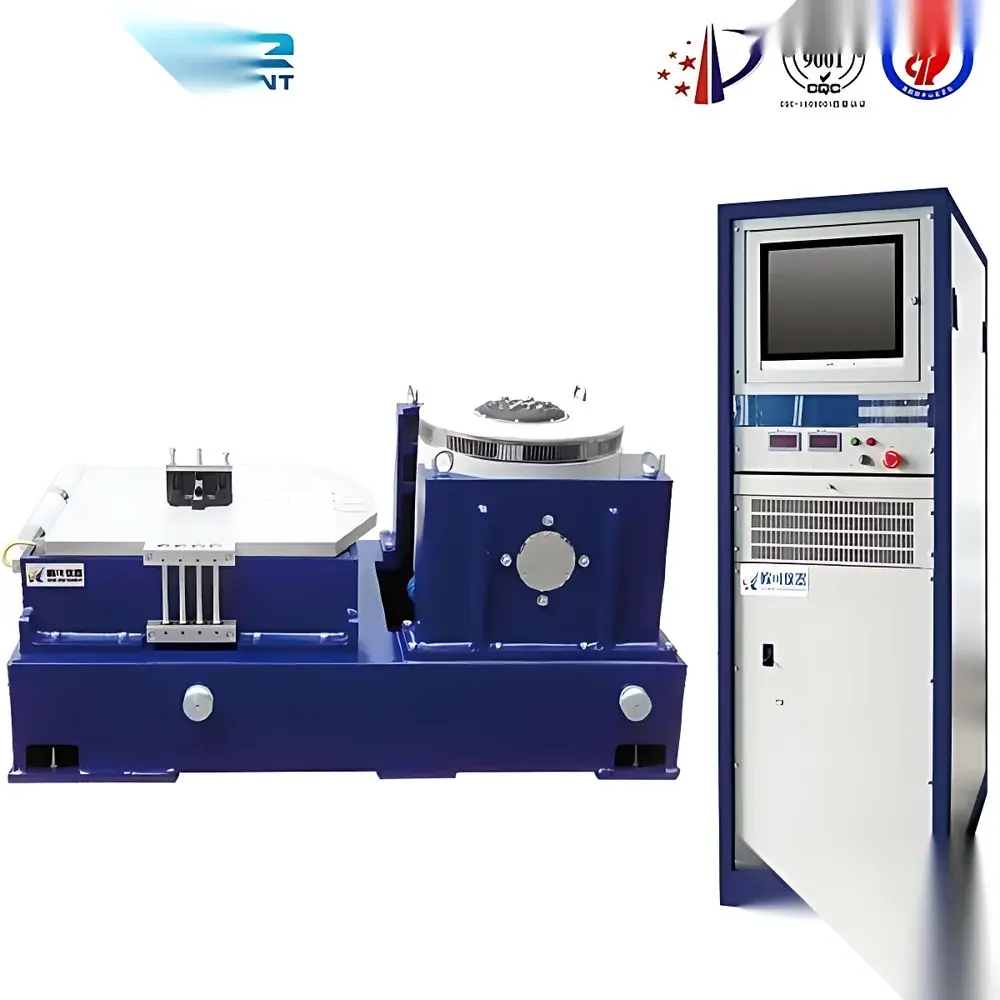
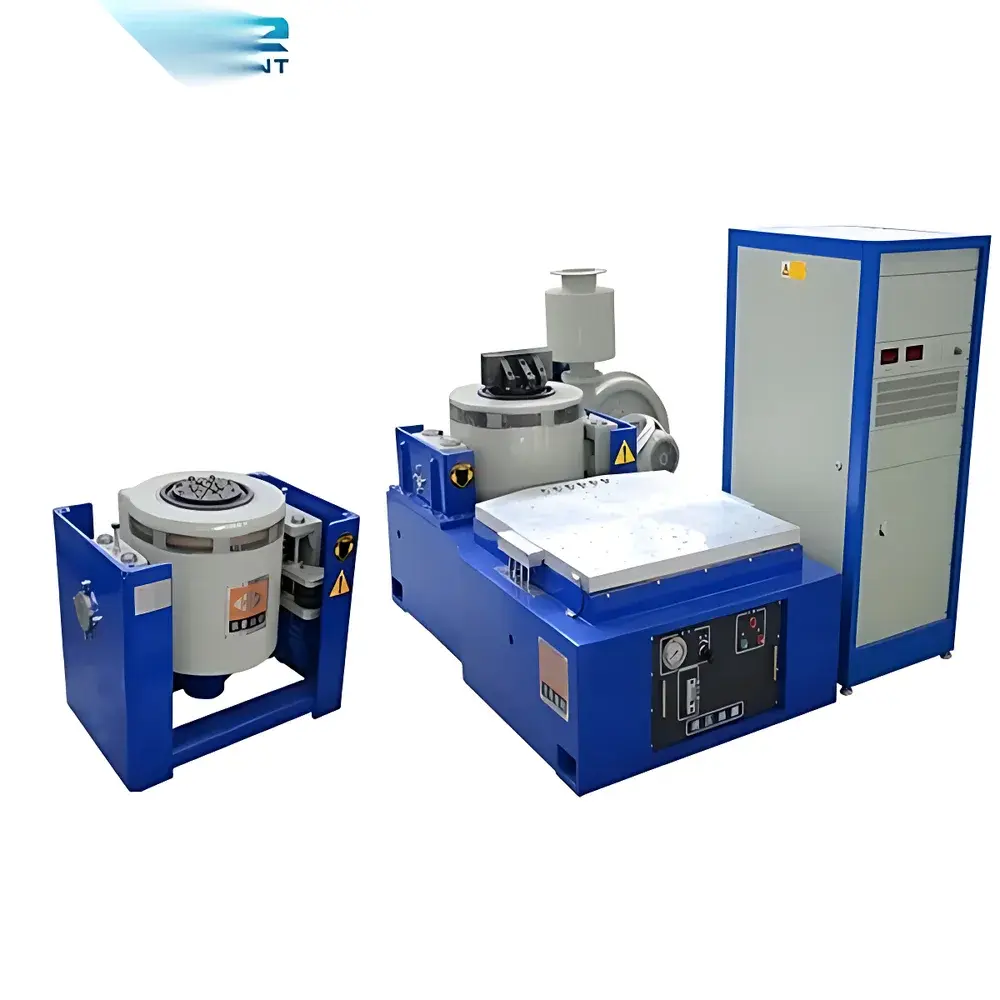
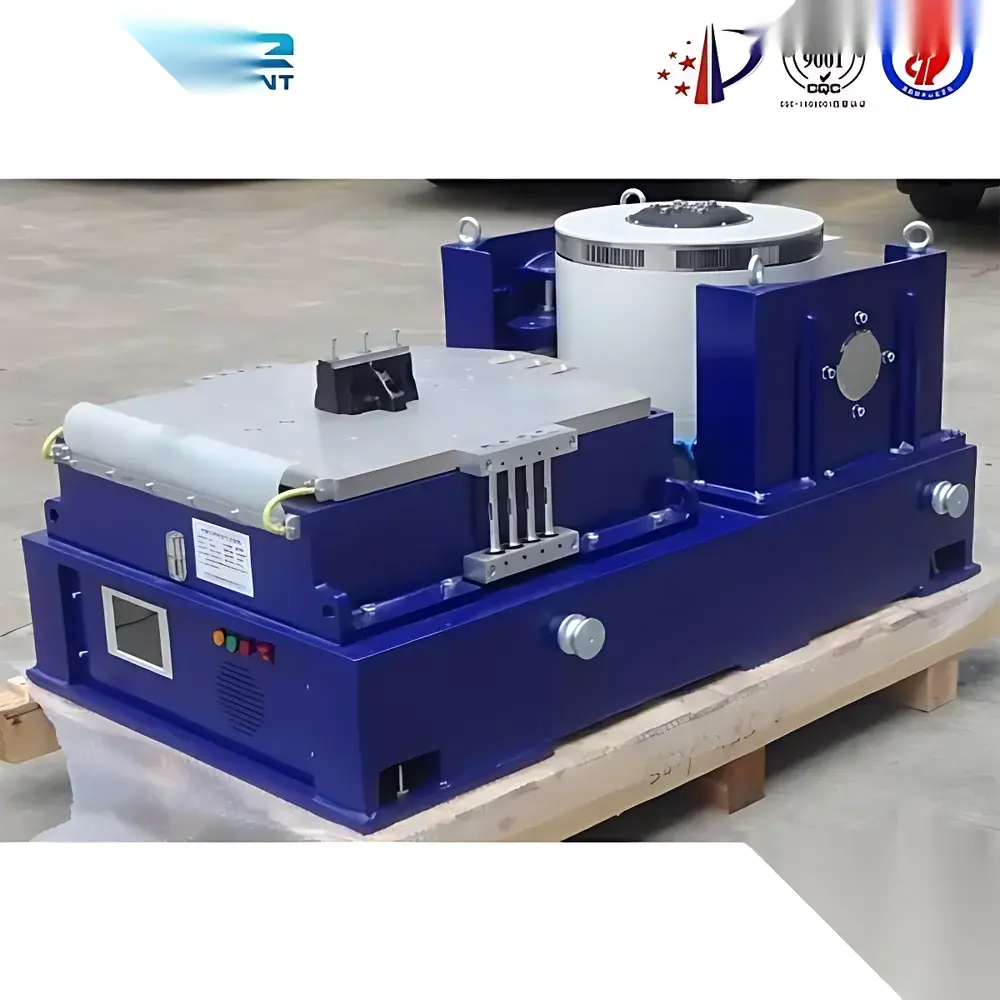
Electromagnetic Vibration Testing System – Model EMV-500 Series
| Key | Brand: OEM |
|---|---|
| Origin | Imported |
| Manufacturer Type | Authorized Distributor |
| Frequency Range | 5–500 Hz |
| Sweep Range | 5–500 Hz |
| Peak-to-Peak Displacement (Unloaded) | 0–5 mm |
| Table Dimensions | 550 × 550 × 46 mm |
| Control Cabinet Dimensions | 350 × 250 × 710 mm |
| Maximum Load Capacity | 100 kg |
| Vibration Axes | Vertical (Z), Horizontal (X/Y) |
| Max Acceleration | 33 g |
| Operating Ambient Temperature | 0–45 °C |
| Control Method | Digital PID with Programmable Sweep & Fixed-Frequency Modes |
| Amplitude Adjustment | Continuous (Stepless) |
| Excitation Configuration | 9-Point Synchronized Electromagnetic Actuation |
| Compliance | Designed to Support ISO 10816, IEC 60068-2-6, MIL-STD-810H Vibration Test Protocols |
Overview
The Electromagnetic Vibration Testing System – Model EMV-500 Series is a precision-engineered electrodynamic shaker platform designed for laboratory-grade vibration qualification, reliability screening, and structural integrity assessment. Based on electromagnetic force generation (Lorentz principle), the system delivers controlled sinusoidal, random, or swept-sine excitations across a broad frequency spectrum (5–500 Hz) with high linearity and low harmonic distortion. Its dual-axis capability—supporting simultaneous or independent vertical (Z-axis) and horizontal (X/Y-axis) excitation—enables realistic simulation of transport, operational, and environmental vibration profiles encountered in automotive electronics, aerospace avionics, consumer device manufacturing, and industrial control systems. The system is engineered for repeatability and traceability under GLP-compliant test environments and integrates seamlessly into quality management workflows aligned with ISO/IEC 17025-accredited laboratories.
Key Features
- 9-point synchronized electromagnetic actuation ensures uniform acceleration distribution across the full 550 × 550 mm test table surface, minimizing modal distortion and edge effects during high-g testing.
- Digital PID-controlled frequency synthesis enables stable amplitude tracking over wide sweep ranges, with real-time feedback compensation for load-dependent impedance shifts.
- Programmable multi-segment sweep functionality supports complex test profiles—including dwell, ramp-up/down, and hold phases—with up to 99 programmable steps per test sequence.
- Stepless amplitude adjustment (0–5 mm p-p displacement, up to 33 g peak acceleration) allows precise tailoring of stress levels for early-life failure detection (infant mortality screening) and fatigue life modeling.
- Integrated anti-EMI filtering and shielded signal pathways mitigate electromagnetic interference from adjacent high-power equipment—a critical requirement in EMC test labs and production floor integration.
- Self-contained vibration isolation base eliminates need for anchored foundation; compliant mounting permits rapid deployment on standard laboratory flooring without structural reinforcement.
- Real-time parameter mirroring interface displays frequency, acceleration, displacement, velocity, and phase synchronously—enabling immediate verification against test specification limits.
- Built-in amplitude prediction algorithm calculates required drive voltage based on payload mass and target g-level, reducing setup iteration time and improving test reproducibility.
Sample Compatibility & Compliance
The EMV-500 accommodates rigid and semi-rigid samples up to 100 kg, including PCB assemblies, enclosures, sensors, connectors, and complete subassemblies. Its flat, non-perforated stainless-steel table (550 × 550 × 46 mm) supports direct bolting or fixture-mounting via standardized M6 threaded holes (grid pitch: 50 mm). The system conforms to key international vibration test standards, including ISO 10816 (vibration severity evaluation), IEC 60068-2-6 (sinusoidal vibration testing), and MIL-STD-810H Method 514.8 (environmental engineering considerations). While not certified as a standalone FDA 21 CFR Part 11-compliant instrument, its logging architecture supports audit-ready data export (CSV/TXT) compatible with validated LIMS or QMS platforms used in regulated medical device and pharmaceutical manufacturing.
Software & Data Management
The embedded controller firmware provides local operation via a high-resolution TFT touchscreen interface, supporting both manual mode (fixed-frequency tuning, single-point amplitude setting) and automated program execution. All test parameters—including start/stop timestamps, sweep direction, dwell duration, and limit violation flags—are logged internally with microsecond timestamp resolution. Export options include USB-stick transfer of raw waveform data (acceleration vs. time), summary reports (PDF), and spectral plots (FFT-based). Optional PC-based software (sold separately) adds remote monitoring, multi-system synchronization, statistical process control (SPC) charting, and integration with LabVIEW™ and MATLAB® via TCP/IP or RS-232 protocols. Audit trails retain operator ID, parameter changes, and calibration event history—fully traceable for internal quality audits and third-party assessments.
Applications
- Pre-shipment vibration screening for automotive ECUs, infotainment modules, and ADAS components per OEM-specific durability requirements (e.g., Ford WSS-M99P1111-A, GM GMW3172).
- Structural resonance mapping and modal analysis support during mechanical design validation (DVP&R phase).
- Production-line pass/fail endurance testing of consumer electronics (smartphones, wearables, IoT gateways) per IEC 60721-3-3 Class 3K5 environmental classification.
- Reliability growth testing (RGT) and HALT/HASS protocol implementation for electronic assemblies subjected to thermal-vibration combined stress.
- Qualification of packaging systems (e.g., corrugated shipping containers, molded foam inserts) using ASTM D999 or ISTA 3A protocols.
FAQ
What is the maximum payload capacity when operating at 500 Hz?
The rated 100 kg load capacity applies across the full 5–500 Hz range; however, sustained operation above 300 Hz at full amplitude is recommended only for payloads ≤60 kg to maintain mechanical stability and thermal margin.
Does the system support random vibration testing?
No—the EMV-500 Series is optimized for deterministic excitation (sine, swept-sine, and multi-step fixed-frequency tests). Random vibration capability requires an optional add-on controller module and dedicated power amplifier.
Is calibration certification included with shipment?
A factory-as-built calibration report (traceable to NIST-equivalent national metrology institutes) is provided. Full ISO/IEC 17025-accredited calibration services are available upon request through authorized service partners.
Can the control cabinet be remotely located from the shaker table?
Yes—standard cabling supports separation up to 15 m between shaker and control cabinet using supplied shielded harnesses. Longer distances require custom-length cables and signal conditioning to preserve loop integrity.
How often does the system require preventive maintenance?
Routine inspection (coil cooling airflow, suspension integrity, electrical connections) is recommended every 500 operational hours. Full bearing and voice-coil alignment service is advised annually or after 2,000 hours—whichever occurs first.



