
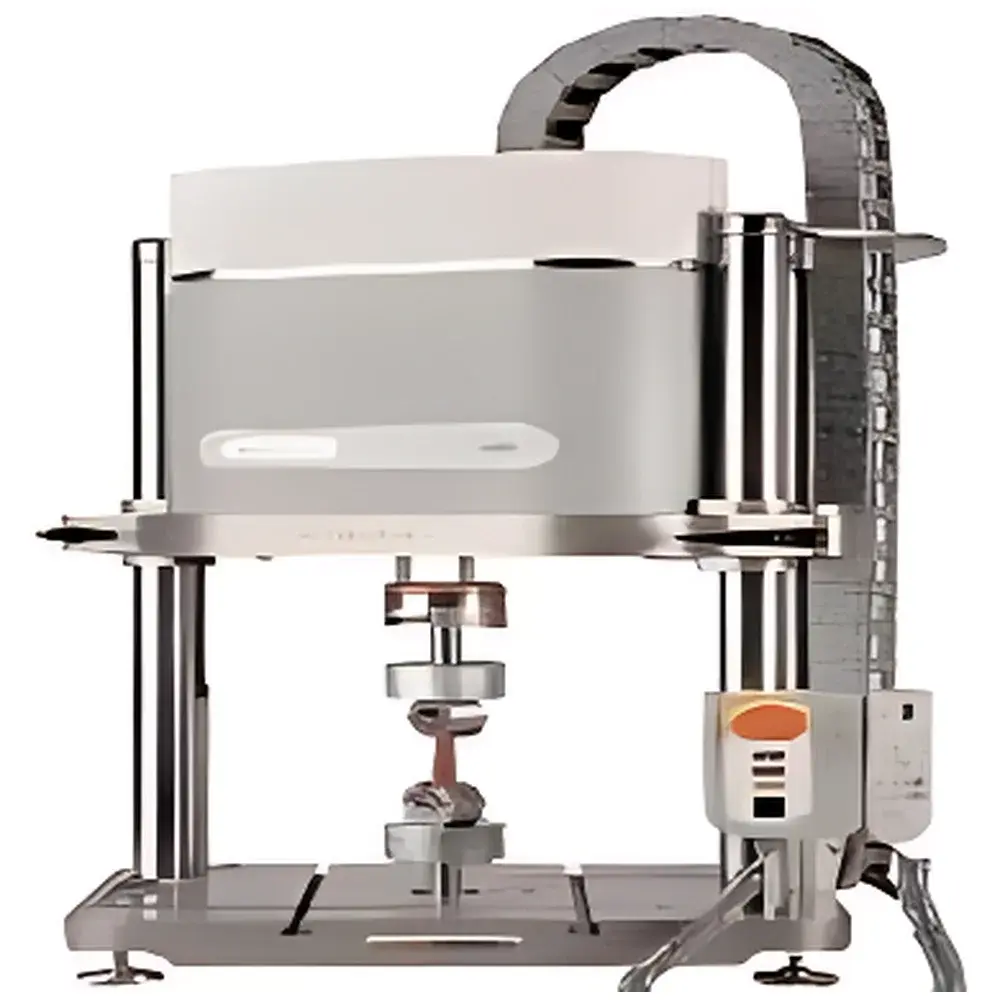
ElectroPuls E1000/E3000 Electrodynamic Universal Testing Machine
| Origin | USA |
|---|---|
| Manufacturer Type | Authorized Distributor |
| Origin Category | Imported |
| Model | ElectroPuls E1000 / E3000 |
| Quotation | Upon Request |
Overview
The ElectroPuls E1000 and E3000 are fully electromechanical, servo-controlled electrodynamic testing systems engineered for high-fidelity static, quasi-static, and dynamic mechanical characterization of materials and components. Unlike traditional hydraulic or pneumatic testing machines, these instruments utilize linear motor actuation technology—eliminating the need for hydraulic fluid, compressed air, cooling water, or dedicated utility infrastructure. The core measurement principle relies on closed-loop force and displacement control governed by real-time digital signal processing (DSP) architecture. Force is measured via Instron’s patented Dynacell dynamic load cell, which integrates piezoelectric sensing with active inertial compensation to maintain accuracy across frequencies from DC to 100 Hz (E1000) or 75 Hz (E3000), while displacement is tracked with coaxial optical encoders and redundant LVDT feedback for traceable, high-resolution positional control. Designed for ISO 17025-compliant laboratories and R&D environments requiring GLP/GMP-aligned audit trails, the system supports full traceability of test parameters, calibration history, and raw data acquisition in accordance with ASTM E4, E8, E9, E21, and ISO 6892-1 standards.
Key Features
- Fully electronic actuation: Linear motor-driven crosshead eliminates oil contamination, maintenance downtime, and facility dependency—ideal for cleanrooms, corrosion-prone environments, and multi-user labs.
- Auto-tuning PID control: Instron’s proprietary algorithm automatically calculates optimal control gains based solely on specimen stiffness—no manual tuning required, reducing setup time and operator dependency.
- Dynacell dynamic load cell: Integrated inertial compensation reduces fixture-induced phase lag and resonance artifacts, ensuring ±0.5% full-scale accuracy over the entire dynamic frequency range.
- High lateral stiffness actuator bearing system: Maintains axial alignment under off-center loading conditions—critical for asymmetric specimens, composites, and biomedical implants.
- Corrosion-resistant T-slot test table: Constructed from electropolished stainless steel (AISI 316), rated for continuous exposure to saline mist, acidic vapors, and electrolyte solutions per ASTM B117.
- Dual-mode control interface: Full PC-based operation via Bluehill Universal software or standalone hardware panel for rapid sine, triangle, or step waveform execution without host computer dependency.
- Modular orientation: Supports both vertical and horizontal configurations using standardized mounting interfaces—enabling fatigue testing of long beams, torsional fixtures, or environmental chamber integration.
Sample Compatibility & Compliance
The ElectroPuls accommodates tensile, compression, flexure, and low-cycle fatigue testing of metals, polymers, elastomers, composites, adhesives, and biomaterials. Specimen geometries range from miniature coupons (≥2 mm gauge length) to structural subassemblies (up to 855 mm maximum test space). All models comply with ISO/IEC 17025:2017 requirements for measurement uncertainty estimation and support FDA 21 CFR Part 11–compliant electronic signatures, audit trails, and role-based user access when configured with Bluehill Universal v5.x or later. Calibration certificates are NIST-traceable and include as-found/as-left data per ISO 17025 Annex A.5.
Software & Data Management
Bluehill Universal software provides a validated, modular platform for test method development, real-time visualization, automated reporting (PDF/CSV/XLSX), and database archiving. Dynamic test sequences—including block loading, spectrum fatigue, and thermomechanical cycling—are programmable via intuitive drag-and-drop workflows. Raw data streams (force, displacement, strain, temperature) are recorded at up to 10 kHz sampling rate with synchronized timestamping. Data integrity safeguards include write-once archive mode, checksum validation, and encrypted backup export—meeting requirements for regulatory submissions under ICH M7 and USP .
Applications
Typical use cases include ASTM D790 flexural fatigue of polymer composites; ISO 13314 compression testing of metallic foams; USP viscoelastic characterization of hydrogels; cyclic loading of orthopedic fixation devices per ISO 14801; and creep-recovery analysis of elastomeric seals under elevated temperature. The system is widely deployed in aerospace OEM validation labs, automotive Tier-1 material certification centers, and pharmaceutical packaging QA departments conducting ISTA 3A/3E vibration durability assessments.
FAQ
What is the difference between E1000 and E3000 models in terms of dynamic force capacity?
The E1000 supports ±1000 N peak dynamic force (±710 N static), while the E3000 delivers ±3000 N dynamic force (±2100 N static), with identical 60 mm stroke and enhanced thermal management for extended high-load cycling.
Does the system require external cooling or compressed air?
No—ElectroPuls operates entirely on standard 208–240 VAC power. No hydraulic oil, pneumatic lines, or chiller units are required.
Can Bluehill Universal generate 21 CFR Part 11–compliant reports?
Yes—when deployed with validated installation qualification (IQ), operational qualification (OQ), and electronic signature modules, it meets all technical and procedural requirements for regulated environments.
Is the T-slot table compatible with environmental chambers?
Yes—the table features integrated mounting holes and thermal expansion compensation, enabling seamless integration with temperature-humidity chambers (e.g., Weiss, Angelantoni) up to ±85 °C.
What is the maximum achievable test speed?
The system achieves speeds from 0.001 mm/min to 2000 mm/min—over two orders of magnitude faster than lead-screw-driven alternatives—enabling high-strain-rate tensile testing per ASTM D1642.



