
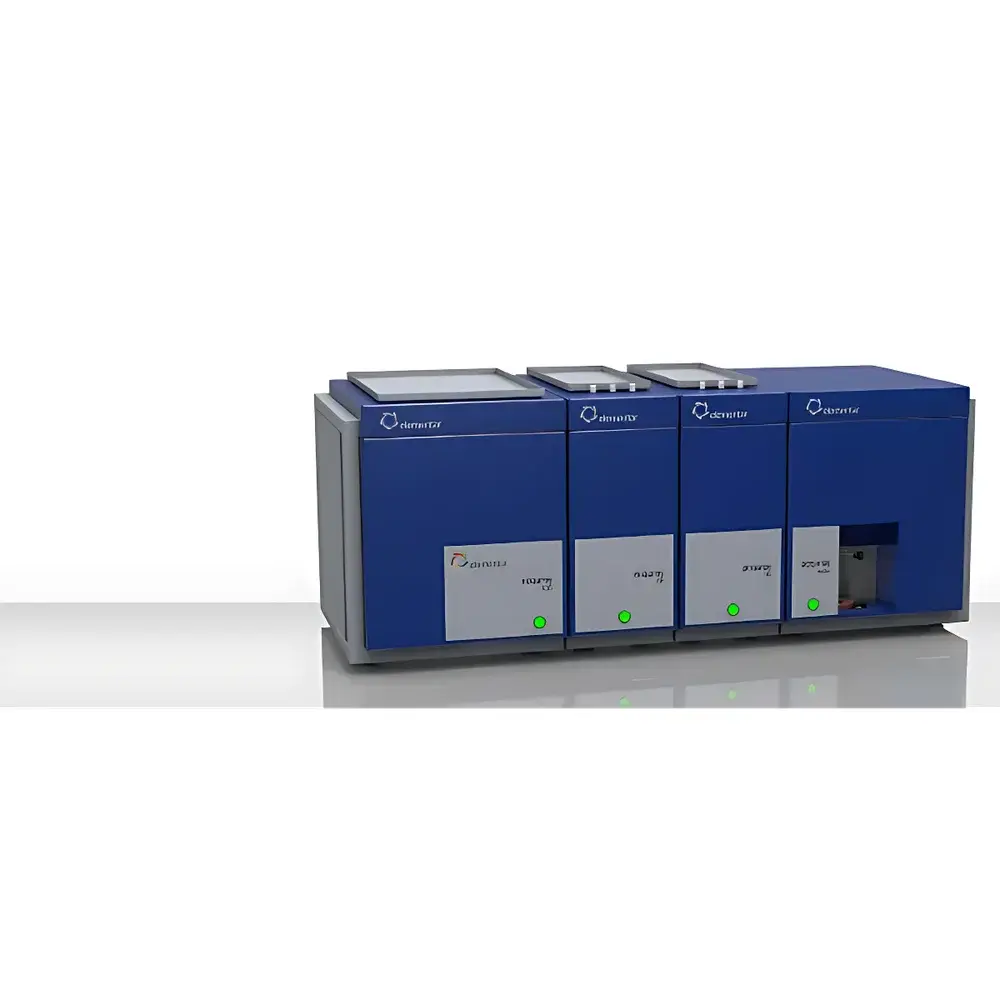
Elementar acquray TOC Total Organic Carbon Analyzer
| Brand | Elementar |
|---|---|
| Origin | Germany |
| Model | acquray TOC |
| Detection Principle | High-Energy UV-Persulfate Wet Oxidation |
| LOD (TOC in Water) | 2 ppb |
| Sample Types | Liquid (aqueous), Solid, Suspended Particulates |
| Optional Modules | Solid TOC, TN (Total Nitrogen), TP (Total Phosphorus) |
| Automation | Optional Autosampler (up to 109 positions) |
| Compliance | Designed for ISO 8245, ASTM D5903, USP <643>, EPA Method 415.3 & 9060A |
| Calibration | Fully Automated Predefined Calibration Sequences |
| Maintenance | Predictive Alert System with Access-Optimized Component Layout |
Overview
The Elementar acquray TOC Analyzer is a high-performance, modular benchtop instrument engineered for precise and reliable quantification of total organic carbon (TOC) in liquid, solid, and heterogeneous environmental and industrial samples. It employs high-energy ultraviolet (UV) radiation combined with persulfate-mediated wet chemical oxidation—a robust, widely validated method that ensures complete mineralization of refractory and non-volatile organic compounds into CO₂. This principle delivers superior oxidation efficiency (>99% for most organics) across diverse matrices, including wastewater, drinking water, pharmaceutical process streams, soil extracts, and digested sludge. Unlike combustion-based TOC analyzers, the acquray’s low-temperature oxidative approach eliminates risk of catalyst poisoning, minimizes NOₓ interference, and avoids thermal decomposition artifacts—making it especially suitable for routine compliance monitoring where reproducibility and regulatory traceability are critical.
Key Features
- Modular architecture supporting field-upgradable expansion to solid-sample TOC, total nitrogen (TN), and total phosphorus (TP) analysis—enabling multi-parameter environmental profiling from a single platform.
- Ultra-low detection limit of 2 ppb TOC in aqueous samples, achieved through high-sensitivity NDIR (non-dispersive infrared) CO₂ detection and optimized gas separation kinetics.
- Fully automated calibration routines with built-in standard verification checks; pre-programmed sequences reduce operator dependency and ensure consistent method adherence.
- Predictive maintenance alerts integrated into the instrument firmware—monitors reagent consumption, UV lamp intensity decay, and flow-path integrity to schedule interventions before performance drift occurs.
- Human-centered mechanical design: all serviceable components—including oxidant reservoirs, CO₂ scrubbers, and UV reactor cells—are front-accessible and tool-free replaceable, minimizing mean time to repair (MTTR).
- Optional high-capacity autosampler accommodating up to 109 vials, compatible with standard 40-mL and 10-mL EPA-compliant sample containers, and programmable for unattended overnight operation under GLP conditions.
Sample Compatibility & Compliance
The acquray TOC Analyzer accepts liquid samples directly via syringe injection or autosampler aspiration, and solid samples (soils, sediments, filters, biomass) following acid-purge pretreatment and slurry homogenization. Its oxidation chemistry meets the performance criteria specified in ISO 8245:1999 (Water quality — Determination of total organic carbon), ASTM D5903-18 (Standard Test Method for Total Organic Carbon in Water by High-Temperature Catalytic Combustion and Infrared Detection), and USP Chapter <643> (Total Organic Carbon). For regulated environments, the system supports 21 CFR Part 11-compliant audit trails when paired with Elementar’s certified LIMS-integrated software suite. Data integrity safeguards include electronic signatures, user role-based access control, and immutable raw signal logging.
Software & Data Management
Instrument control, method development, and data evaluation are managed through Elementar’s proprietary acquray Control Software—a Windows-based application compliant with IEC 62304 Class B medical device software standards. The interface provides real-time reaction monitoring (oxidation curve visualization), automatic peak integration with baseline correction algorithms, and customizable reporting templates aligned with EPA, ISO, and pharmaceutical QA/QC requirements. All analytical sessions generate timestamped, digitally signed PDF reports containing metadata (reagent lot numbers, lamp hours, calibration history), ensuring full traceability. Raw data files (ASCII .csv and binary .acq formats) are exportable for third-party statistical analysis or integration into enterprise LIMS platforms via OPC UA or HL7 interfaces.
Applications
- Environmental laboratories performing routine TOC monitoring in surface water, groundwater, effluent, and reclaimed water per EPA Method 415.3 and ISO 8245.
- Pharmaceutical manufacturing sites conducting purified water (PW) and water-for-injection (WFI) qualification per USP <643> and EU Annex 1.
- Research institutions studying carbon sequestration dynamics in soils and sediments using solid-phase TOC quantification protocols.
- Power generation facilities monitoring condensate purity and cycle chemistry integrity in steam-water systems.
- Academic and contract labs requiring flexible multi-analyte capability (TOC/TN/TP) without cross-platform method validation overhead.
FAQ
What oxidation method does the acquray TOC use, and why is it preferred for regulatory applications?
It uses high-energy UV/persulfate wet oxidation, which provides complete, reproducible mineralization without combustion artifacts—meeting ISO, ASTM, and USP requirements for method equivalence and robustness.
Can the same instrument measure both TOC and TN in one run?
No—TOC and TN require separate oxidation and detection chemistries, but the modular design allows rapid hardware reconfiguration between modes with minimal downtime.
Is the 2 ppb LOD achievable in all water matrices?
Yes, under clean matrix conditions (e.g., deionized water, PW); for complex matrices (e.g., wastewater), method detection limits may increase slightly due to background interference—requiring matrix-matched calibration per EPA guidance.
How is data integrity ensured during unattended operation?
All runs are logged with digital signatures, real-time checksum validation, and tamper-evident audit trails synchronized to system clock and NIST-traceable time servers.
Does the acquray support solid sample analysis out-of-the-box?
Solid TOC functionality requires the optional Solid Module add-on, including acid purge unit, sample introduction carousel, and dedicated digestion protocol library.



