
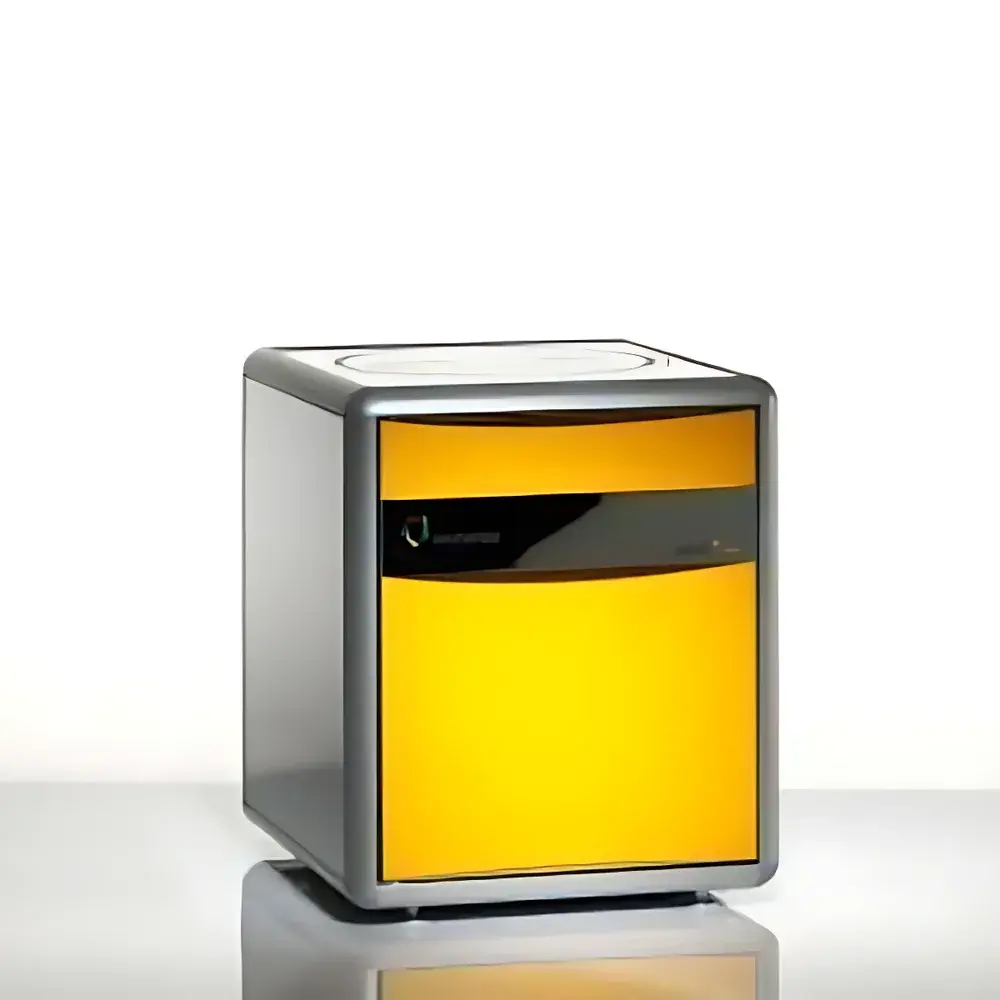
Elementar rapid CS cube Infrared Carbon-Sulfur Analyzer
| Brand | Elementar |
|---|---|
| Origin | Germany |
| Model | rapid CS cube |
| Detection Principle | High-Temperature Combustion + Non-Dispersive Infrared (NDIR) Detection |
| Sample Throughput | Up to 60 samples unattended (standard), optional 80/120-position autosamplers |
| LOD (S in coal) | ≤2 ppm |
| Warranty | 10 years on combustion furnace and thermal conductivity detector (TCD) |
| Compliance | Designed for ISO 15594, ASTM D4294, ASTM D7622, and USP <281> carbon/sulfur testing environments |
| Software | vario LINK with full audit trail, 21 CFR Part 11-compliant user management and electronic signature support |
| Optional Modules | Chlorine detection (solid-state electrochemical sensor), TOC/TIC dual-module configuration |
Overview
The Elementar rapid CS cube is a high-precision, high-throughput infrared carbon-sulfur analyzer engineered for routine and regulatory-compliant quantification of total carbon (C) and total sulfur (S) in solid and liquid matrices. It operates on the principle of high-temperature combustion (up to 1350 °C) in an oxygen-rich environment, followed by selective gas-phase detection using dual-channel non-dispersive infrared (NDIR) cells—optimized for CO₂ (carbon) and SO₂ (sulfur) absorption bands at 4.26 µm and 7.35 µm, respectively. The system integrates a proprietary zero-blank spherical valve mechanism that eliminates carryover and background contamination during sample transfer, ensuring trace-level accuracy without matrix-matched calibration standards. Designed specifically for energy, metallurgical, and environmental laboratories, the rapid CS cube delivers robust performance across heterogeneous sample types—from coal and coke to biomass, soils, rubber, and pharmaceutical excipients—while maintaining full compliance with international method standards including ISO 15594 (solid fuels), ASTM D4294 (oil-based matrices), and USP <281> (pharmaceutical elemental impurities).
Key Features
- Standard 60-position integrated autosampler enabling fully unattended overnight operation with real-time status monitoring and dynamic re-loading capability
- Patented zero-blank spherical valve system ensuring quantitative sample transfer and eliminating memory effects between analyses
- 10-year warranty on both the high-stability combustion furnace and the thermally compensated thermal conductivity detector (TCD) used for auxiliary gas analysis
- Modular architecture supporting optional chlorine detection via solid-state electrochemical sensor—no microcoulometric titration required, minimal maintenance, 15-minute analysis for coke
- TOC/TIC dual-module configuration available: direct acidification-compatible solid-sample TOC determination; TIC added via acid sparging module; TC–TIC difference yields certified TOC values per ISO 8245 and EPA Method 415.1
- Wide dynamic range: 0.005–100 wt% C/S across diverse matrices, validated with NIST SRM and CRM reference materials
Sample Compatibility & Compliance
The rapid CS cube accepts solid samples ranging from 1 mg (high-purity chemicals, catalysts) to 400 mg (coal, coke), as well as liquids (e.g., oils, digested sludge extracts) via ceramic boat or quartz crucible loading. All samples are encapsulated in pure tin foil prior to combustion—a critical step that prevents ash deposition, minimizes furnace contamination, and suppresses halogen interference. The instrument meets GLP/GMP data integrity requirements through vario LINK software, which provides full 21 CFR Part 11 compliance—including role-based access control, electronic signatures, immutable audit trails, and automatic backup of raw chromatograms, calibration logs, and QC reports. Routine operation adheres to ISO/IEC 17025 quality system documentation protocols and supports external validation per ASTM D7622 (coal and coke) and DIN 51725 (petroleum products).
Software & Data Management
vario LINK is the native acquisition and evaluation platform, built on a Windows-based client-server architecture with SQL database backend. It enables method-driven workflows, automated calibration verification (including drift correction via internal reference gases), and statistical process control (SPC) charting for long-term precision monitoring. All analytical sequences—including autosampler positioning, combustion parameters, gas flow profiles, and detector integration times—are fully scriptable and exportable in .csv or .xlsx format. Raw NDIR absorbance signals are stored with timestamped metadata, supporting retrospective reprocessing and third-party data review. Instrument diagnostics—including furnace temperature stability, carrier gas purity, and detector baseline noise—are continuously logged and trigger configurable alerts upon deviation thresholds.
Applications
- Coal and coke quality control: rapid determination of total sulfur for compliance with emission regulations (e.g., EU Industrial Emissions Directive)
- Biomass fuel certification: carbon content assessment for energy content calculation and sustainability reporting (EN 14918)
- Environmental soil testing: total organic carbon (TOC) and inorganic carbon (TIC) partitioning in contaminated site characterization
- Pharmaceutical raw material screening: sulfur residue quantification in APIs per ICH Q3D guidelines
- Rubber and polymer manufacturing: sulfur cross-linking content verification and chlorine impurity screening in elastomers
- Metallurgical feedstock analysis: carbon specification in ferroalloys and graphite electrodes
FAQ
What sample preparation is required for coal analysis?
Minimal preparation: air-dried, homogenized coal is weighed directly into tin capsules and sealed. No acid digestion or fusion is needed.
Can the rapid CS cube analyze liquid samples without derivatization?
Yes—liquids such as lubricating oils or aqueous digests can be introduced via quartz boats or micro-crucibles; no pre-concentration or solvent removal is necessary.
Is chlorine detection truly maintenance-free?
The solid-state electrochemical chlorine sensor requires no electrolyte refills, pump maintenance, or electrode polishing—only periodic zero-point verification with inert gas.
How does the instrument ensure accuracy without matrix-matched standards?
Through patented combustion efficiency optimization, dynamic oxygen dosing, and multi-point linearization using universal calibration curves verified across >20 certified reference materials.
What level of IT infrastructure is required for 21 CFR Part 11 compliance?
A domain-joined Windows Server environment with Group Policy enforcement, time-synchronized NTP server, and encrypted SQL database storage—fully documented in the System Validation Package provided by Elementar.
Related Products






