
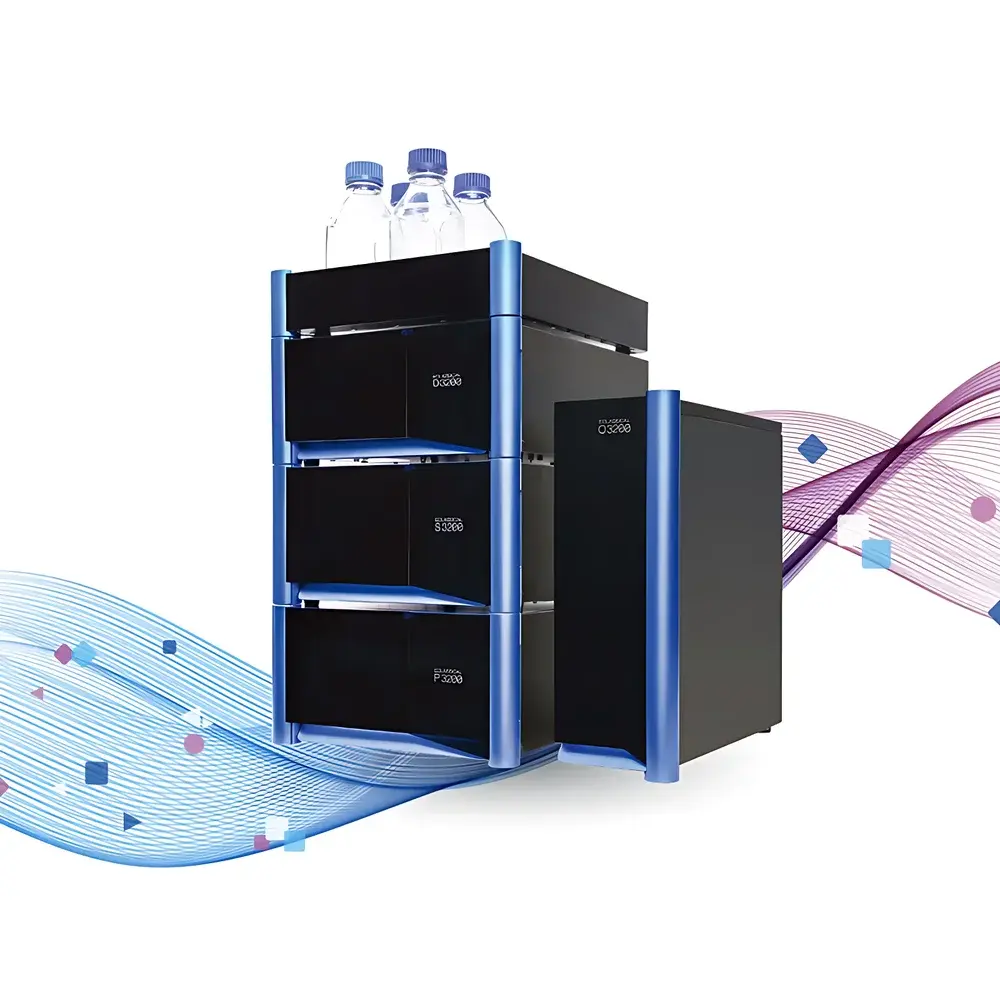
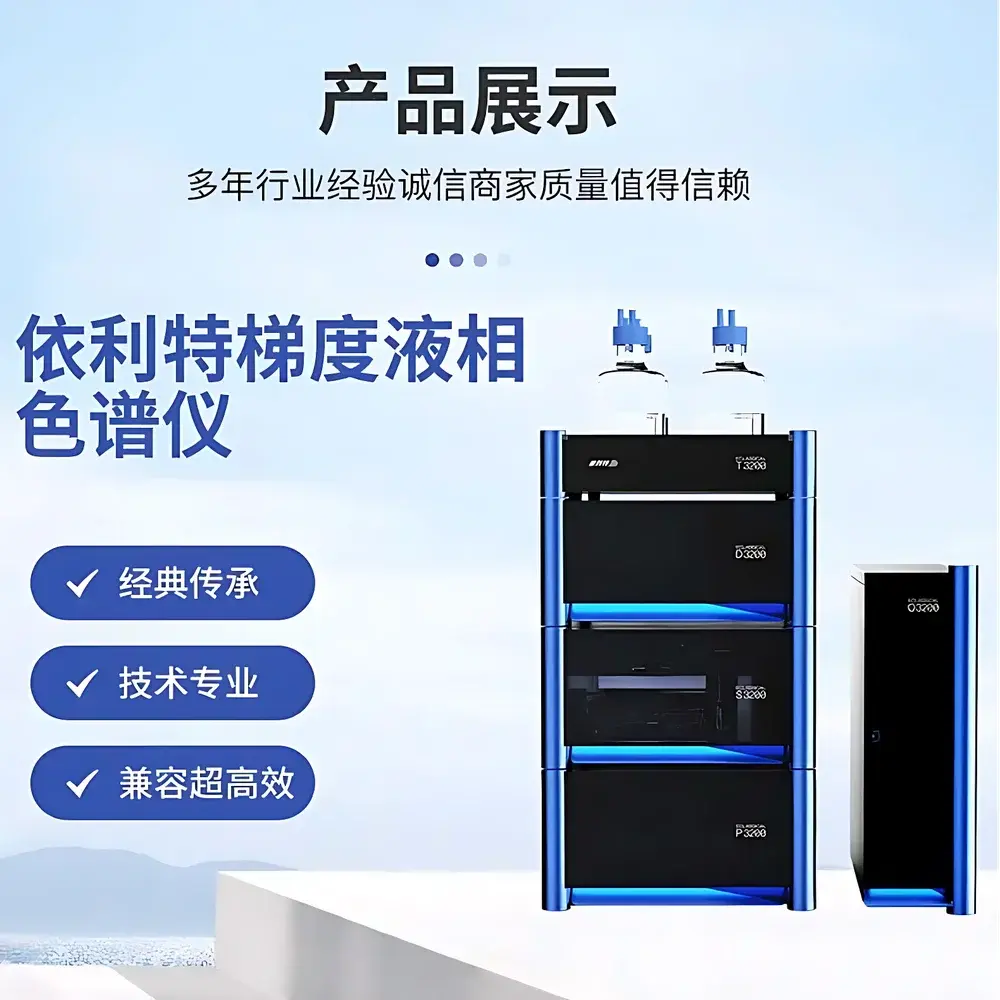
Elite 3200 Gradient High-Performance Liquid Chromatograph
| Brand | Elite |
|---|---|
| Origin | Jiangsu, China |
| Manufacturer Type | Direct Manufacturer |
| Product Category | Domestic HPLC System |
| Model | 3200 Gradient HPLC |
| Instrument Type | Conventional High-Performance Liquid Chromatograph |
| Application Scope | General-Purpose Analytical HPLC |
| Flow Rate Range | 0.001–10.000 mL/min |
| Maximum Operating Pressure | 90 MPa |
| Column Oven Temperature Range | 4–85 °C |
| UV-Vis Detector Wavelength Range | 190–800 nm |
Overview
The Elite 3200 Gradient High-Performance Liquid Chromatograph is an engineered analytical platform designed for robust, reproducible separation of complex mixtures in research, quality control, and routine laboratory environments. Built upon proven high-pressure liquid chromatography (HPLC) principles—including isocratic and gradient elution modes—the system employs dual high-precision piston pumps with active solvent selection and low-dead-volume flow paths to deliver exceptional gradient accuracy and minimal dwell volume (< 700 µL typical). Its modular architecture supports scalable configurations for method development, stability-indicating assays, impurity profiling, and regulatory-compliant testing. The system operates under ISO/IEC 17025-aligned design principles and conforms to key chromatographic performance criteria defined in USP , EP 2.2.46, and ASTM D7932, ensuring traceable retention time precision, peak symmetry, and baseline stability across extended run sequences.
Key Features
- High-stability binary gradient pumping system with real-time flow compensation and pulse-dampening technology—achieving flow accuracy ±0.1% RSD and pulsation < 0.1% at 1 mL/min.
- Low-dwell-volume fluidic path (< 700 µL) minimizes gradient delay and improves method transfer fidelity between instruments and laboratories.
- Integrated solvent selection valve and online degassing module enable automated mobile phase switching and continuous vacuum degassing—reducing bubble formation and baseline drift during long-gradient runs.
- Column oven with Peltier-based temperature control (4–85 °C, ±0.1 °C stability) ensures precise retention time reproducibility and method robustness across ambient fluctuations.
- UV-Vis detector featuring a 1024-element diode array and tungsten-halogen/deuterium dual-lamp source delivers full-spectrum acquisition (190–800 nm) with 1 nm wavelength resolution and < 0.001 AU/hr baseline noise.
- Modular expansion capability: compatible with optional autosamplers (up to 120-position trays), fluorescence detectors, conductivity detectors, and preparative-scale fraction collectors.
Sample Compatibility & Compliance
The Elite 3200 accommodates standard 2.1–4.6 mm ID analytical columns packed with C18, phenyl-hexyl, HILIC, or ion-exchange phases, supporting reversed-phase, normal-phase, ion chromatography, and size-exclusion applications. It meets essential requirements for GLP and GMP environments: audit trail functionality (with user-level access controls), electronic signature support per FDA 21 CFR Part 11, and instrument qualification documentation (IQ/OQ/PQ templates available upon request). All firmware and control logic are validated against IEC 62304 software lifecycle standards. System compliance with CE marking (2014/30/EU EMC Directive and 2014/35/EU LVD) and RoHS 2011/65/EU is certified by independent third-party testing.
Software & Data Management
Controlled via EliteChrom™ 3.0 workstation software (Windows 10/11 64-bit), the system provides intuitive method building, real-time chromatogram visualization, peak integration with customizable baselines, and automated system suitability calculations (tailing factor, resolution, plate count). Raw data files comply with ANDI/MSD format (ASTM E1947) and are exportable to CSV, PDF, and XML for LIMS integration. Audit trail records include operator ID, timestamp, parameter changes, sequence execution logs, and detector calibration events—all retained with immutable hashing for forensic review. Software validation packages (including UAT protocols and test scripts) are provided for regulated users.
Applications
- Pharmaceutical QC: assay quantitation, related substances testing, dissolution profile analysis per USP .
- Food safety: pesticide residue screening (multi-residue methods), mycotoxin detection, vitamin profiling.
- Environmental analysis: PAHs, PCBs, pharmaceuticals in wastewater per EPA Method 1694.
- Academic research: natural product isolation, polymer characterization, metabolomics sample prep validation.
- Chemical manufacturing: raw material identity verification, reaction monitoring, purity assessment per ICH Q2(R2).
FAQ
Is the Elite 3200 compliant with FDA 21 CFR Part 11 for electronic records and signatures?
Yes—the system includes configurable audit trail logging, role-based user authentication, and electronic signature workflows validated per Part 11 Annex A guidance.
What column dimensions and chemistries are supported out-of-the-box?
Standard 50–250 mm × 2.1–4.6 mm ID columns with silica-based packings (C18, C8, phenyl, amino, cyano) and polymeric phases (e.g., TSK-GEL) are fully supported; custom packing validation assistance is available.
Can the system be integrated into a laboratory information management system (LIMS)?
Yes—via standardized ODBC drivers and ASCII/CSV export protocols; HL7 and ASTM E1467 interfaces are available as optional modules.
Does the UV-Vis detector support spectral library matching?
Yes—EliteChrom™ includes built-in spectral search against NIST and USP reference libraries, with match scoring based on correlation coefficient and peak shape deviation.
What is the recommended maintenance interval for pump seals and check valves?
Under typical use (≤ 40 MPa, aqueous/organic mobile phases), pump seal replacement is advised every 6,000–8,000 operational hours; check valves every 12 months or after 5,000 injections—detailed PM schedules are included in the service manual.




