
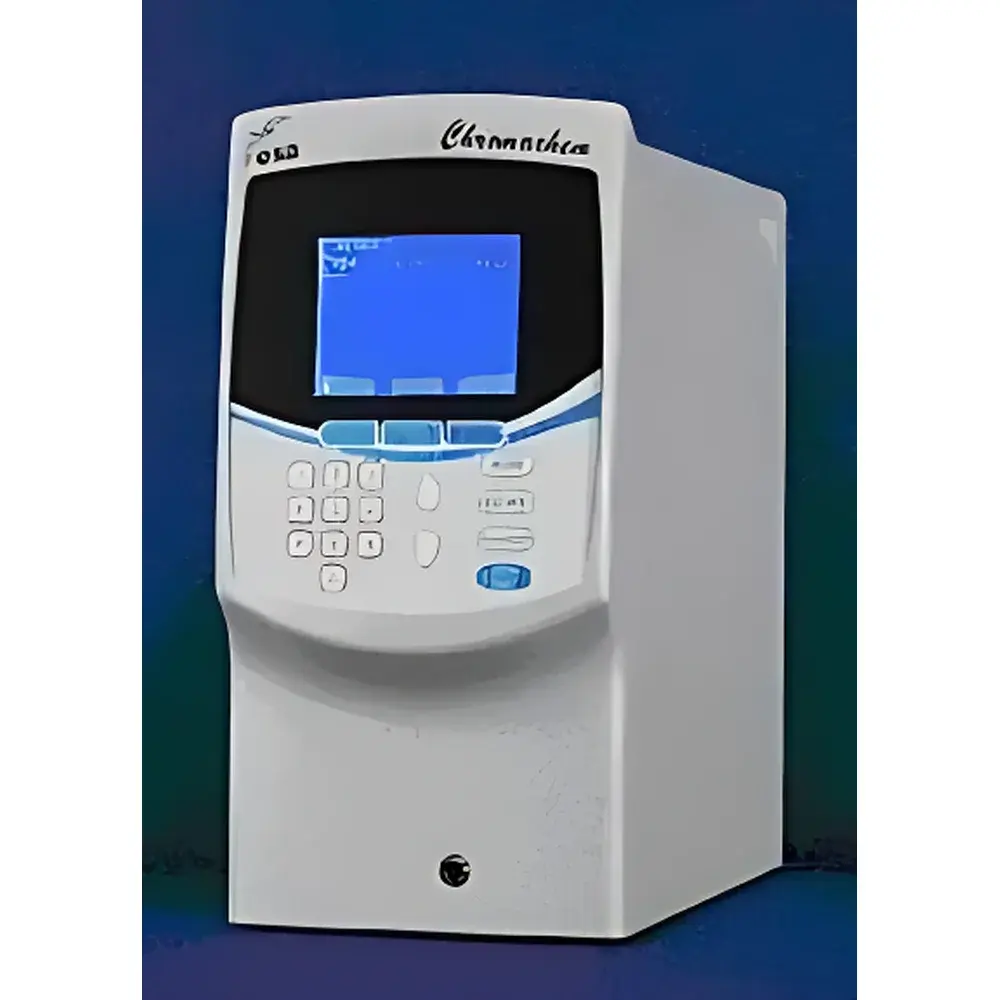
Elite Chromachem® ELSD — High-Performance Evaporative Light Scattering Detector for HPLC Systems
| Brand | Elite |
|---|---|
| Origin | USA |
| Manufacturer Type | Original Equipment Manufacturer (OEM) |
| Product Category | Imported Instrument |
| Model | Chromachem® |
| Detection Principle | Evaporative Light Scattering Detection (ELSD) |
| Compatible Systems | Liquid Chromatography (HPLC/UHPLC) |
| Light Source | High-Intensity Halogen Lamp |
| Photomultiplier Tube (PMT) | High-Sensitivity Detector |
| Evaporator Temperature Range | 20–100 °C |
| Nebulizer Temperature Range | 20–70 °C |
| Power Supply | AC 110/240 V, 50/60 Hz, 350 W |
| Dimensions (L×W×H) | 480 × 240 × 460 mm |
Overview
The Elite Chromachem® ELSD is a precision-engineered evaporative light scattering detector designed for integration with high-performance liquid chromatography (HPLC) and ultra-high-performance liquid chromatography (UHPLC) systems. Operating on the fundamental principle of nebulization, solvent evaporation, and light scattering detection, the Chromachem® ELSD enables universal, non-destructive quantification of analytes lacking chromophores or UV absorbance—such as lipids, phospholipids, triglycerides, carbohydrates, and synthetic polymers. Unlike UV-Vis or refractive index (RI) detectors, ELSD response is largely independent of molecular structure and exhibits near-uniform mass sensitivity across diverse compound classes. This makes it especially valuable in pharmaceutical development, natural product analysis, and quality control workflows where gradient elution compatibility, low baseline drift, and robust signal reproducibility are critical.
Key Features
- Universal detection capability for non-chromophoric and semi-volatile compounds, including glycerides, polysaccharides, surfactants, and macromolecules
- Optimized dual-zone thermal control: independently adjustable evaporator (20–100 °C) and nebulizer (20–70 °C) temperatures to maximize desolvation efficiency and minimize analyte degradation
- High-intensity halogen lamp coupled with a low-noise, high-gain photomultiplier tube (PMT) for enhanced signal-to-noise ratio and sub-nanogram detection limits under optimized conditions
- Gradient-compatible operation with minimal baseline fluctuation—enabling reliable quantitation in complex mobile phase gradients containing volatile organic solvents (e.g., acetonitrile, methanol)
- Rugged, modular architecture with front-accessible nebulizer and drain ports for rapid maintenance and reduced system downtime
- Compliant with standard HPLC flow rate ranges (0.2–5.0 mL/min), supporting both analytical and preparative-scale separations
Sample Compatibility & Compliance
The Chromachem® ELSD is validated for use with a broad spectrum of sample matrices, including crude plant extracts, lipid fractions, polymer solutions, and formulation excipients. It supports compliance with method validation requirements outlined in ICH Q2(R2), USP , and FDA guidance for bioanalytical method validation. When deployed in regulated environments, the instrument’s stable analog output and optional digital interface (RS-232 or USB) facilitate integration into LIMS and chromatography data systems (CDS) that support 21 CFR Part 11-compliant audit trails, electronic signatures, and secure data archiving. All internal wetted surfaces are chemically resistant to common HPLC solvents, ensuring long-term reliability and minimizing carryover risk.
Software & Data Management
The Chromachem® ELSD operates as a standalone analog detector or integrates seamlessly with third-party CDS platforms—including Thermo Chromeleon®, Waters Empower®, Agilent OpenLab CDS, and Shimadzu LabSolutions—via standardized voltage output (0–1 V or 0–10 V) or optional digital protocols. No proprietary acquisition software is required; raw signal output is fully compatible with peak integration, calibration curve generation, and statistical reporting modules within validated CDS environments. For laboratories implementing GLP or GMP workflows, the detector supports configurable signal filtering, real-time baseline correction, and export of time-stamped analog traces in CSV or ASCII formats for traceable data review and reprocessing.
Applications
- Quantitative analysis of lipids and phospholipids in pharmaceutical formulations and nutraceuticals
- Detection of carbohydrate-based active ingredients and impurities in herbal medicines and biologics
- Method development for polymer molecular weight distribution assessment without derivatization
- Stability-indicating assays for non-UV-absorbing degradation products in forced degradation studies
- Residual solvent and excipient profiling in generic drug product characterization
- QC release testing of heparin, hyaluronic acid, and other glycosaminoglycans per pharmacopeial monographs
FAQ
What types of compounds can the Chromachem® ELSD detect?
It detects non-volatile and semi-volatile analytes that form stable particles upon solvent evaporation—including lipids, carbohydrates, polymers, surfactants, and natural product glycosides—regardless of UV absorbance.
Is the Chromachem® ELSD compatible with gradient HPLC methods?
Yes. Its design minimizes baseline noise during solvent composition changes, making it suitable for reversed-phase and HILIC gradients using volatile mobile phases.
Does it require calibration with reference standards for each analyte?
Yes. ELSD response is non-linear and compound-dependent; quantitative analysis requires analyte-specific calibration curves generated from pure standards.
Can it be used with UHPLC systems operating above 1000 bar?
Yes, provided the flow cell and nebulizer are rated for high-pressure operation; the standard Chromachem® ELSD supports inlet pressures up to 600 bar when configured with appropriate fittings and restrictors.
How often does the nebulizer require cleaning or replacement?
Under typical usage with filtered mobile phases and samples, routine nebulizer inspection is recommended every 200–300 injections; cleaning intervals depend on sample cleanliness and solvent purity.





