
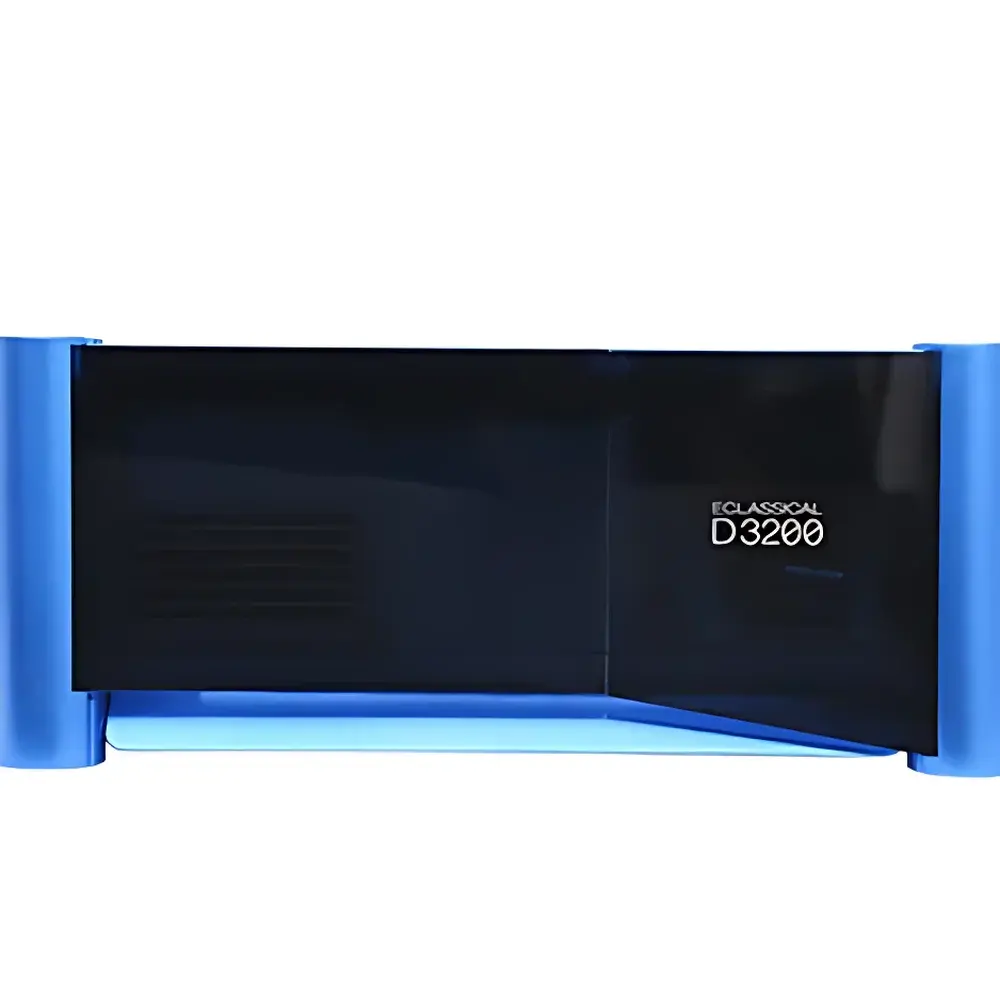
Elite D3200 Series UV-Vis Detector
| Brand | Elite |
|---|---|
| Origin | Liaoning, China |
| Manufacturer Type | Original Equipment Manufacturer (OEM) |
| Product Category | Domestic |
| Model | D3200 |
| Price Range | USD 7,000–14,000 (FOB) |
| Compatible Instrument | HPLC Systems |
| Detector Type | Ultraviolet-Visible (UV-Vis) Detector |
| Wavelength Range | 235–254 nm |
| Detection Method | Dual-Beam Optical Path |
| Light Sources | Deuterium Lamp & Tungsten-Halogen Lamp |
Overview
The Elite D3200 Series UV-Vis Detector is a high-stability, dual-beam optical detection module engineered for integration with high-performance liquid chromatography (HPLC) systems. It operates on the principle of absorbance photometry, measuring analyte concentration based on Beer-Lambert law compliance at selected wavelengths within the ultraviolet and visible spectrum. Designed specifically for routine QC/QA laboratories and method-development environments, the D3200 delivers robust baseline stability and reproducible signal response under continuous operation. Its dual-beam architecture compensates for lamp intensity drift and optical path fluctuations in real time, significantly enhancing long-term measurement fidelity—particularly critical during gradient elution or extended run sequences exceeding 48 hours. The detector supports both fixed-wavelength and dual-wavelength ratio modes, enabling simultaneous monitoring of primary and reference channels to mitigate solvent front interference or column bleed artifacts.
Key Features
- Dual-light-source configuration: Deuterium lamp (for UV range below 350 nm) and tungsten-halogen lamp (for visible extension up to 800 nm), ensuring spectral continuity and optimal signal-to-noise performance across the specified operational window (235–254 nm).
- Optimized optical path design featuring automated mirror switching and dynamically adjustable slit width control—enabling real-time alignment calibration and consistent photometric accuracy without manual intervention.
- Integrated “dark array” auto-zeroing technology: A dedicated photodiode array monitors ambient dark current continuously; firmware-driven compensation eliminates thermal drift-induced baseline offset, reducing post-run re-equilibration time by up to 30%.
- Modular mechanical interface compliant with ISO 8573-1 pneumatic port standards and ANSI/MC96.1 electrical mounting dimensions—ensuring plug-and-play compatibility with major HPLC platforms including Waters, Agilent, Shimadzu, and Thermo Fisher systems.
- Front-panel LED status indicators and RS-232/USB 2.0 dual communication ports support both standalone operation and networked instrument control via third-party chromatography data systems (CDS).
Sample Compatibility & Compliance
The D3200 is validated for use with standard reversed-phase, normal-phase, and ion-exchange HPLC columns (ID 2.1–4.6 mm, length ≤250 mm) and compatible with common mobile phases including aqueous buffers (e.g., phosphate, acetate), acetonitrile, methanol, and tetrahydrofuran. All wetted parts—including flow cell quartz windows and stainless-steel capillary tubing—meet ASTM F899-22 biocompatibility requirements for low-metal-leaching applications. The detector conforms to IEC 61010-1:2010 safety standards for laboratory electrical equipment and carries CE marking per EU Directive 2014/30/EU (EMC) and 2014/35/EU (LVD). Firmware supports audit trail logging and user-access-level permissions aligned with FDA 21 CFR Part 11 Annex 11 principles for regulated environments.
Software & Data Management
The D3200 interfaces natively with Elite’s ChromaLink CDS v3.2 (Windows 10/11 64-bit), providing full remote parameter configuration, real-time chromatogram display, peak integration, and spectral overlay functions. Raw absorbance data are stored in vendor-neutral .CDF format (compatible with OpenChrom and Chromeleon 7.3+). Built-in memory retains ≥10,000 scan records with timestamped metadata (lamp hours, temperature logs, calibration history). Optional Ethernet module enables TLS 1.2-secured data streaming to LIMS via HL7 or ASTM E1384-compliant protocols. All calibration events—including wavelength verification using holmium oxide reference filter—are digitally signed and exportable as PDF reports meeting GLP documentation requirements.
Applications
- Pharmaceutical impurity profiling per USP and ICH Q2(R2) guidelines, particularly for assay validation of small-molecule APIs at 254 nm.
- Food additive quantification (e.g., benzoic acid, sorbic acid) in acidic matrices using 235 nm detection to minimize background interference.
- Environmental water analysis for nitrate/nitrite speciation via post-column derivatization with sensitivity down to 0.5 µg/L.
- Quality control of monoclonal antibody fragments where dual-wavelength ratio mode corrects for aggregation-related scattering effects.
- Academic research in natural product isolation—supporting rapid method scouting across UV-active flavonoids, alkaloids, and terpenoids.
FAQ
What is the maximum flow rate supported by the D3200 flow cell?
The standard 10-µL fused-silica flow cell accommodates flow rates from 0.1 to 5.0 mL/min with pressure tolerance up to 40 MPa.
Does the detector support wavelength scanning or only fixed-wavelength operation?
The D3200 operates exclusively in fixed-wavelength or dual-wavelength ratio mode; it does not perform full-spectrum scanning. For spectral acquisition, consider the D3230 Diode Array Detector variant.
Is lamp lifetime monitored and reported in software?
Yes—lamp operating hours are tracked autonomously and displayed in real time via ChromaLink CDS; predictive alerts trigger at 90% of rated service life (≥2,000 h for deuterium lamp, ≥5,000 h for tungsten lamp).
Can the D3200 be used in GMP-regulated manufacturing environments?
When deployed with ChromaLink CDS v3.2 configured for 21 CFR Part 11 compliance (electronic signatures, audit trails, role-based access), the system meets baseline GMP data integrity requirements for batch release testing.
What maintenance procedures are recommended for optical alignment stability?
No user-performed optical alignment is required; the automated mirror positioning system recalibrates during each power-up cycle and after every 24 h of continuous operation.






