
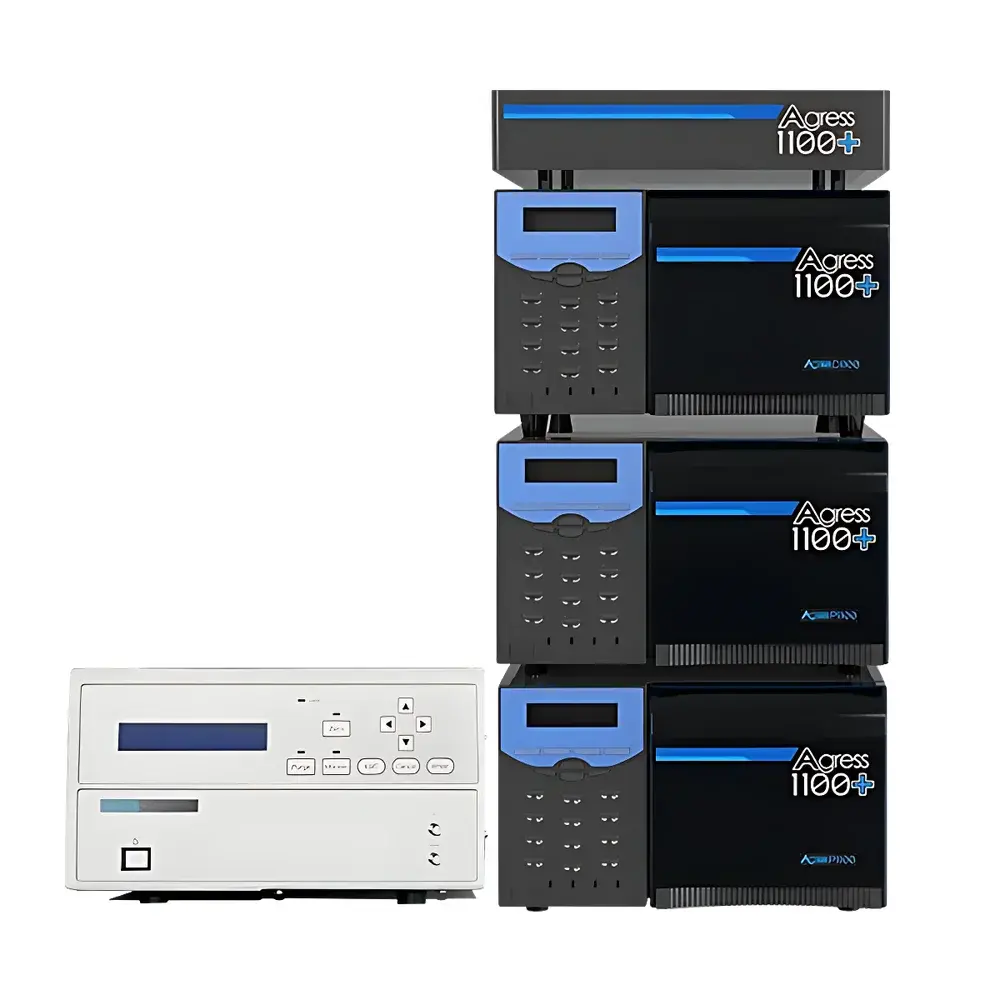
Elite GPC Gel Permeation Chromatography System
| Brand | Elite |
|---|---|
| Origin | Jiangsu, China |
| Manufacturer Type | Direct Manufacturer |
| Regional Classification | Domestic (China) |
| Model | GPC Gel Permeation Chromatography System |
| Price Range | USD 7,000 – 42,000 |
| Instrument Type | Ambient-Temperature Operation |
Overview
The Elite GPC Gel Permeation Chromatography System is a dedicated ambient-temperature liquid chromatographic platform engineered for the precise separation and molecular weight distribution (MWD) analysis of synthetic polymers, oligomers, and macromolecules soluble in organic solvents. Operating on the principle of size-exclusion chromatography (SEC), this system separates analytes based on hydrodynamic volume—larger molecules elute earlier due to exclusion from the porous network of the stationary phase, while smaller species penetrate deeper into the pores and exhibit longer retention times. Unlike high-temperature GPC systems designed for polyolefins or crystalline polymers, the Elite GPC system is optimized for routine characterization of polystyrene, poly(methyl methacrylate), polyacrylates, polyesters, and other thermolabile or low-melting synthetic polymers under stable ambient conditions. Its modular architecture supports integration with refractive index (RI), UV-Vis, or multi-angle light scattering (MALS) detectors, enabling absolute molecular weight determination when calibrated against narrow-distribution polystyrene standards.
Key Features
- Modular, rack-mounted configuration with independent solvent delivery, column oven (ambient-only), autosampler, and detector interfaces—designed for long-term operational stability and serviceability
- High-precision dual-piston reciprocating pump delivering flow rates from 0.01 to 10.00 mL/min with pulse dampening and pressure monitoring up to 400 bar
- Autosampler with 120-position vial capacity, programmable injection volumes (1–100 µL), and temperature-controlled sample tray (4–40 °C)
- Column compartment engineered for minimal thermal gradient variation; compatible with standard 300 × 7.8 mm ID analytical columns packed with cross-linked polystyrene-divinylbenzene (PS-DVB) gels
- Integrated system control and data acquisition via Ethernet-connected PC running Elite ChromaLink GPC software—supporting method development, calibration curve generation, and batch processing
- Compliance-ready architecture: audit trail logging, user access levels (admin/operator/observer), electronic signature support, and export formats aligned with ISO/IEC 17025 documentation requirements
Sample Compatibility & Compliance
The Elite GPC system is validated for use with common organic mobile phases including tetrahydrofuran (THF), chloroform, o-dichlorobenzene (ODCB), and dimethylformamide (DMF)—all handled via chemically resistant fluidic paths (PEEK, stainless steel 316L, and sapphire components). Sample matrices must be fully dissolved and filtered (≤0.45 µm) prior to injection to prevent column clogging. The system meets mechanical and electrical safety standards per GB/T 14710 (Chinese national standard for environmental adaptability of medical and laboratory equipment) and conforms to electromagnetic compatibility (EMC) Class B limits per GB 9254. While not certified to FDA 21 CFR Part 11 out-of-the-box, its software architecture supports validation protocols required for GLP-compliant polymer laboratories conducting ASTM D5296 (standard test method for molecular weight averages of polystyrene by GPC) and ISO 16014 series (plastics—determination of average molecular parameters of polymers by size-exclusion chromatography).
Software & Data Management
ChromaLink GPC software provides full instrument control, real-time chromatogram visualization, peak integration using tangent skim or inflection point algorithms, and automated calculation of Mn, Mw, Mz, dispersity (Đ = Mw/Mn), and cumulative molecular weight distribution curves. Calibration models accept linear, quadratic, or cubic fitting; users may import reference standards from external databases or generate custom calibrations. All raw data (.chd), processed results (.rpt), and method files (.mth) are stored in a structured directory hierarchy with timestamped versioning. Audit logs record operator ID, method changes, calibration updates, and report generation events—enabling traceability for internal QA reviews or regulatory inspections. Export options include CSV, PDF, and XML formats compatible with LIMS environments.
Applications
- Quality control of polymer raw materials and intermediates in chemical manufacturing
- Batch-to-batch consistency assessment of acrylic resins, epoxy prepolymers, and polyurethane dispersions
- Reaction monitoring during step-growth or chain-growth polymerization processes
- Characterization of polymer additives, compatibilizers, and branching agents
- Supporting R&D in biomedical polymers (e.g., PLGA, PCL) where thermal degradation must be avoided
- Academic research in polymer physics, including conformational analysis and solvent–polymer interaction studies
FAQ
What types of polymers can be analyzed on this GPC system?
It is suitable for organic-soluble synthetic polymers including polystyrene, PMMA, PET, PC, polyacrylonitrile, and polyether sulfones—provided they are stable in THF, chloroform, or DMF at ambient temperature.
Is column calibration included with the system?
A set of five narrow-distribution polystyrene standards (ranging from 1,000 to 10,000,000 Da) is available as an optional accessory; calibration kits are traceable to NIST SRM 1475a and certified per ISO Guide 34.
Can the system be upgraded for high-temperature operation?
No—this is a fixed ambient-temperature platform. High-temperature applications (e.g., polyolefins in ODCB at 160 °C) require a separate high-temp GPC configuration with heated columns, oven, and detector flow cells.
Does the software support 21 CFR Part 11 compliance?
The base software includes audit trail, electronic signature prompts, and role-based access controls; however, full Part 11 compliance requires site-specific validation documentation and IT infrastructure alignment, which is supported through Elite’s professional services engagement.




