
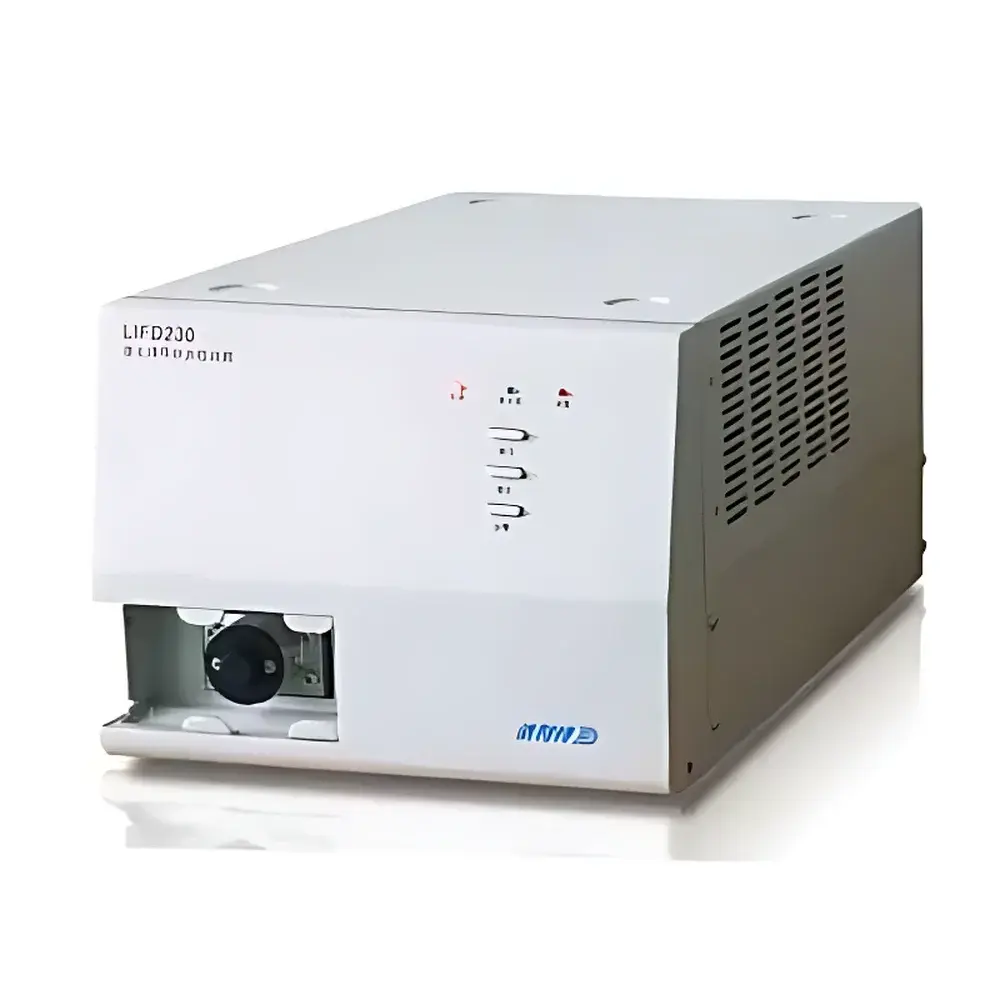
Elite LIFD230 Laser-Induced Fluorescence Detector for HPLC Systems
| Brand | Elite |
|---|---|
| Origin | Liaoning, China |
| Manufacturer Type | Direct Manufacturer |
| Regional Classification | Domestic (China) |
| Model | LIFD230 |
| Price Range | USD 7,000–14,000 (FOB) |
| Instrument Category | Conventional High-Performance Liquid Chromatography (HPLC) Detector |
| Application Scope | General-purpose analytical detection in life sciences, environmental analysis, and pharmaceutical QC/QA |
Overview
The Elite LIFD230 is a high-sensitivity laser-induced fluorescence (LIF) detector engineered for integration with high-performance liquid chromatography (HPLC), microbore LC, and capillary electrophoresis (CE) platforms. It operates on the fundamental principle of selective molecular excitation using monochromatic laser light, followed by collection and quantification of emitted fluorescent photons. The detector employs a solid-state diode laser (473 nm excitation) coupled with a confocal optical architecture to maximize signal-to-noise ratio and spatial resolution at the detection interface. This configuration enables sub-picomolar detection limits for native or derivatized fluorophores—critical for trace-level quantification in biological matrices, environmental monitoring, and nucleic acid analysis. Unlike broadband UV-Vis detectors, the LIFD230 delivers exceptional selectivity by exploiting intrinsic or induced fluorescence signatures, thereby minimizing interferences from non-fluorescent co-eluting species. Its design adheres to core engineering requirements for analytical reproducibility, thermal stability, and optical alignment retention under continuous operation in regulated laboratory environments.
Key Features
- Solid-state 473 nm diode laser source with <1% power fluctuation over 8-hour operation, ensuring stable excitation intensity and long-term baseline integrity.
- Confocal optical layout incorporating a reflective mirror within the Z-shaped flow cell to redirect off-axis fluorescence emission toward the photomultiplier tube (PMT), increasing effective photon collection efficiency by ~35% compared to conventional orthogonal designs.
- Dual-stage optical filtering: long-pass excitation blocking filter + narrow-bandpass emission filter (centered at 525 nm, 30 nm FWHM, 510–540 nm transmission window) to suppress Raman scatter, stray light, and Rayleigh background.
- Optimized flow cell geometry: Z-configured fused-silica capillary with 0.8 mm internal diameter, 6.8 mm effective optical path length, and 3.42 µL total volume—engineered to balance sensitivity, peak dispersion, and backpressure compatibility with standard HPLC systems (≤400 bar).
- Electronic specifications: RFU output range 0–1000, baseline noise ≤0.005 RFU (RMS, 1 s bandwidth), baseline drift ≤0.5 RFU/h (25 °C ambient, stabilized power supply), analog voltage output (0–1 V) compatible with all major HPLC data systems.
Sample Compatibility & Compliance
The LIFD230 supports detection of endogenous fluorophores (e.g., tryptophan, NADH, catecholamines) and derivatized analytes (e.g., o-phthalaldehyde–amino acid adducts, fluorescamine-labeled peptides, dansyl chloride–modified amines). It is routinely deployed in applications requiring compliance with ICH Q2(R2) method validation guidelines, USP Analytical Instrument Qualification, and GLP/GMP-aligned workflows. While not intrinsically 21 CFR Part 11 compliant, the detector’s analog output and deterministic response behavior enable full audit-trail integration when paired with validated chromatography data systems (CDS) supporting electronic signatures and secure user access controls. All optical components meet ISO 10110 surface quality standards; electrical design conforms to IEC 61010-1 safety requirements for laboratory equipment.
Software & Data Management
The LIFD230 operates as a plug-and-play analog detector—no proprietary software or drivers required. It outputs calibrated RFU signals directly to third-party CDS platforms (e.g., Waters Empower, Thermo Chromeleon, Agilent OpenLab). For standalone characterization, optional calibration utilities (provided via secure download portal) support wavelength verification using NIST-traceable fluorescent reference standards (e.g., quinine sulfate in 0.05 M H2SO4). Raw signal logs are timestamped and exportable in CSV format for post-acquisition processing in MATLAB, Python (NumPy/Pandas), or R environments. Firmware updates—delivered annually—include optical alignment diagnostics, PMT gain stabilization routines, and extended linearity validation reports.
Applications
- DNA sequencing via capillary gel electrophoresis–LIF coupling, meeting performance benchmarks established during the Human Genome Project for base-calling fidelity and read-length consistency.
- Quantification of neurotransmitters (dopamine, serotonin, epinephrine) in cerebrospinal fluid and plasma at low-femtomole levels—supporting neuropharmacokinetic studies per FDA guidance for bioanalytical method validation.
- Monitoring polycyclic aromatic hydrocarbons (PAHs) and heterocyclic amines in wastewater effluents per EPA Method 8310 and ISO 13877 protocols.
- Residual protein A and host-cell protein (HCP) analysis in monoclonal antibody purification streams, where LIF detection of dansylated impurities achieves 10× lower LOD than ELISA-based alternatives.
- Single-cell metabolite profiling using nanoflow HPLC–LIF, leveraging the detector’s low dead-volume flow cell and high temporal resolution (data acquisition ≥50 Hz).
FAQ
Is the LIFD230 compatible with UHPLC systems operating above 600 bar?
No—the Z-cell’s mechanical design and sealing architecture are rated for maximum system pressures of 400 bar. For UHPLC integration, a pressure-resistant flow cell adapter kit (P/N LIFD230-UHPLC-KIT) must be installed.
Can the excitation wavelength be modified to 532 nm or 635 nm?
Not without hardware modification. The LIFD230 is factory-optimized for 473 nm excitation; alternate wavelengths require replacement of the laser module, dichroic mirror, and emission filter set—available only as custom-engineered configurations.
Does the detector support real-time spectral deconvolution?
No—it is a fixed-wavelength, single-channel intensity detector. Spectral resolution requires coupling with an imaging spectrometer or tunable filter wheel, which are outside the standard product scope.
What maintenance intervals are recommended for the PMT and laser diode?
PMT gain calibration is advised every 6 months; laser diode output power verification should occur quarterly. Full optical alignment verification is required after any physical relocation or impact event.
Is CE–LIF system integration supported out of the box?
Yes—the detector includes a CE-compatible high-voltage isolation interface and adjustable trigger delay settings for synchronization with electrophoretic injection timing.
Related Products






