
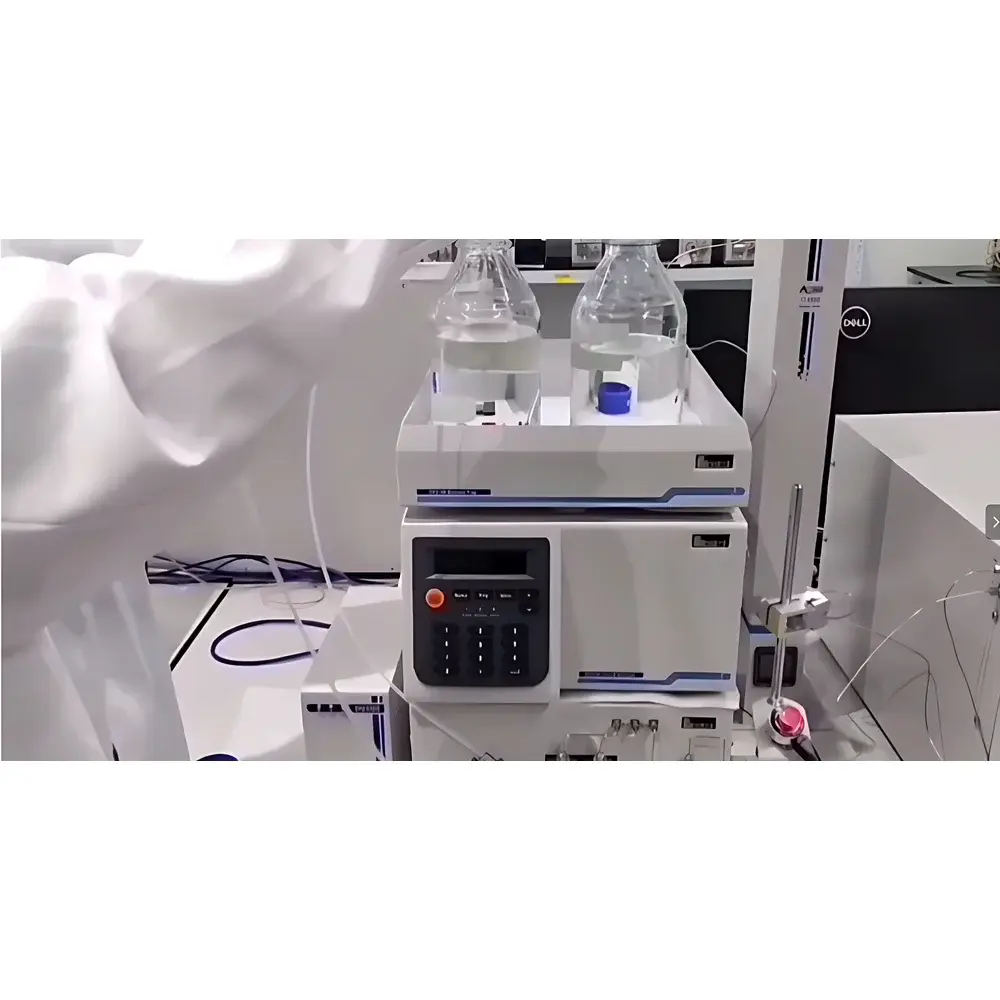
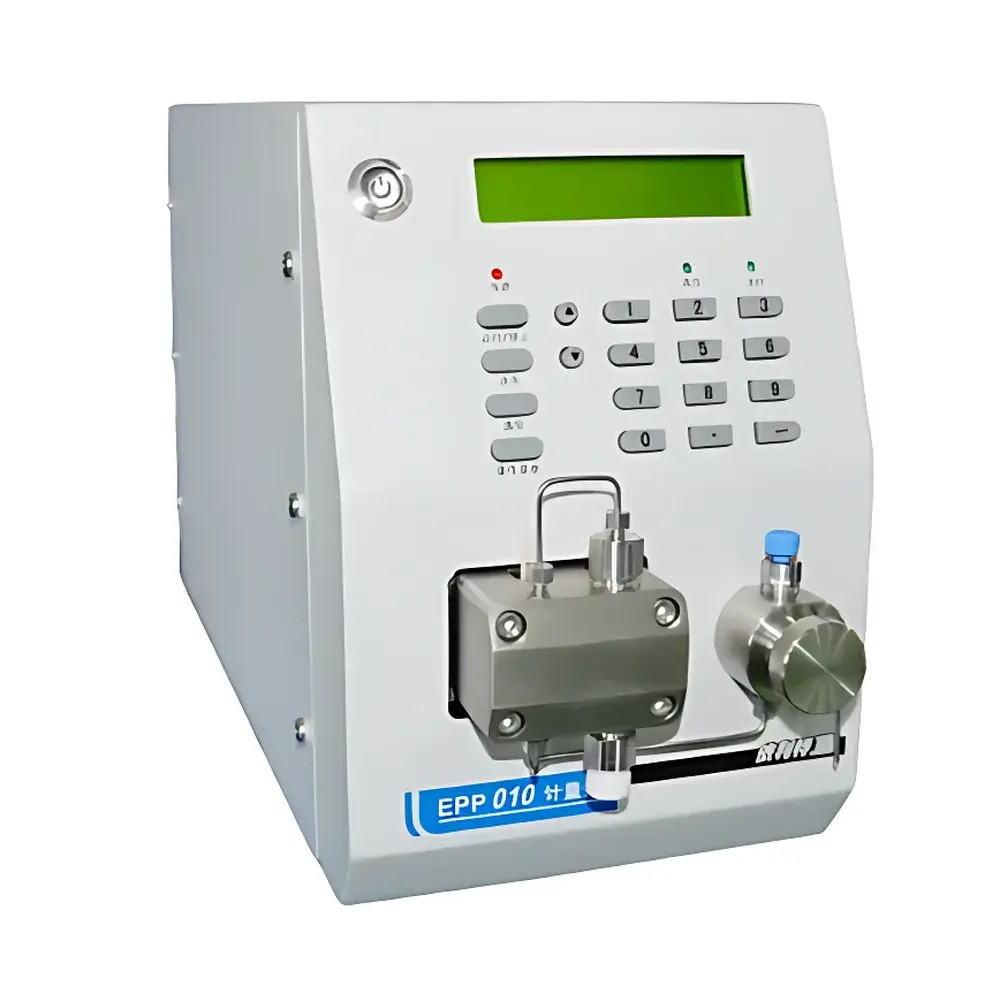
Elite Metro EPP Series High-Pressure Liquid Chromatography Pump
| Brand | Elite |
|---|---|
| Origin | Liaoning, China |
| Manufacturer Type | Manufacturer |
| Origin Category | Domestic |
| Model | Metro EPP |
| Instrument Type | Isocratic Pump |
| Max. Operating Pressure | ≤45 MPa |
| Flow Rate Range | 0.001–10.000 mL/min |
| Flow Accuracy | ±0.2% |
| Flow Precision (RSD) | ≤0.075% |
| Flow Path Materials | 316L Stainless Steel / Titanium / PEEK / Fluoropolymer |
| Control Interface | Dual-mode (PC + Front Panel) |
| Power Supply | AC 220 V ±10%, 50 Hz |
| Power Consumption | 80 W |
| Dimensions (L×W×H) | 400 × 155 × 235 mm |
| Weight | 10 kg |
Overview
The Elite Metro EPP Series is a family of precision-engineered isocratic high-pressure liquid chromatography (HPLC) pumps designed for demanding analytical and preparative applications requiring stable, reproducible solvent delivery under elevated backpressure. Based on positive displacement piston technology with dual-syringe or parallel-piston architecture, the Metro EPP series delivers continuous, pulse-dampened flow through precise motor-driven actuation and real-time pressure feedback control. Its modular flow path design supports interchangeable wetted materials—including 316L stainless steel, titanium alloy, PEEK, and fluoropolymer—enabling compatibility across aggressive organic solvents, corrosive inorganic media, and biologically sensitive samples. Engineered for integration into HPLC, UHPLC, SFC, and custom fluidic systems, the Metro EPP series meets fundamental requirements for method transferability, long-term baseline stability, and regulatory traceability in GLP- and GMP-aligned environments.
Key Features
- High-precision flow delivery with accuracy of ±0.2% and repeatability (RSD) ≤0.075% at 0.001–10.000 mL/min range (EPP010 variant)
- Maximum operating pressure up to 45 MPa (6500 psi), suitable for sub-2 µm particle column operation and high-viscosity mobile phases
- Modular wetted-material options: 316L stainless steel (optimized for general organic solvents), titanium (enhanced resistance to halides and reducing acids), PEEK (biocompatible, low metal leaching), and fluoropolymer (full chemical inertness to strong oxidizers, HF, and concentrated mineral acids)
- Dual-control architecture supporting both front-panel manual operation and PC-based remote control via RS-232 or USB interface
- Low-pressure pulsation design (≤0.1 MPa) minimizing baseline noise in UV/Vis and fluorescence detection
- Integrated pressure sensor with real-time monitoring and over-pressure shutdown safeguard (configurable threshold)
- Compact footprint (400 × 155 × 235 mm) and lightweight chassis (10 kg) facilitating benchtop integration and system portability
Sample Compatibility & Compliance
The Metro EPP Series accommodates a broad spectrum of sample matrices and mobile phase chemistries without compromising integrity or performance. Titanium and fluoropolymer variants comply with ASTM F2529 (titanium biocompatibility) and ASTM D471 (fluoroelastomer resistance to fluids), while PEEK components meet USP Class VI biocompatibility standards. All models support operation within ISO/IEC 17025-accredited laboratories when paired with validated methods and documented calibration records. The pump’s firmware supports audit trail logging (user actions, parameter changes, error events), aligning with FDA 21 CFR Part 11 requirements for electronic records and signatures when used in regulated pharmaceutical QC/QA workflows. Pressure and flow calibration certificates are traceable to NIM (National Institute of Metrology, China) standards.
Software & Data Management
Elite provides dedicated pump control software compatible with Windows OS (v7–11), offering real-time graphical display of flow rate, system pressure, and operational status. The software enables method storage, sequence programming, gradient simulation (for multi-pump configurations), and export of time-stamped CSV logs for QA review. Communication protocols adhere to standard SCPI (Standard Commands for Programmable Instruments), enabling seamless integration with third-party chromatography data systems (CDS) such as Chromeleon, Empower, or OpenLab. All parameter modifications are timestamped and user-logged; configuration backups can be saved locally or to network drives for version control and audit readiness.
Applications
- HPLC and UHPLC method development and routine analysis in pharmaceutical QC labs
- Solvent delivery in catalytic reaction evaluation systems, including fixed-bed and slurry-phase microreactors
- Mobile phase supply for supercritical fluid chromatography (SFC) using CO₂–co-solvent mixtures
- Controlled reagent infusion in continuous-flow synthesis platforms
- Biopharmaceutical purification process monitoring where low-metal leaching and endotoxin-free flow paths are critical (PEEK/titanium variants)
- Corrosion-resistant pumping of acidic or halogenated streams in petrochemical R&D and environmental testing
FAQ
What flow path material is recommended for acetonitrile/water mobile phases in pharmaceutical HPLC?
316L stainless steel is the standard and optimal choice for common reversed-phase HPLC solvents, offering mechanical robustness and cost-effective longevity.
Can the Metro EPP pump be integrated into an existing HPLC system with a third-party detector?
Yes—its analog output (0–5 V or 4–20 mA) and digital interfaces (RS-232/USB) allow synchronization with most commercial detectors and data acquisition modules.
Is firmware upgrade supported remotely?
Firmware updates are delivered via secure download and installed through the Elite control software; no hardware modification is required.
Does the pump support gradient elution?
The single-channel Metro EPP is an isocratic pump; gradient capability requires pairing two or more Metro EPP units with external mixing valves or using Elite’s Metro GP series quaternary gradient system.
What maintenance intervals are recommended for long-term reliability?
Piston seal inspection every 6 months (or after 500 h of operation), purge valve cleaning quarterly, and annual calibration verification against gravimetric or volumetric standards per ISO 8655-3.
Related Products





