
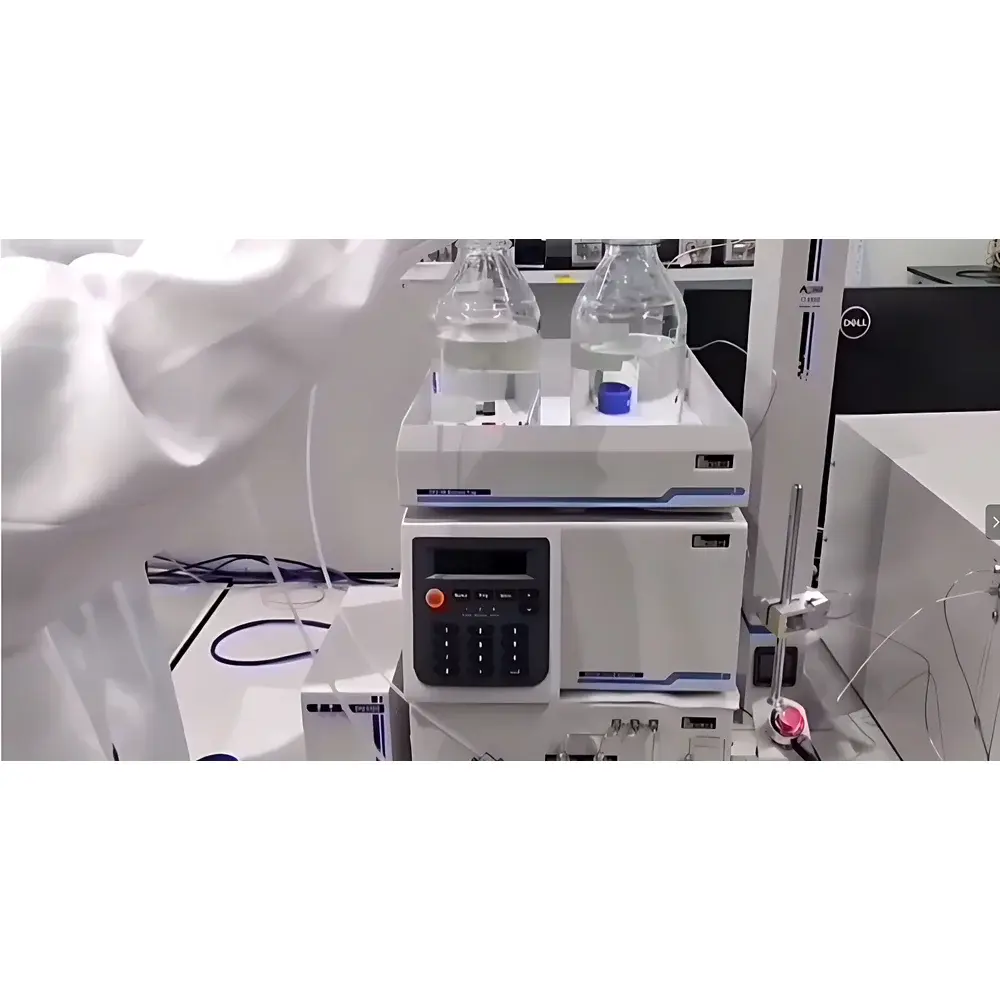
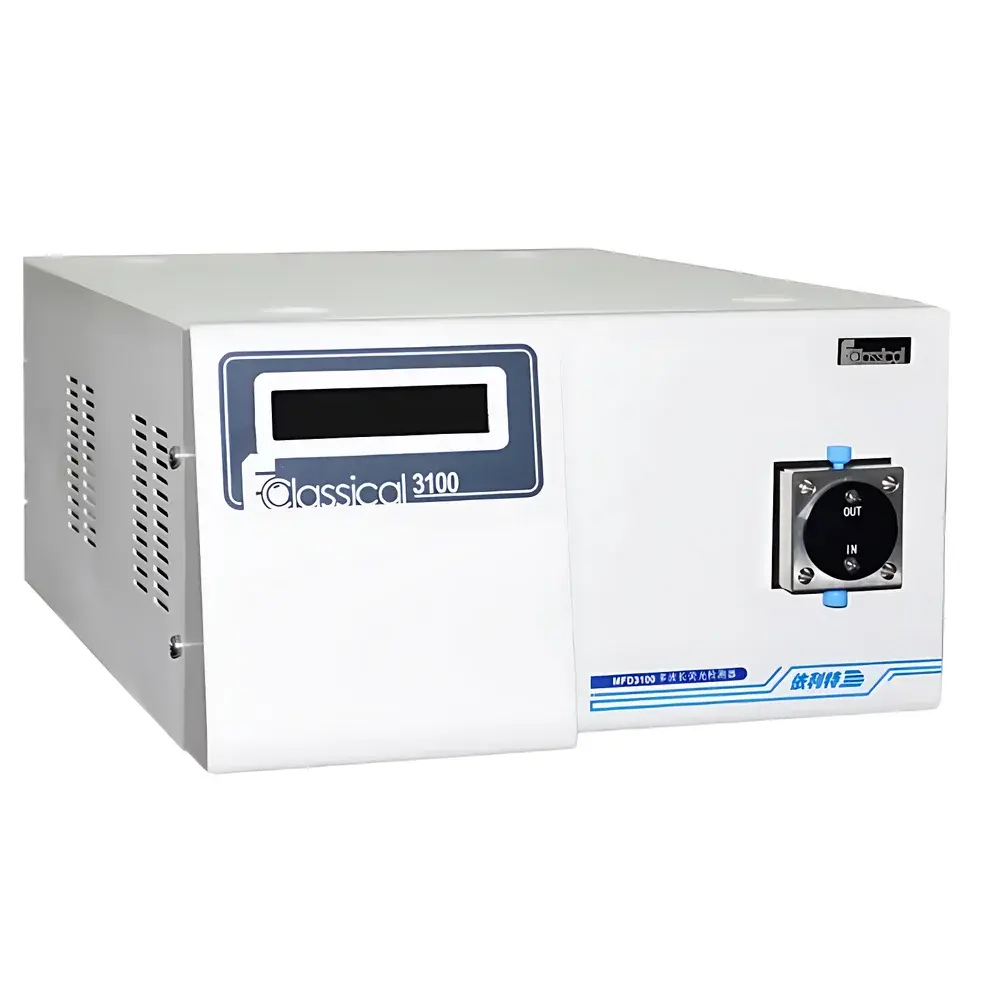
Elite MFD3100 Multi-Wavelength Fluorescence Detector
| Brand | Elite |
|---|---|
| Origin | Liaoning, China |
| Manufacturer Type | Manufacturer |
| Product Origin | Domestic |
| Model | MFD3100 |
| Price Range | USD 7,000–14,000 (FOB) |
| Compatible Instrument | HPLC Systems |
| Detector Type | Fluorescence Detector (FD) |
| Excitation Wavelength Ranges | 324–350 nm |
| Detection Method | Confocal Optical Path System |
| Light Source | Triple High-Stability LED Array with Motorized Auto-Switching Mechanism |
Overview
The Elite MFD3100 Multi-Wavelength Fluorescence Detector is a purpose-built, high-performance fluorescence detection module engineered for integration with high-performance liquid chromatography (HPLC) systems. Designed on the principle of synchronous excitation-emission fluorescence detection under confocal optical geometry, the MFD3100 delivers enhanced signal-to-noise ratio and improved photometric stability by minimizing stray light and optimizing optical coupling efficiency. Its core architecture centers on a precision-engineered triple-LED excitation source system, each diode calibrated to emit within narrow, thermally stabilized spectral bands—324–350 nm (UV-A), 360–370 nm (near-UV), and 382–392 nm (violet-visible)—enabling selective excitation of analytes with distinct fluorophore absorption profiles. Unlike conventional xenon-lamp-based detectors, the MFD3100 eliminates warm-up drift, spectral degradation, and lamp replacement cycles, offering long-term photometric reproducibility essential for regulated environments.
Key Features
- Triple independently controlled, thermally stabilized LED sources with motorized auto-switching mechanism—ensuring sub-millisecond wavelength transition and repeatable optical alignment without manual recalibration.
- Confocal optical path design featuring fixed-focus emission optics and optimized dichroic filtering, reducing background scatter and improving detection limit for low-abundance fluorescent compounds.
- Integrated self-diagnostic firmware with automated power-on system check: validates photodiode response linearity, LED driver voltage stability, analog-to-digital converter (ADC) offset/gain calibration, and thermal sensor functionality prior to operation.
- Five-level sensitivity adjustment combined with three-stage programmable gain amplification—enabling dynamic range optimization across trace-level (e.g., aflatoxin B₁ at sub-pg injection levels) and high-concentration applications without detector saturation.
- Onboard automatic optical axis alignment routine: uses reference photodiode feedback to dynamically adjust LED collimation and emission filter positioning, maintaining ±0.3 nm wavelength accuracy and <0.5% RSD in peak area reproducibility over 72-hour continuous operation.
- Modular LED cartridge interface: supports field-replaceable and customer-specified LED modules (e.g., 280 nm for tryptophan, 450 nm for riboflavin), facilitating method transfer across diverse analyte classes without hardware modification.
Sample Compatibility & Compliance
The MFD3100 is validated for quantitative analysis of native and derivatized fluorescent compounds in complex matrices including food extracts, herbal decoctions, environmental water/sediment digests, and pharmaceutical formulations. It meets instrumental performance criteria outlined in USP , EP 2.2.42, and ChP 2020 Volume IV for fluorescence detection in HPLC-based mycotoxin assays. The detector’s digital control architecture supports audit trail generation, electronic signature capability, and user-access-level configuration management—aligning with FDA 21 CFR Part 11 requirements when deployed within validated LIMS or CDS platforms (e.g., Empower, Chromeleon). All firmware and calibration records are timestamped and non-erasable, supporting GLP/GMP laboratory compliance workflows.
Software & Data Management
The MFD3100 communicates via standard RS-232/USB-C serial protocol and emulates industry-standard detector command sets (e.g., Agilent G1321B, Waters 2475), ensuring seamless integration with third-party chromatography data systems. Its embedded firmware includes real-time baseline correction algorithms, peak deconvolution filters for overlapping fluorophore signals, and built-in calibration curve interpolation using quadratic regression per ICH Q2(R2) guidelines. Raw intensity data (mV vs. time) and processed peak tables are exportable in CSV and .CDF formats. Remote firmware updates and diagnostic log retrieval are supported through secure HTTPS-based device management portal.
Applications
- Food Safety: Quantitative determination of aflatoxin B₁/B₂/G₁/G₂ and ochratoxin A in cereals, nuts, spices, and edible oils per GB 5009.22–2016 and AOAC 2005.08.
- Pharmaceutical Quality Control: Compendial testing of fungal toxins in traditional Chinese medicinal materials (ChP 2020, Section 2351), including Polygonum multiflorum, Aspergillus-fermented products, and crude herb powders.
- Environmental Monitoring: Detection of polycyclic aromatic hydrocarbons (PAHs), particularly benzo[a]pyrene, in soil leachates and drinking water following EPA Method 8310 and ISO 17993.
- Grain & Feed Testing: Routine surveillance in national grain quality monitoring networks, supporting implementation of the National Grain Quality Safety Inspection and Monitoring System (NAGQIMS) for multi-mycotoxin screening workflows.
FAQ
Does the MFD3100 support post-column derivatization interfaces?
Yes—the detector features a dedicated 1/16″ stainless-steel inlet port compatible with standard PEEK tubing and reactor coils; it has been verified with o-phthalaldehyde (OPA) and iodine-based derivatization systems for amino acid and ergosterol analysis.
Can the excitation wavelengths be customized beyond the three standard bands?
Yes—Elite offers OEM-configurable LED modules ranging from 254 nm to 520 nm; custom configurations require factory calibration and firmware revision, typically delivered within 4 weeks of order confirmation.
Is the MFD3100 compliant with 21 CFR Part 11 for electronic records?
The detector itself does not store analytical data; however, its communication protocol and status logging fully support Part 11-compliant CDS environments when paired with appropriate audit trail and e-signature functionality in the host software.
What maintenance intervals are recommended for long-term reliability?
No consumables or scheduled lamp replacements are required; annual verification of LED output intensity and wavelength accuracy using NIST-traceable fluorescent standards (e.g., quinine sulfate in 0.05 M H₂SO₄) is recommended per ISO/IEC 17025 internal quality procedures.
How is temperature stability managed in the optical chamber?
A closed-loop Peltier-cooled optical bench maintains detector housing at 25.0 ± 0.3 °C during operation, mitigating thermal lensing effects and ensuring consistent quantum yield measurement across ambient temperatures from 15–30 °C.





