
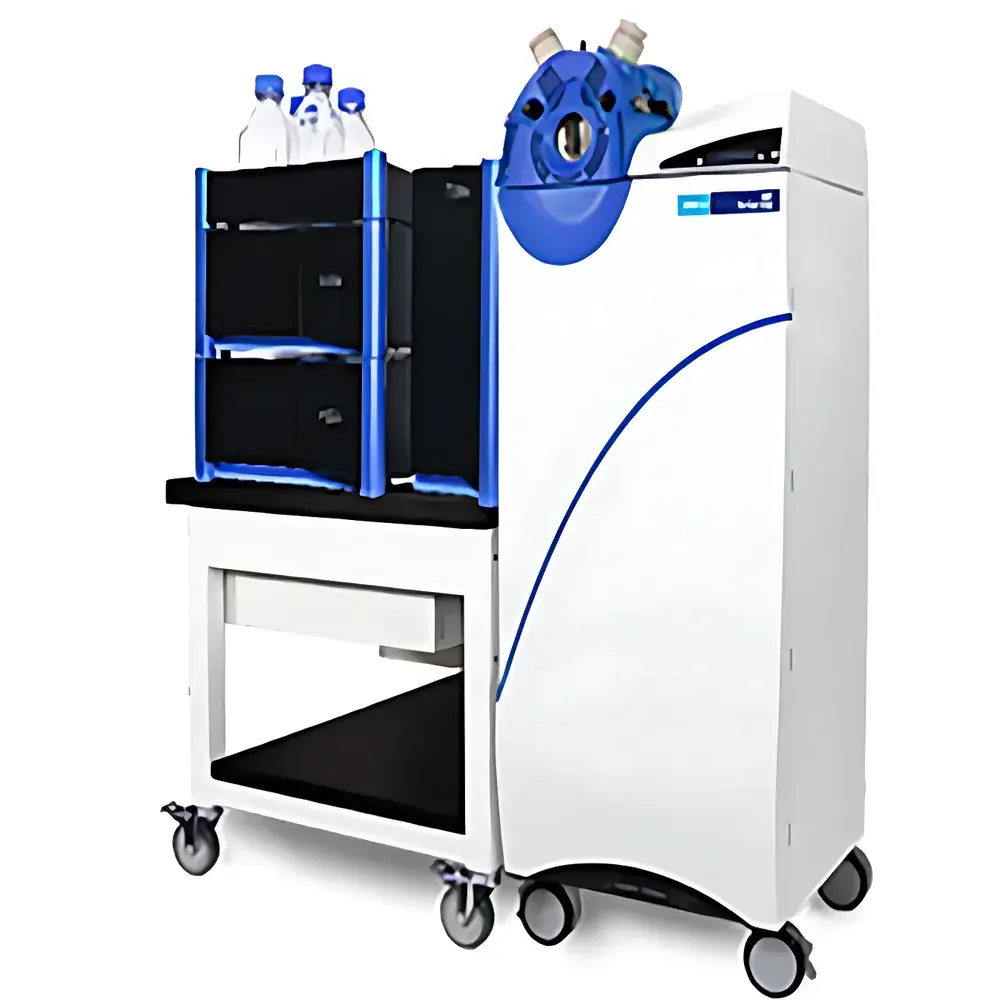
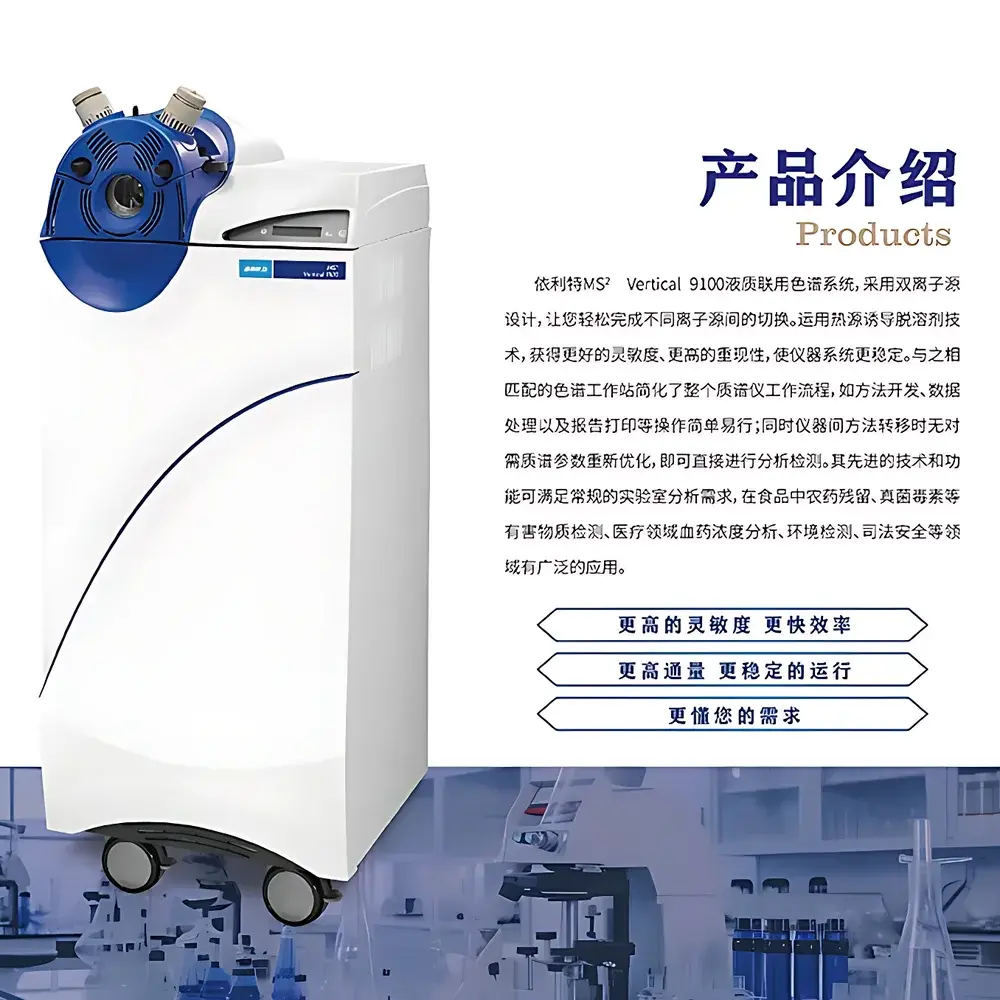
Elite MS2 Vertical 9100 Triple Quadrupole Liquid Chromatography Mass Spectrometer (LC-MS/MS)
| Brand | Elite |
|---|---|
| Origin | Jiangsu, China |
| Manufacturer Type | Original Equipment Manufacturer (OEM) |
| Instrument Type | Triple Quadrupole |
| Mass Range | m/z 5–1500 |
| Sensitivity (ESI+) | ≥ 500,000:1 (S/N, 100 fg injected on-column, reserpine) |
| Maximum System Pressure | 130 MPa |
| Ionization Sources | Dual ESI/APCI Interchangeable Source |
| Software Platform | EliteChrom LC-MS Workstation |
Overview
The Elite MS2 Vertical 9100 is a high-performance triple quadrupole liquid chromatography tandem mass spectrometer engineered for robust quantitative and qualitative analysis in regulated and research laboratory environments. It operates on the principle of electrospray ionization (ESI) and atmospheric pressure chemical ionization (APCI), coupled with collision-induced dissociation (CID) in the second quadrupole (q2) and mass-selective detection in the third quadrupole (q3). The instrument integrates a vertically oriented ion optics architecture—optimized to minimize ion transmission loss and enhance duty cycle efficiency—alongside a thermally assisted desolvation interface that improves ion yield and signal stability across diverse analyte classes. Designed as a universal LC-MS/MS platform, the MS2 Vertical 9100 delivers consistent performance for small-molecule quantification, metabolite identification, and targeted multi-residue screening without requiring hardware reconfiguration between analytical modes.
Key Features
- Dual-source capability: Integrated, motorized ESI/APCI ion source module enables rapid, software-controlled switching (<60 s) without venting the vacuum system or manual recalibration.
- Vertical ion path design: Reduces ion scattering and improves transmission efficiency from source to detector, particularly for low-abundance ions in complex matrices.
- Thermally assisted desolvation (TAD) interface: Precisely controlled heated capillary and counter-current gas flow enhance desolvation efficiency, yielding higher signal-to-noise ratios and improved inter-day reproducibility (RSD < 8% for 100 fg reserpine over 72 h).
- Triple quadrupole mass analyzer: q1 and q3 operate in unit mass resolution (0.4–0.7 Da full width at half maximum); q2 functions as a pressurized RF-only collision cell with adjustable CID energy (0–50 eV) and inert gas (Ar or N₂) control.
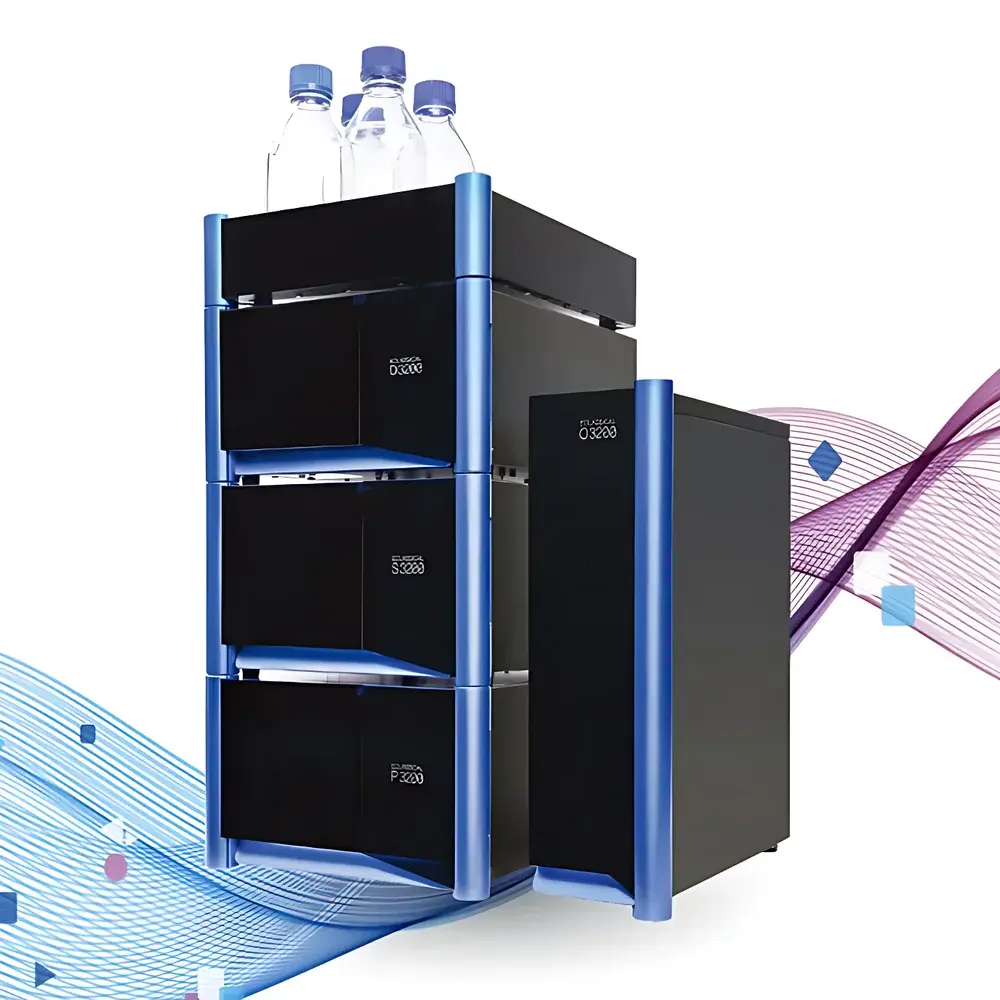
- High-pressure LC compatibility: Fully supports ultra-high-performance liquid chromatography (UHPLC) systems up to 130 MPa (1300 bar), enabling sub-2 µm particle column operation and reduced analysis time without compromising peak capacity.
- Modular vacuum architecture: Dual-stage turbomolecular pumping system (70 L/s + 300 L/s) maintains stable operating pressure (<5 × 10⁻⁶ mbar in analyzer region) during extended batch runs and gradient elution.
Sample Compatibility & Compliance
The MS2 Vertical 9100 accommodates a broad range of sample types—including aqueous extracts, organic solvent dilutions, plasma deproteinized supernatants, tissue homogenates, and environmental water filtrates—without modification to source geometry or gas flow parameters. Its ion source design supports direct infusion, microflow, nanoflow, and standard-flow LC coupling (10–1000 µL/min). The system complies with key regulatory requirements for analytical laboratories: data integrity features align with FDA 21 CFR Part 11 (audit trail, electronic signatures, user access controls); method validation workflows support ICH Q2(R2) and ISO/IEC 17025:2017 documentation standards; and instrument qualification protocols are compatible with GLP and GMP environments. Routine performance verification includes daily tuning with polytyrosine or caffeine solutions per ASTM E2917-22 guidelines.
Software & Data Management
The EliteChrom LC-MS Workstation provides an integrated environment for instrument control, acquisition method development, quantitative processing (MRM, SIM, precursor ion scan), spectral library searching, and report generation. All acquisition and processing methods are stored as encrypted XML files with embedded metadata (operator ID, timestamp, instrument configuration hash). Method transfer between MS2 Vertical 9100 units is fully supported via cross-instrument calibration mapping—no re-optimization of dwell times, collision energies, or declustering potentials is required when migrating validated assays. Raw data files adhere to open mzML 1.1.0 format, ensuring long-term archival compatibility and third-party software interoperability (e.g., Skyline, Compound Discoverer, OpenMS). Audit trails record all parameter changes, file exports, and report modifications with ISO 8601 timestamps and user authentication logs.
Applications
The MS2 Vertical 9100 is routinely deployed in food safety laboratories for multi-analyte quantification of pesticide residues (e.g., organophosphates, neonicotinoids), mycotoxins (aflatoxins, ochratoxin A), and veterinary drug markers (tetracyclines, sulfonamides) at sub-ppb levels in cereals, fruits, and dairy products. In clinical toxicology and therapeutic drug monitoring (TDM), it supports high-throughput analysis of immunosuppressants (tacrolimus, cyclosporine), antiepileptics (lamotrigine, valproic acid), and endogenous biomarkers (vitamin D metabolites, acylcarnitines) in human serum and whole blood. Environmental labs apply the platform for trace-level detection of PFAS compounds, pharmaceuticals in wastewater, and polycyclic aromatic hydrocarbons (PAHs) in soil extracts. Forensic toxicology workflows leverage its MRM-triggered enhanced product ion (EPI) scanning for confirmatory identification in postmortem blood and hair specimens.
FAQ
Does the MS2 Vertical 9100 support scheduled MRM acquisition?
Yes—scheduled MRM mode dynamically adjusts dwell time and retention time windows based on compound elution profiles, improving sensitivity and multiplexing capacity for >500 transitions per run.
Is remote monitoring and control available?
The EliteChrom Workstation supports secure TLS-encrypted remote access via enterprise VPN or dedicated Citrix environments, with real-time status dashboards and alarm notifications for vacuum faults or source contamination.
What maintenance intervals are recommended for the ion source and detector?
Source cleaning is advised every 2–4 weeks under routine use; detector gain calibration is performed semiannually or after 500 hours of operation, using built-in reference ion signals.
Can the system be integrated with third-party HPLC platforms?
Yes—the MS2 Vertical 9100 accepts standard analog and digital trigger signals (TTL, RS-232, Ethernet) from Agilent, Waters, Shimadzu, and Thermo UHPLC systems, with full synchronization of gradient start, injection, and data acquisition.
Does Elite provide IQ/OQ/PQ documentation packages?
Comprehensive qualification kits—including installation checklists, operational test protocols, performance verification reports, and SOP templates—are supplied with each instrument and updated annually per ISO/IEC 17025 revision cycles.
Related Products







