
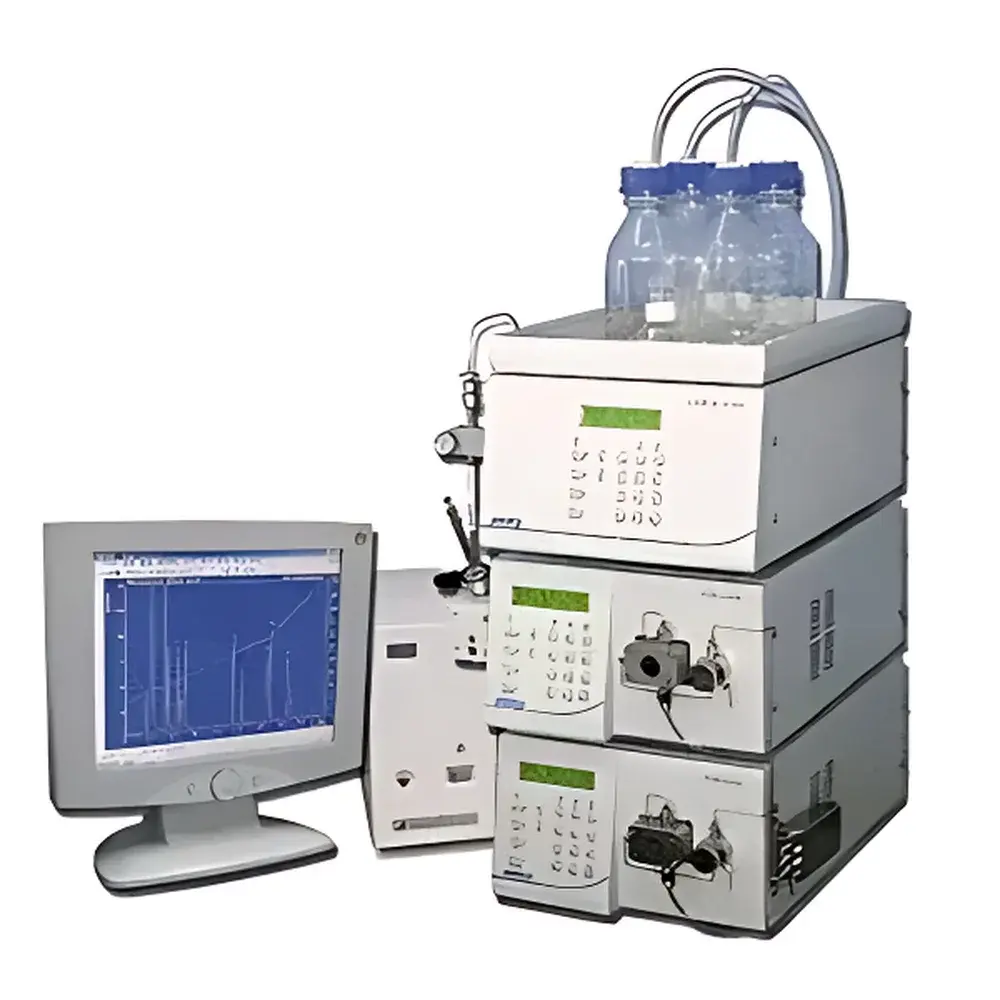
Elite P230 High-Performance Liquid Chromatograph
| Brand | Elite |
|---|---|
| Model | P230 |
| Instrument Type | Conventional HPLC System |
| Flow Rate Range | 0.001–9.999 mL/min (0.001 mL/min increments) |
| Flow Precision | RSD < 0.3% (0.001–4.999 mL/min), RSD < 0.5% (5.000–9.999 mL/min) |
| Max Operating Pressure | 40 MPa (≤4.999 mL/min), 20 MPa (>5.000 mL/min) |
| Wavelength Range | 190–400 nm (D₂ lamp), 190–720 nm (D₂ + W lamp) |
| Baseline Noise | ≤±5.0×10⁻⁵ AU (empty cell, 254 nm, 1.0 s) |
| Baseline Drift | ≤±5.0×10⁻⁴ AU/hr (empty cell, 254 nm, 60 min equilibration) |
| Detector Options | UV230 (UV-Vis), DAD230 (PDA), RI230 (RI), AS230 (autosampler), DG230 (online degasser), LU230 (low-pressure gradient mixer), EC2000 series workstations |
| Compliance | Designed for GLP/GMP environments |
| Sample Compatibility | Compatible with reversed-phase, normal-phase, ion-exchange, size-exclusion (GPC), and amino acid (AAA) chromatography configurations |
Overview
The Elite P230 High-Performance Liquid Chromatograph is an engineered solution for routine and method-development applications in pharmaceutical, environmental, food safety, and academic laboratories. Built upon a modular architecture, the system integrates a high-precision reciprocating piston pump with a solid-state UV-Vis or diode array detector to deliver reproducible separations under isocratic or gradient conditions. Its core separation principle relies on differential partitioning of analytes between a mobile phase (liquid solvent gradient or isocratic eluent) and a stationary phase (packed column), governed by physicochemical properties including polarity, charge, molecular size, and hydrophobicity. The P230 platform supports both analytical-scale and semi-preparative workflows, with pressure capabilities up to 40 MPa enabling use of sub-2 µm particle columns for enhanced resolution and throughput. All critical fluidic components—including pump heads, check valves, and flow paths—are constructed from chemically inert materials (e.g., PEEK, stainless steel, sapphire) to ensure compatibility with aggressive solvents and low-metal leaching—essential for trace-level quantitation and long-term column stability.
Key Features
- Low-pulsation binary pump architecture utilizing short-stroke plunger design driven by a cam mechanism and micro-stepping motor control, minimizing flow disturbance across the full range (0.001–9.999 mL/min)
- Real-time pressure monitoring with configurable high/low pressure alarms, automatic flow compensation against backpressure fluctuations, and three selectable pressure units (MPa, psi, bar)
- System self-diagnostics at power-on: simultaneous verification of lamp status (D₂ and W), lamp energy output, ignition count, and power supply integrity
- UV230 detector featuring fixed-wavelength and time-programmed multi-wavelength acquisition (up to five wavelengths), eliminating mechanical wavelength scanning and ensuring superior photometric reproducibility
- DAD230 option incorporating a 1024-element photodiode array for full-spectrum acquisition (190–720 nm), enabling post-run peak purity assessment, spectral library matching, and method robustness evaluation
- Modular expandability: supports dual-pump high-pressure gradient formation, low-pressure quaternary mixing (LU230), online degassing (DG230), and automated injection (AS230)
- EC2000 workstation software suite offering dedicated modules for general HPLC, GPC/SEC, and amino acid analysis—including calibration curve generation, integration algorithms compliant with USP , and audit-trail-enabled data archiving
Sample Compatibility & Compliance
The P230 system accommodates diverse sample matrices through configuration flexibility. With optional PEEK pump heads and inert flow cells (e.g., titanium or fused silica capillaries), it meets requirements for biocompatible analysis—including peptides, monoclonal antibodies, nucleotides, and other labile biomolecules. It is validated for use in Elite-AAA amino acid analysis kits and Elite-GPC gel permeation chromatography systems, supporting ASTM D5296, ISO 11348, and USP methodologies. Hardware and software are designed to align with Good Laboratory Practice (GLP) and current Good Manufacturing Practice (cGMP) expectations. When deployed with EC2000 GxP-compliant software modules—including electronic signatures, user access levels, and immutable audit trails—the system satisfies FDA 21 CFR Part 11 requirements for regulated environments.
Software & Data Management
Data acquisition, processing, and reporting are managed through the EC2000 family of chromatography data systems (CDS). Each module provides instrument control, real-time monitoring, peak detection (with customizable baselines and thresholds), quantitative analysis (external standard, internal standard, normalization), and report generation per ISO/IEC 17025 templates. Raw data files are stored in vendor-neutral formats compatible with third-party review tools. The software supports method transfer validation protocols, system suitability testing (SST) automation—including tailing factor, resolution, and theoretical plates calculations—and batch processing for high-throughput labs. All user actions, parameter changes, and instrument events are timestamped and logged with role-based permissions, facilitating regulatory inspections and internal quality audits.
Applications
The P230 serves as a foundational platform for multiple analytical disciplines: small-molecule pharmaceutical impurity profiling per ICH Q2(R2); residual solvent analysis in APIs (ICH Q3C); pesticide residue screening in agricultural commodities (AOAC 2007.01); polymer molecular weight distribution via SEC/GPC; vitamin and organic acid quantification in fortified foods (AOAC 992.16); and chiral separations using polysaccharide-based columns. Its gradient versatility and detector modularity allow seamless transition between reversed-phase C18 methods and hydrophilic interaction liquid chromatography (HILIC) for polar metabolites. In academic research, the system supports method development studies requiring precise dwell volume characterization, dwell time optimization, and retention modeling.
FAQ
What gradient configurations does the P230 support?
The system natively supports isocratic operation and binary high-pressure gradients. With the LU230 low-pressure mixer, it extends to ternary or quaternary solvent delivery for complex method development.
Is the UV230 detector capable of spectral deconvolution?
No—the UV230 is a single- or multi-wavelength absorbance detector. Spectral acquisition and deconvolution require the optional DAD230 diode array detector.
Can the P230 be integrated into a LIMS environment?
Yes—via RS232 or optional Ethernet interface, the EC2000 workstation supports ASTM E1384 and ASTM E1467-compliant data export protocols for LIMS ingestion.
What column dimensions and particle sizes are recommended for optimal performance?
Standard analytical columns (4.6 × 150 mm, 5 µm) are fully supported. For UHPLC-grade efficiency, columns with 2.7 µm or 1.8 µm particles may be used up to 40 MPa, provided system dwell volume and extra-column dispersion are minimized.
Does the system include compliance documentation for IQ/OQ/PQ validation?
Elite provides standardized qualification protocols and test scripts aligned with ASTM E2500 and EU Annex 11. Full validation packages—including equipment specifications, calibration certificates, and installation records—are available upon request.




