
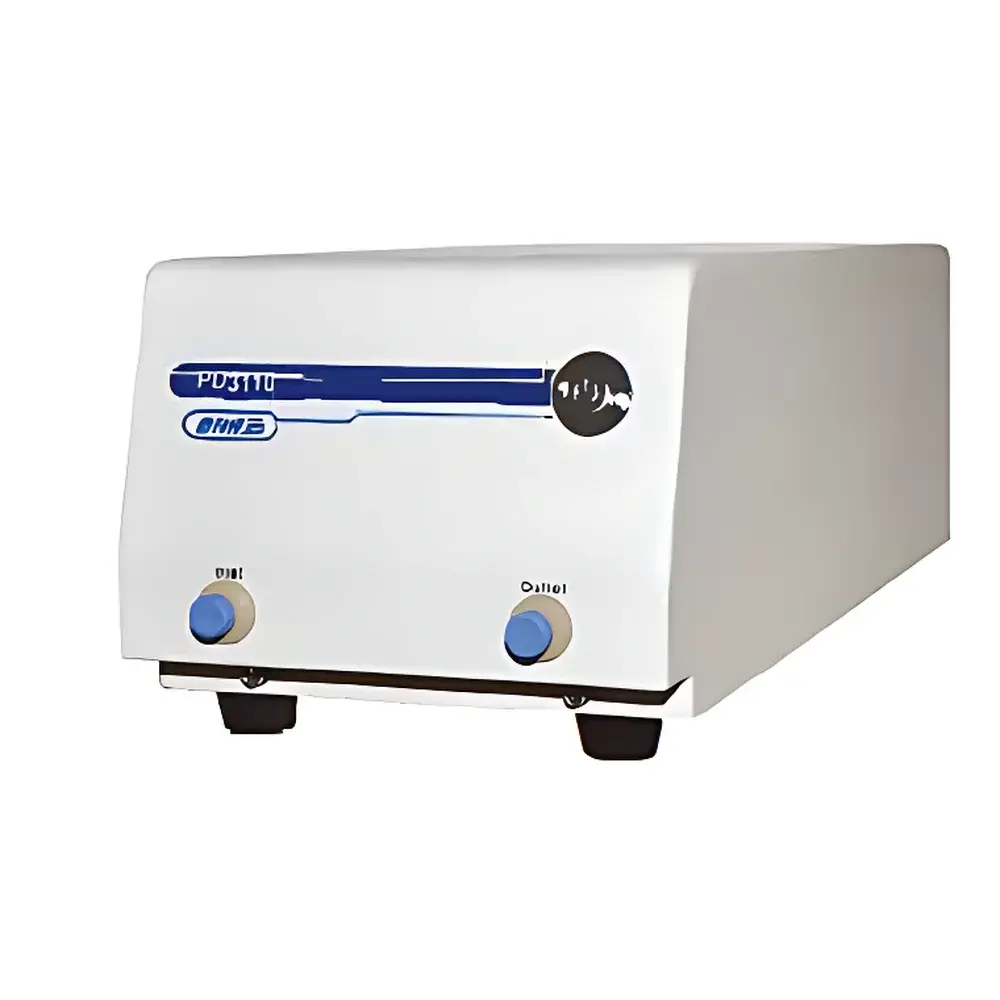
Elite PD3110 Photochemical Derivatization Unit
| Brand | Elite |
|---|---|
| Origin | Liaoning, China |
| Manufacturer Type | Direct Manufacturer |
| Product Origin | Domestic (China) |
| Model | PD3110 |
| Price Range | USD 2,800 – 7,000 |
Overview
The Elite PD3110 Photochemical Derivatization Unit is a dedicated post-column derivatization system engineered for high-sensitivity fluorescence detection of analytes with native or photoinduced fluorophores—particularly aflatoxins (B₁, B₂, G₁, G₂) and sulfonamide antibiotics—in liquid chromatography workflows. Unlike chemical derivatization methods requiring reagent pumps, mixing tees, or reaction coils, the PD3110 employs controlled ultraviolet (UV) irradiation (typically at 254 nm or 365 nm, depending on configuration) to induce photolytic cleavage or structural rearrangement—e.g., conversion of non-fluorescent aflatoxin B₁ into highly fluorescent 2′-hydroxyaflatoxin B₁—directly within a fused-silica reaction coil positioned immediately downstream of the HPLC column. This principle eliminates reagent consumption, minimizes backpressure fluctuations, and avoids contamination of the LC flow path, thereby preserving column lifetime and baseline stability. The device operates as a modular, pressure-rated accessory compatible with standard 1/16″ OD stainless steel or PEEK tubing interfaces, enabling seamless integration with Agilent, Waters, Shimadzu, Thermo Fisher, and other major HPLC/UHPLC platforms.
Key Features
- Reagent-free photochemical derivatization: No pumps, solvents, or hazardous chemical reagents required—reducing operational cost, waste disposal burden, and method development complexity.
- Optimized UV irradiation chamber: Quartz-lined reaction coil housed in a temperature-stabilized aluminum block; precise UV lamp intensity control ensures reproducible photoreaction kinetics across analytical runs.
- Low dead-volume design: Integrated 0.5–1.0 mL reaction coil with minimal extra-column dispersion—preserving chromatographic resolution and peak shape integrity.
- Pressure-compatible operation: Rated for continuous use up to 400 bar (5,800 psi), fully compatible with UHPLC systems without flow restriction or seal degradation.
- Plug-and-play interface: Standard 10-32 UNF and M6 fittings; supports both isocratic and gradient elution without compromising derivatization efficiency.
- CE-compliant electrical safety and UV shielding: Fully enclosed UV source with interlock switch and optical-grade quartz window to prevent operator exposure.
Sample Compatibility & Compliance
The PD3110 is validated for use in regulatory-compliant testing environments including food safety laboratories (CNAS-accredited), pharmaceutical QC labs, and agricultural monitoring facilities. It supports derivatization of structurally diverse compounds whose photoproducts exhibit enhanced quantum yield in the 400–450 nm emission range, notably:
- Aflatoxins (B₁, B₂, G₁, G₂, M₁) per GB 5009.22–2016, AOAC Official Method 2005.08, and EU Commission Regulation (EC) No 401/2006;
- Sulfonamides (sulfamethazine, sulfadimethoxine, sulfamethoxazole) following USP and ISO 14501:2009 protocols;
- Other UV-activatable analytes including certain mycotoxins (ochratoxin A derivatives), nitrofuran metabolites, and chloramphenicol analogues.
The unit conforms to IEC 61000-6-3 (EMC emissions) and IEC 61000-6-2 (immunity), and its mechanical construction meets ISO 9001:2015 manufacturing controls. While not FDA 21 CFR Part 11–certified out-of-the-box, audit-ready electronic logs (lamp usage hours, power-on cycles) can be exported for GLP/GMP documentation.
Software & Data Management
The PD3110 operates as a standalone hardware module with no embedded firmware or proprietary software dependency. Lamp status (on/off), irradiation time (fixed or externally triggered via TTL signal), and operating temperature are manually set via front-panel controls. For automated synchronization, the unit accepts external TTL trigger pulses from the HPLC system’s fraction collector or data acquisition module—enabling precise alignment of UV activation with analyte elution windows. All operational parameters are logged in the host LC software (e.g., Empower, Chromeleon, LabSolutions) as discrete event markers, supporting full traceability in regulated environments. Raw fluorescence chromatograms retain native timestamping and detector metadata, ensuring compliance with ALCOA+ data integrity principles.
Applications
- Routine quantification of aflatoxin contamination in cereals, nuts, spices, and dairy products at sub-ppb levels (LOQ ≤ 0.1 µg/kg);
- Multi-residue screening of sulfonamides in animal tissues and honey under EU Maximum Residue Level (MRL) regulations;
- Method validation studies requiring low inter-day CV (92% conversion yield);
- Research applications involving photo-labile compound stabilization prior to fluorescence detection;
- Replacement of o-phthalaldehyde (OPA) or iodine-based derivatization in legacy HPLC-FLD methods seeking improved robustness and reduced maintenance.
FAQ
Does the PD3110 require calibration or periodic lamp replacement?
Yes—UV lamp output degrades over time; Elite recommends lamp replacement every 1,000–1,500 operating hours. No user calibration is required, but intensity verification using a NIST-traceable UV radiometer is advised quarterly.
Can the PD3110 be used with mass spectrometry detection?
No—it is designed exclusively for fluorescence detection workflows. UV-induced photoproducts may fragment unpredictably under ESI or APCI conditions, compromising MS identification reliability.
Is the reaction coil replaceable, and what materials are available?
Yes—the standard 0.75 mL fused-silica coil is field-replaceable; optional PEEK-coated silica and titanium-alloy coils are available for aggressive mobile phases (e.g., >95% acetonitrile or pH <2.5).
What safety certifications does the unit hold?
It carries CE marking per Directive 2014/30/EU (EMC) and 2014/35/EU (LVD), and complies with IEC 62471 (Photobiological Safety) Class 1 requirements for UV radiation exposure.
Is remote monitoring or Ethernet connectivity supported?
Not natively—but analog voltage output (0–5 V) for lamp status and digital I/O (TTL) for trigger synchronization allow integration into SCADA or LIMS via third-party DAQ modules.





