
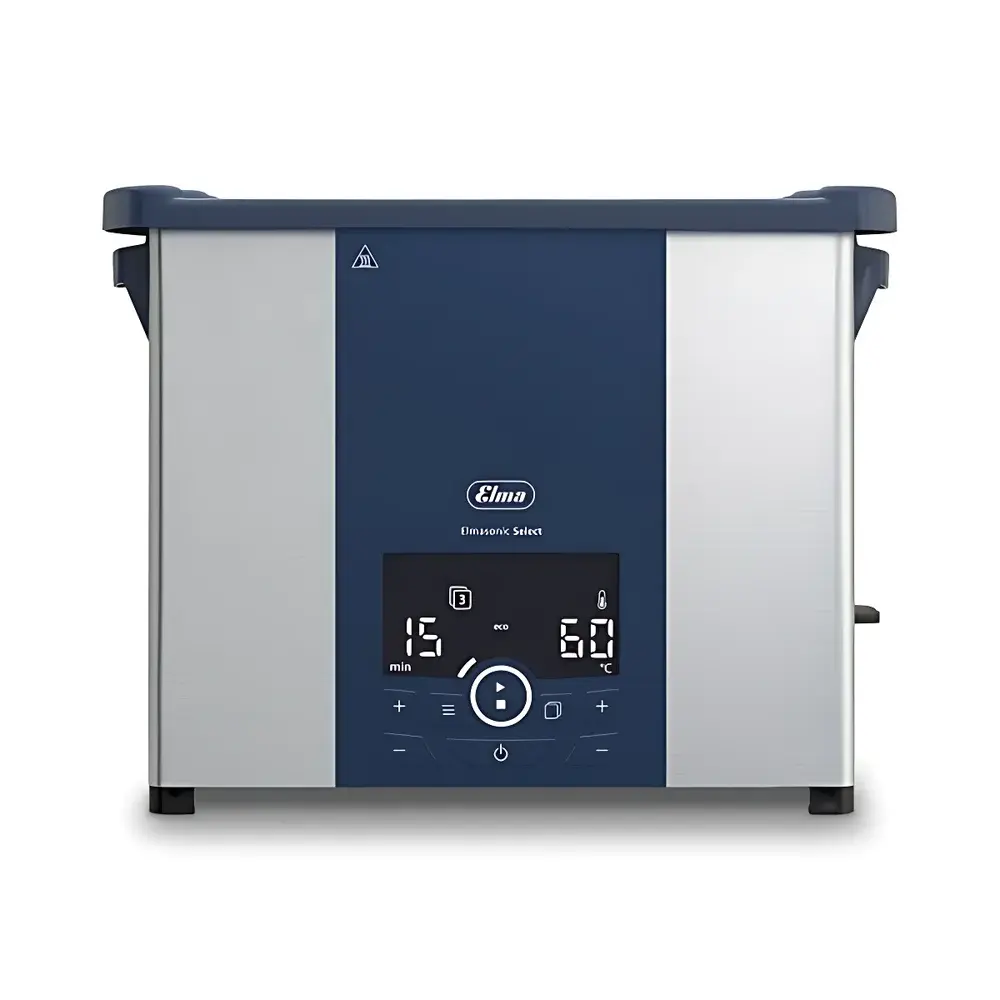
ELMA S 30 H Ultrasonic Cleaner with Digital Control Panel
| Origin | Germany |
|---|---|
| Manufacturer Type | Authorized Distributor |
| Origin Category | Imported |
| Model | ELMA S 30 H |
| Instrument Type | Dedicated Benchtop Ultrasonic Cleaner |
| Tank Capacity | 2.75 L |
| Ultrasonic Frequencies | 37 kHz / 80 kHz (Dual-Frequency Operation) |
| Ultrasonic Power Output | 100 W (Adjustable Range: 40–100% in 10% increments) |
| Heating Temperature Range | 30–80 °C (Adjustable in 1 °C steps) |
| Timer Range | 1–30 min (Predefined presets: 1, 2, 3, 4, 5, 10, 15, 20, 25, 30 min |
| Sound-Dampening Lid | Integrated Acoustic Lid with Safety Interlock |
| Drain & Fill | Automatic Drain Valve with Optional Fill Function |
| Sweep Frequency Mode | Enabled via Dedicated Toggle |
| Degassing Mode | Manual & Auto-Activated (10-min timed cycle, triggered by ≥2 s press during sonication) |
Overview
The ELMA S 30 H is a precision-engineered benchtop ultrasonic cleaner designed for reproducible, contamination-sensitive cleaning in analytical laboratories, quality control environments, and R&D facilities. It operates on the principle of cavitation-induced micro-scrubbing: high-frequency acoustic energy (37 kHz and 80 kHz) generates controlled microbubbles in aqueous or mild solvent-based cleaning media; their implosive collapse delivers localized mechanical energy to dislodge particulate, organic, and thin-film residues from complex geometries—including pipette tips, HPLC vials, optical lenses, surgical instruments, and semiconductor wafers. Dual-frequency capability enables optimization across diverse sample types: lower frequency (37 kHz) delivers higher cavitation intensity for robust particulate removal, while higher frequency (80 kHz) provides gentler, more uniform energy distribution suitable for delicate surfaces and sub-micron contaminant detachment. The unit features a stainless steel tank (316L grade), integrated temperature regulation, programmable timing, and intelligent frequency sweep to minimize standing wave formation and ensure spatial homogeneity of cleaning action.
Key Features
- Dual-frequency ultrasonic generator (37 kHz / 80 kHz) with independent power modulation—enabling method-specific selection for varying substrate sensitivity and soil type.
- 100 W nominal output with linear 40–100% power adjustment in 10% increments—ensuring precise energy delivery without thermal overshoot or acoustic instability.
- Digital PID temperature control (30–80 °C, ±0.5 °C accuracy) with real-time feedback loop; heating element located beneath tank base for uniform thermal distribution.
- Programmable timer with tactile rotary encoder and dual LED indicators: one for set time (steady illumination), one for remaining time (pulsed flash); includes ∞ position for manual termination.
- Integrated acoustic lid with safety interlock—automatically suspends ultrasonic output when opened, compliant with IEC 61000-6-3 EMC and EN 61000-6-2 immunity standards.
- Dedicated Sweep Mode button: dynamically modulates frequency ±1 kHz around center point to disrupt node/antinode patterns—improving cleaning uniformity across full tank volume.
- Degassing Mode with dual activation: manual toggle (for pre-cleaning deaeration) and auto-trigger (≥2 s press during sonication initiates 10-min degas cycle, then resumes primary program).
- Automatic drain valve with solenoid actuation—enables hands-free waste fluid evacuation post-cycle; optional fill interface supports automated refill integration.
Sample Compatibility & Compliance
The ELMA S 30 H accommodates standard laboratory ware up to 150 mm height and 120 mm diameter, including glassware (volumetric flasks, cuvettes), metal components (tweezers, forceps), polymer substrates (PET slides, microfluidic chips), and ceramic parts. Its non-aggressive, aqueous-compatible cleaning profile meets ASTM D2603 (Ultrasonic Cleaning Performance Testing) and ISO 13485 requirements for medical device reprocessing validation. The system supports GLP-compliant documentation when paired with external data loggers (temperature/time stamping). All electrical components conform to UL 61010-1 and CE marking directives; acoustic emissions comply with EU Directive 2006/42/EC for machinery safety.
Software & Data Management
While the S 30 H operates via embedded firmware without PC connectivity, its front-panel interface supports full audit trail capability through visual status encoding: each operational mode (Sweep, Degassing, Temp Hold, Timer Active) activates discrete LED states that can be recorded manually or via facility-wide CCTV logging systems. For regulated environments, users may integrate optional RS-232 or USB-to-serial adapters (sold separately) to capture timestamped event logs—including start/stop times, temperature setpoints, power levels, and fault codes—supporting FDA 21 CFR Part 11 compliance when paired with validated third-party data acquisition software.
Applications
- Pre-analytical sample preparation: removal of residual buffers, salts, or proteins from LC-MS autosampler vials and syringe filters.
- Microelectronics: cleaning photomasks, bond pads, and MEMS devices without surface erosion or particle redeposition.
- Pharmaceutical QC: decontamination of dissolution apparatus baskets and sinker discs per USP <701>.
- Materials science: deburring and oxide layer removal from sintered metal samples prior to SEM imaging.
- Dental and orthopedic device reprocessing: validated cleaning of titanium implants and CAD/CAM abutments under ISO 15883-1 protocols.
FAQ
What happens if both Sweep and Degassing modes are activated simultaneously?
The control logic prevents concurrent activation: pressing one button while the other is active automatically deactivates the prior mode. This ensures stable transducer loading and avoids resonant interference.
Can the unit operate without heating enabled?
Yes—rotating the temperature knob to “0” disables the heater while preserving ultrasonic function and timer operation.
Is the automatic drain compatible with corrosive cleaning solutions?
The drain valve seals are EPDM-rated; use only pH-neutral or mildly alkaline solutions (pH 6–10). Strong acids or halogenated solvents require manual drainage.
How is temperature stability maintained during extended cycles?
The PID algorithm continuously compares thermistor readings against setpoint and modulates heater duty cycle at 2 Hz resolution, limiting drift to ≤±0.3 °C over 30-minute runs.
Does the ∞ timer setting bypass safety cutoffs?
No—the acoustic lid interlock remains fully active, and overtemperature protection (95 °C hard cutoff) is always enforced regardless of timer position.



