Elveflow MPS Miniature Pressure Sensor
| Brand | Elveflow |
|---|---|
| Origin | France |
| Model | MPS |
| Accuracy | ±0.2 % FS |
| Pressure Ranges | 70–7,000 mbar (5 selectable full-scale options) |
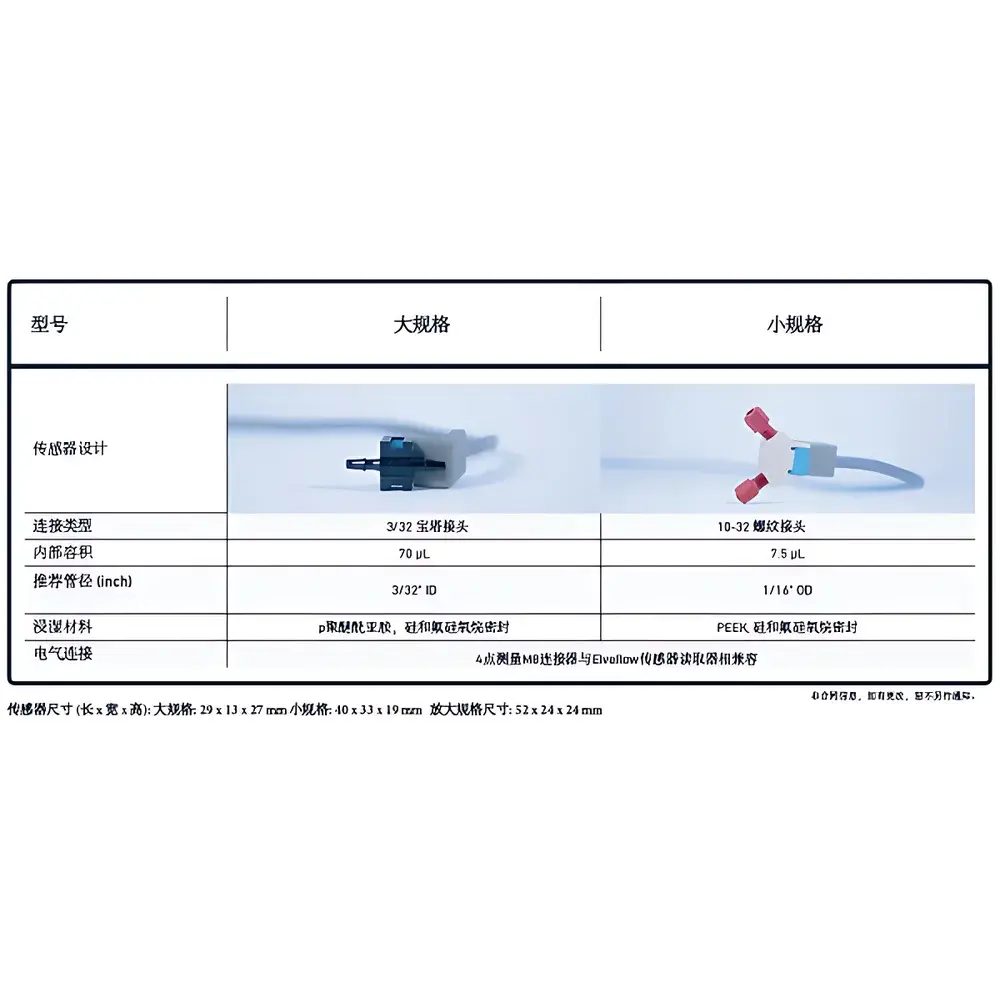
| Internal Volume | 7 µL |
| Response Time (Stabilization) | 20 ms |
| Media Compatibility | Liquids and Gases |
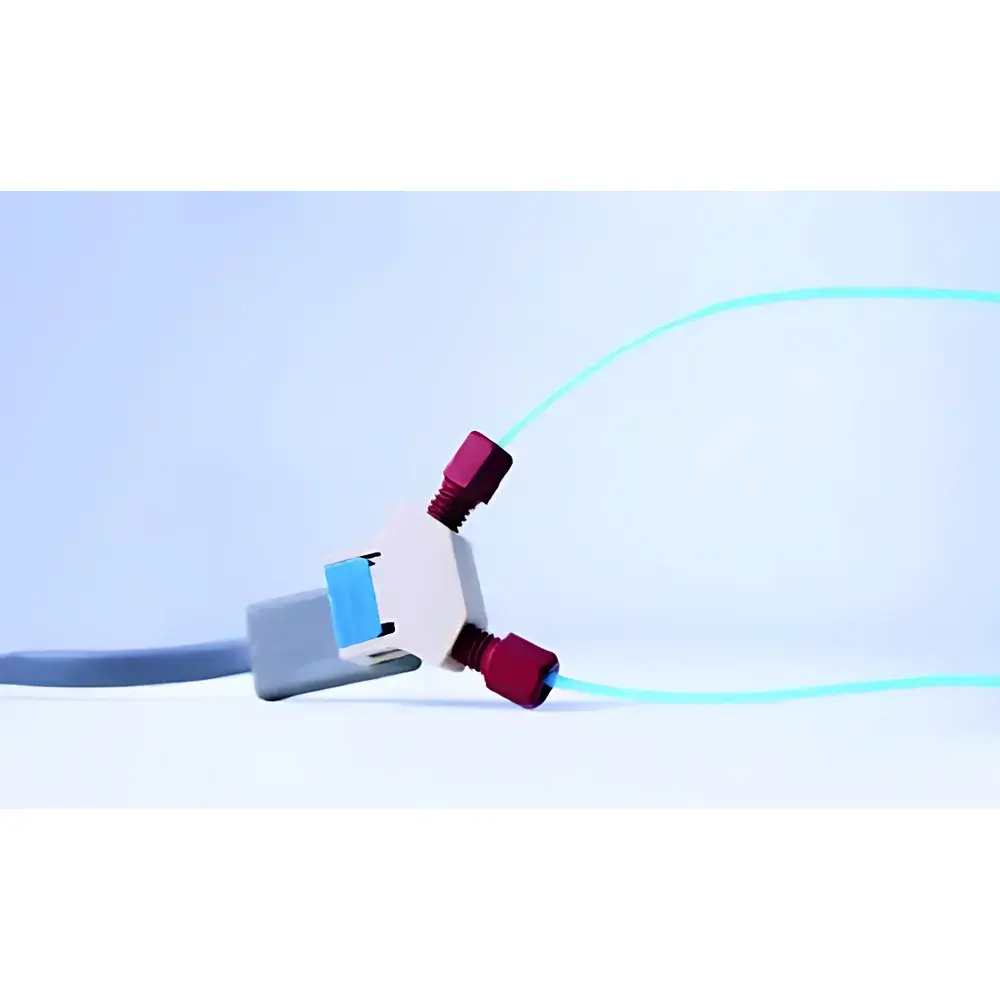
| Connection | Compatible with 3/32" ID tubing or 10-32 threaded fitting for 1/16" OD tubing |
| Type | Gauge Pressure Sensor (relative to ambient atmospheric pressure) |
Overview
The Elveflow MPS Miniature Pressure Sensor is an ultra-compact, high-precision gauge pressure transducer engineered specifically for integration into microfluidic systems where space constraints, dynamic response, and measurement fidelity are critical. Based on piezoresistive sensing technology, the MPS delivers stable, repeatable pressure readings across a wide range of fluids—including aqueous solutions, organic solvents, and inert gases—without requiring recalibration for media switching. Its design adheres to fundamental principles of microscale fluid mechanics, enabling accurate monitoring of low-flow, low-pressure regimes typical in droplet generation, cell manipulation, organ-on-chip platforms, and capillary-driven assays. As a gauge sensor, it measures pressure relative to local ambient atmospheric conditions, eliminating the need for absolute pressure referencing while maintaining traceability through factory calibration against NIST-traceable standards.
Key Features
- Miniaturized footprint with only 7 µL internal dead volume—minimizing system compliance and enabling real-time pressure feedback in low-inertia microfluidic circuits.
- Five user-selectable full-scale ranges (70, 200, 1,000, 3,500, and 7,000 mbar), allowing optimal signal-to-noise ratio across diverse experimental configurations—from gentle perfusion of sensitive tissues to high-pressure pneumatic actuation.
- Fast stabilization time of 20 ms ensures compatibility with transient pressure events, such as valve switching, bubble formation, or rapid flow rate changes.
- Robust stainless steel and ceramic wetted materials ensure chemical resistance to common lab solvents (e.g., ethanol, isopropanol, PBS, DMF) and compatibility with sterilization protocols including autoclaving (when used with appropriate sealing accessories).
- Integrated temperature compensation circuitry maintains accuracy across ambient operating temperatures from 15 °C to 40 °C.
- Factory-calibrated with documented uncertainty budgets and individual calibration certificates available upon request for GLP/GMP-aligned workflows.
Sample Compatibility & Compliance
The MPS sensor is validated for use with Newtonian and weakly non-Newtonian liquids (e.g., cell culture media, glycerol-water mixtures up to 40% v/v) and dry, particle-free gases (N₂, CO₂, air, Ar). It is not rated for corrosive gases (e.g., Cl₂, NH₃), aggressive acids/bases, or slurries containing abrasive particulates. The device complies with CE marking requirements under the EU Electromagnetic Compatibility Directive 2014/30/EU and Low Voltage Directive 2014/35/EU. While not intrinsically safe, it may be deployed in standard laboratory environments per IEC 61000-6-2 (immunity) and IEC 61000-6-4 (emissions). For regulated bioprocessing applications, raw sensor output data can be logged via Elveflow’s AFC software with optional audit trail and electronic signature modules compliant with FDA 21 CFR Part 11 requirements.
Software & Data Management
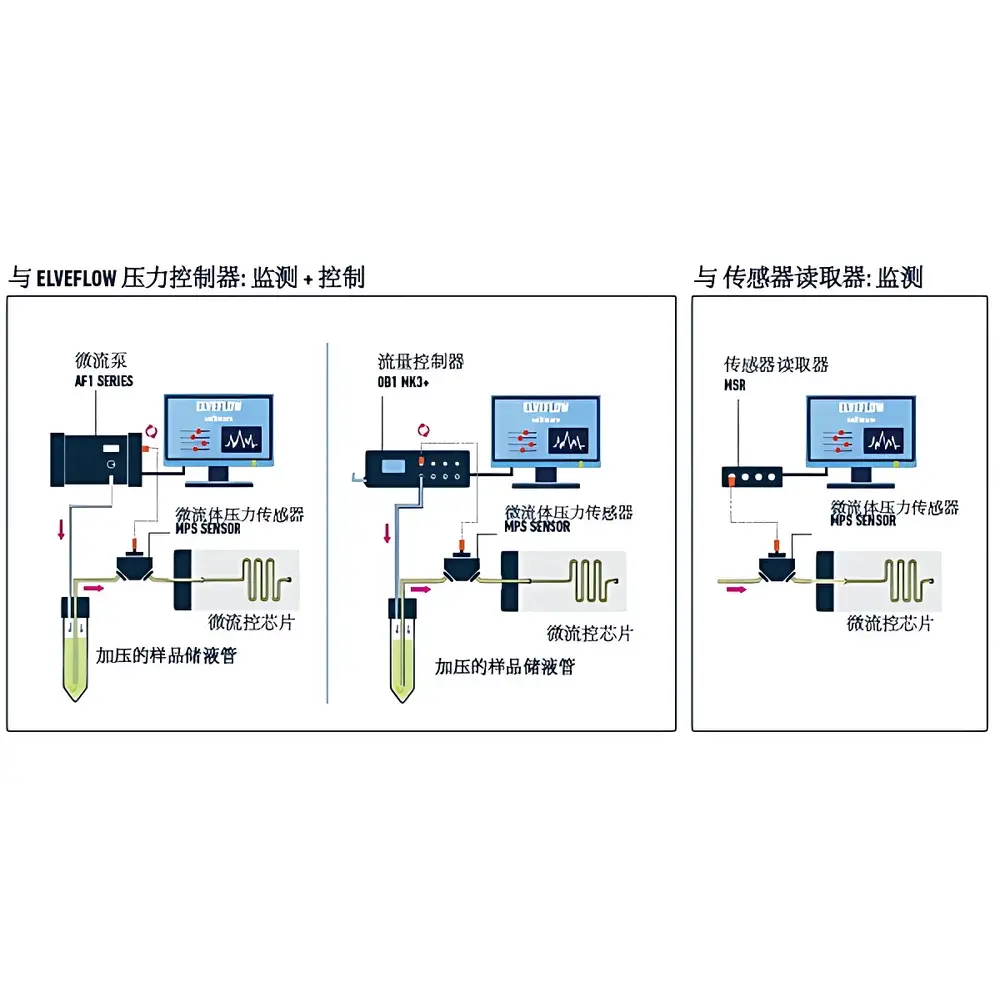
The MPS integrates natively with Elveflow’s AFM (Advanced Flow Manager) software suite, supporting real-time visualization, multi-channel synchronization, and script-based automation via Python SDK. Raw analog output (0–5 V or 0–10 V, configurable) enables direct acquisition using third-party DAQ systems (e.g., National Instruments, Keysight, or Arduino-compatible interfaces). All firmware updates, sensor configuration, and zero-point adjustment are performed through USB-C interface without external hardware. Data export supports CSV, HDF5, and MATLAB .mat formats, preserving timestamped metadata (including sensor serial number, calibration date, and full-scale setting) for traceable analysis and regulatory submission.
Applications
- Real-time pressure monitoring upstream/downstream of microvalves and micropumps in closed-loop flow control systems.
- In-line pressure feedback for adaptive regulation of droplet size and frequency in T-junction or flow-focusing geometries.
- Monitoring hydrostatic head variations during long-term organoid culture or barrier tissue integrity assays.
- Validation of pressure drop across microstructured membranes or porous scaffolds in filtration and permeability studies.
- Calibration reference for custom-built pressure controllers in academic and industrial microfluidics foundries.
FAQ
Is the MPS sensor compatible with vacuum measurements?
No—the MPS is a gauge pressure sensor and does not support negative pressure (vacuum) measurement below ambient atmospheric pressure.
Can the MPS be sterilized using autoclaving?
The sensor body is autoclavable at 121 °C for 20 minutes when equipped with high-temperature compatible O-rings (optional accessory); however, the electrical connector and cable assembly must be removed prior to sterilization.
Does the MPS require regular recalibration?
Under normal laboratory use and stable thermal conditions, annual recalibration is recommended; more frequent verification is advised after mechanical shock or exposure to extreme overpressure events.
What is the maximum permissible overpressure limit?
The absolute maximum overpressure is 1.5× the selected full-scale range—exceeding this threshold may cause permanent zero drift or diaphragm deformation.
Can multiple MPS sensors be synchronized in a single AFM session?
Yes—up to 16 MPS units can be daisy-chained via USB and time-synchronized to within ±100 µs using AFM’s master clock distribution protocol.