
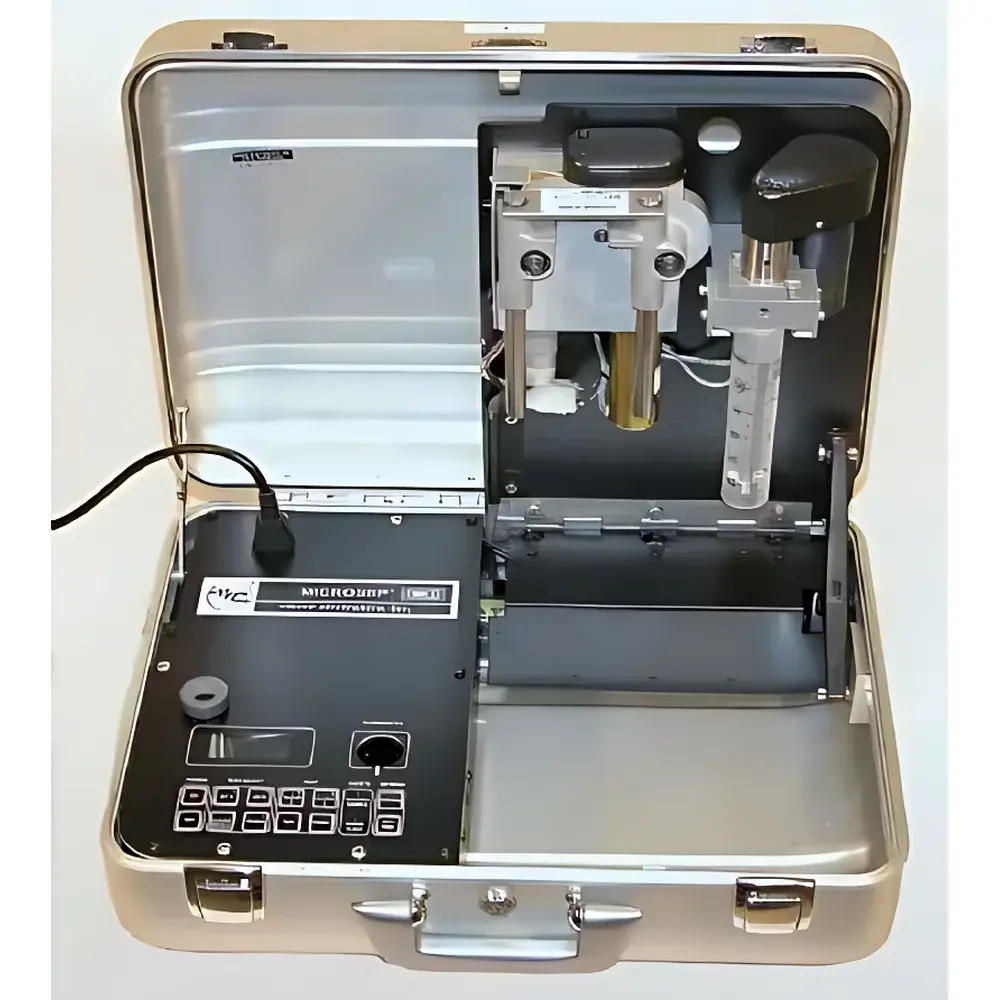
EMCEE 1140 Portable Aviation Fuel Water Separation Index Analyzer
| Brand | EMCEE |
|---|---|
| Origin | USA |
| Model | 1140 |
| Compliance | ASTM D3948, ASTM D4860 |
| Design | Integrated portable analyzer with built-in audio-guided test protocol |
| Test Duration | 5–10 minutes per sample |
| Sample Volume | Low-consumption (≤50 mL typical) |
| User Interface | Touch-sensitive control panel |
| Test Kit | Standard six-piece test assembly (pre-calibrated, disposable-compatible) |
Overview
The EMCEE 1140 Portable Aviation Fuel Water Separation Index Analyzer is a field-deployable, standards-compliant instrument engineered for rapid, on-site assessment of water separation performance in aviation turbine fuels—primarily Jet A, Jet A-1, and JP-8. It operates on the principle of controlled coalescence and gravitational phase separation, quantifying the fuel’s ability to release entrained water under standardized mechanical agitation and settling conditions. The measurement yields the Water Separation Index (WSI), a dimensionless value defined per ASTM D3948 and D4860, reflecting both emulsion stability and coalescer efficiency. Unlike laboratory-based benchtop systems, the 1140 integrates all critical subsystems—including precision fluid handling, timed agitation, optical detection of interfacial clarity, and real-time signal processing—within a single ruggedized aluminum enclosure, enabling deployment at ramp sites, fuel farms, maintenance hangars, or mobile quality control units without reliance on fixed infrastructure.
Key Features
- True portability: Fully self-contained unit housed in a MIL-STD-810G-rated anodized aluminum carry case with integrated battery power (optional AC adapter support), rated for operation across −10 °C to +50 °C ambient range.
- Audio-guided workflow: Embedded voice prompts synchronize with each procedural step—sample loading, reagent addition, agitation cycle initiation, settling interval, and endpoint evaluation—minimizing operator dependency and reducing training overhead.
- Touch-actuated interface: Sealed capacitive buttons eliminate mechanical wear and resist fuel splash contamination; menu navigation supports language-independent iconography and contextual status feedback.
- Standardized six-piece test assembly: Includes calibrated glass separator funnel, precision orifice plate, defined-volume syringes, certified reference water standard vial, and disposable filtration components—designed to eliminate cross-contamination and reduce cleaning cycles to zero between tests.
- Robust architecture: No moving parts external to the test kit; all fluidic paths are chemically resistant (PTFE, borosilicate glass, stainless steel 316); no internal pumps or valves requiring recalibration or scheduled maintenance.
Sample Compatibility & Compliance
The EMCEE 1140 is validated for use with aviation turbine fuels meeting ASTM D1655 specifications, including hydrotreated and synthetic blendstocks (e.g., Fischer–Tropsch, HEFA). It accommodates fuels containing approved antioxidant, static dissipater, and corrosion inhibitor additives without interference. All measurements adhere strictly to the procedural requirements of ASTM D3948 (Standard Test Method for Determining Water Separation Characteristics of Aviation Turbine Fuels by Portable Separometer) and ASTM D4860 (Standard Test Method for Determining Water Separation Characteristics of Aviation Turbine Fuels by Portable Separometer—Alternative Procedure). The device does not require third-party calibration certification for routine use, though periodic verification using NIST-traceable reference standards (e.g., EMCEE WSI Reference Kit 1140-RK) is recommended per internal QA protocols and ISO/IEC 17025-aligned laboratories.
Software & Data Management
The 1140 operates firmware-driven logic with embedded non-volatile memory storing up to 250 test records, each timestamped with date, operator ID (manually entered), ambient temperature, and calculated WSI value. Data export is supported via USB-C interface to standard CSV format for integration into LIMS or enterprise QC databases. While the unit itself lacks wireless connectivity or cloud synchronization, its output structure complies with ASTM E1461 and ASTM E2500 data formatting conventions, facilitating automated parsing in regulated environments. Audit trail functionality meets GLP documentation requirements, logging all user-initiated actions—including parameter overrides, calibration verifications, and firmware updates—with immutable timestamps.
Applications
- Routine acceptance testing of delivered fuel batches prior to aircraft refueling operations.
- On-wing troubleshooting of suspected fuel system water ingress or filter bypass events.
- Verification of coalescer/filter performance during scheduled maintenance intervals.
- Field validation of fuel storage tank integrity following seasonal condensation or tank entry events.
- Supporting root-cause analysis during fuel-related engine anomalies under FAA Advisory Circular 150/5200-37B guidance.
FAQ
Does the EMCEE 1140 require annual calibration by an accredited lab?
No—calibration is inherent to the physical geometry of the six-piece test assembly and traceable reference standards. Users perform functional verification using EMCEE-supplied WSI Reference Kits before each shift or after transport shock.
Can the instrument be used with diesel or gasoline?
Not recommended. Its hydrodynamic design, timing parameters, and optical detection thresholds are optimized exclusively for aviation turbine fuel viscosity, density, and interfacial tension profiles per ASTM D3948 Annex A1.
Is the six-piece test kit reusable?
Components are designed for single-shift reuse under clean-room conditions, but full replacement is required after 20 tests or upon visible residue accumulation to maintain ASTM D3948 repeatability (±0.5 WSI units).
What power sources are supported?
Internal rechargeable Li-ion battery (8-hour continuous operation), plus universal 100–240 VAC input via included switching adapter; no external inverters or generators needed.
How is compliance with FDA 21 CFR Part 11 addressed?
While the 1140 itself is not a Part 11–regulated system, its CSV export format, audit-log timestamping, and operator-ID field support integration into validated electronic record systems compliant with Part 11 when deployed within pharmaceutical-grade fuel logistics workflows.






