
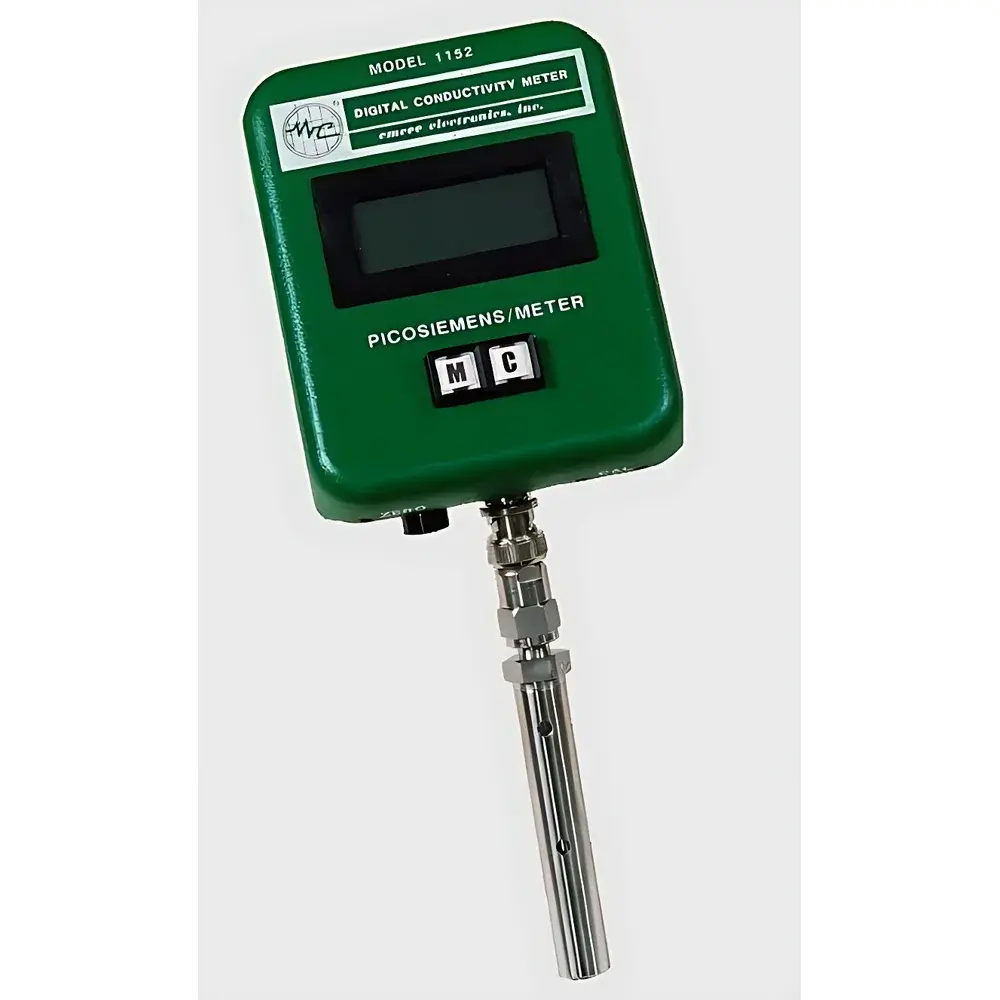
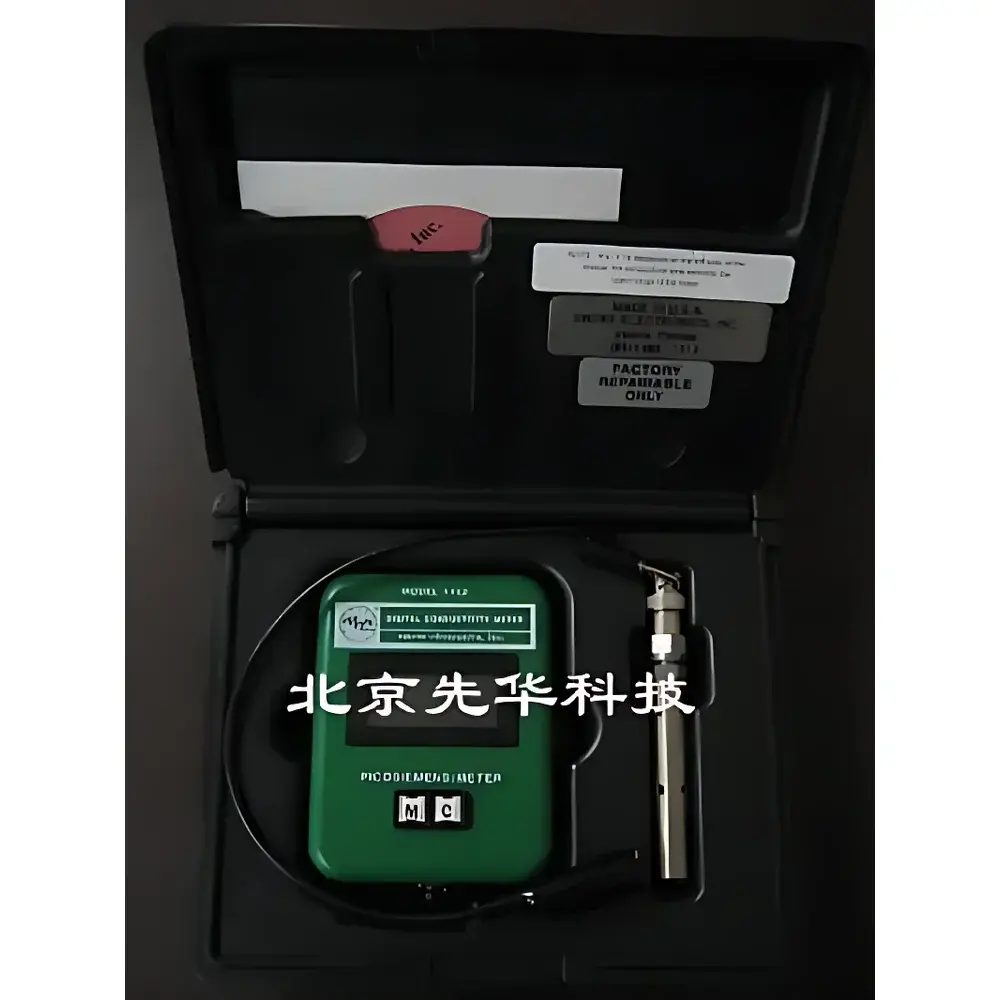
EMCEE 1152 Aviation Fuel Digital Conductivity Meter
| Brand | EMCEE |
|---|---|
| Origin | USA |
| Model | 1152 |
| Portability | Portable |
| Application Environment | Laboratory & Field |
| Conductivity Range | 0–1999 pS/m |
| Temperature Range | 0 °C to 75 °C |
| Accuracy | ±2% of reading or ±1 pS/m (whichever is greater) |
| Resolution | 1 pS/m |
| Display | LCD |
| Calibration | Auto-calibration via field-adjustable circuitry |
| Power Supply | 3 × AA alkaline batteries |
| Enclosure | Anodized aluminum housing with corrosion-resistant coating |
| Probe | Removable stainless-steel electrode |
| Safety Certification | UL, CSA, LCIE certified for Class I, Division 1 hazardous locations |
| Compliance | ASTM D2624–22 (Standard Test Method for Electrical Conductivity of Aviation Turbine Fuels) |
Overview
The EMCEE 1152 Aviation Fuel Digital Conductivity Meter is a purpose-engineered, intrinsically safe instrument designed specifically for the precise measurement of electrical conductivity in hydrocarbon-based fuels—particularly aviation turbine fuels (Jet A, Jet A-1, JP-5, JP-8)—in accordance with ASTM D2624–22. This standard defines the methodology for assessing static charge dissipation capability, a critical parameter governing fuel handling safety during transfer, storage, and refueling operations. The instrument operates on the principle of two-electrode AC conductance measurement at low frequency (typically <1 kHz), minimizing polarization effects and ensuring stable readings in low-conductivity, non-aqueous media. Its ruggedized mechanical architecture and certified hazardous-area operation make it suitable for both laboratory QC verification and field deployment at airports, refineries, and fuel depots.
Key Features
- Intrinsically safe design certified by UL, CSA, and LCIE for Class I, Division 1 (Group D) environments—enabling direct use in fuel loading bays, tank farms, and aircraft refueling zones without explosion risk.
- Dedicated 0–1999 pS/m measurement range optimized for aviation fuel conductivity, where values below 50 pS/m indicate insufficient charge relaxation and elevated electrostatic ignition hazard.
- True auto-calibration architecture with field-adjustable reference circuitry eliminates need for external calibration standards during routine operation; calibration verification performed using internal reference impedance.
- High-resolution 1 pS/m digital readout on backlit LCD display ensures unambiguous interpretation under variable lighting conditions—including hangar interiors and outdoor daylight.
- Modular probe assembly: removable 316 stainless-steel electrode with integrated temperature sensor (0–75 °C), compatible with short leads or extended coiled cables up to 30 m for sampling from tanker trucks, railcars, and fixed storage tanks.
- Low-power consumption design powered by three standard AA alkaline cells, supporting continuous operation >200 hours per battery set without voltage regulation drift.
Sample Compatibility & Compliance
The EMCEE 1152 is validated for use with non-polar, low-dielectric liquids including kerosene-type aviation fuels, diesel fuels, naphthas, and other refined hydrocarbons. It is not intended for aqueous, high-conductivity, or corrosive electrolyte solutions. Its measurement protocol conforms strictly to ASTM D2624–22 Annex A1 (electrode cell constant determination) and Section 8 (field testing procedure). Instrument traceability aligns with ISO/IEC 17025 requirements when operated within an accredited laboratory’s documented calibration interval (recommended annually or after 500 measurements). No TDS, resistivity, or salinity functions are implemented—consistent with regulatory focus on electrostatic safety rather than general water quality assessment.
Software & Data Management
The 1152 is a standalone, microprocessor-controlled analog-digital hybrid instrument with no embedded data logging, Bluetooth, or USB interface. All measurements are displayed in real time only; no onboard memory or export capability exists. This design choice prioritizes intrinsic safety, electromagnetic compatibility (EMC), and operational simplicity in explosive atmospheres—where wireless transmission or stored electronic records could introduce ignition risks or complicate regulatory audit trails. For GLP/GMP-aligned environments, users are expected to record results manually in bound logbooks or integrate readings into LIMS via secondary transcription. Audit-ready documentation includes factory calibration certificate (NIST-traceable), UL/CSA certification reports, and ASTM D2624 conformance statement—all supplied with each unit.
Applications
- Pre-flight fuel quality verification at commercial and military airfields per Joint Service Manual (JSM) 3–120 and FAA Advisory Circular 150/5200–33B.
- Refinery off-spec screening: detection of conductivity-suppressing contaminants (e.g., biocide overdosing, antioxidant carryover, or pipeline corrosion inhibitors).
- Tanker truck and railcar acceptance testing prior to delivery to airport fuel farms.
- Investigation of electrostatic discharge incidents through retrospective conductivity profiling of retained samples.
- Validation of fuel additive performance (e.g., Stadis 450, Lubrizol 564) in accordance with SAE ARP5008 and DEF STAN 91–87.
FAQ
Does the EMCEE 1152 comply with ASTM D2624–22?
Yes—the instrument implements the exact electrode geometry, excitation signal, and signal processing methodology specified in Sections 6–8 of ASTM D2624–22.
Can it measure conductivity in diesel or gasoline?
It may provide indicative readings, but ASTM D2624 does not validate its use outside aviation turbine fuels; alternative methods (e.g., ASTM D4308 for diesel) require different instrumentation.
Is temperature compensation automatic?
No—temperature is measured concurrently but not applied as a correction factor; ASTM D2624 requires reporting raw conductivity at measured temperature.
What is the recommended calibration frequency?
Annual calibration against a certified reference cell is advised; more frequent verification is required if used >50 times per month or following physical impact.
Why does it lack data storage or connectivity?
To maintain intrinsic safety certification and avoid electromagnetic interference in classified hazardous areas—features intentionally omitted per UL 60079–11 and IEC 60079–0 requirements.
Related Products






