
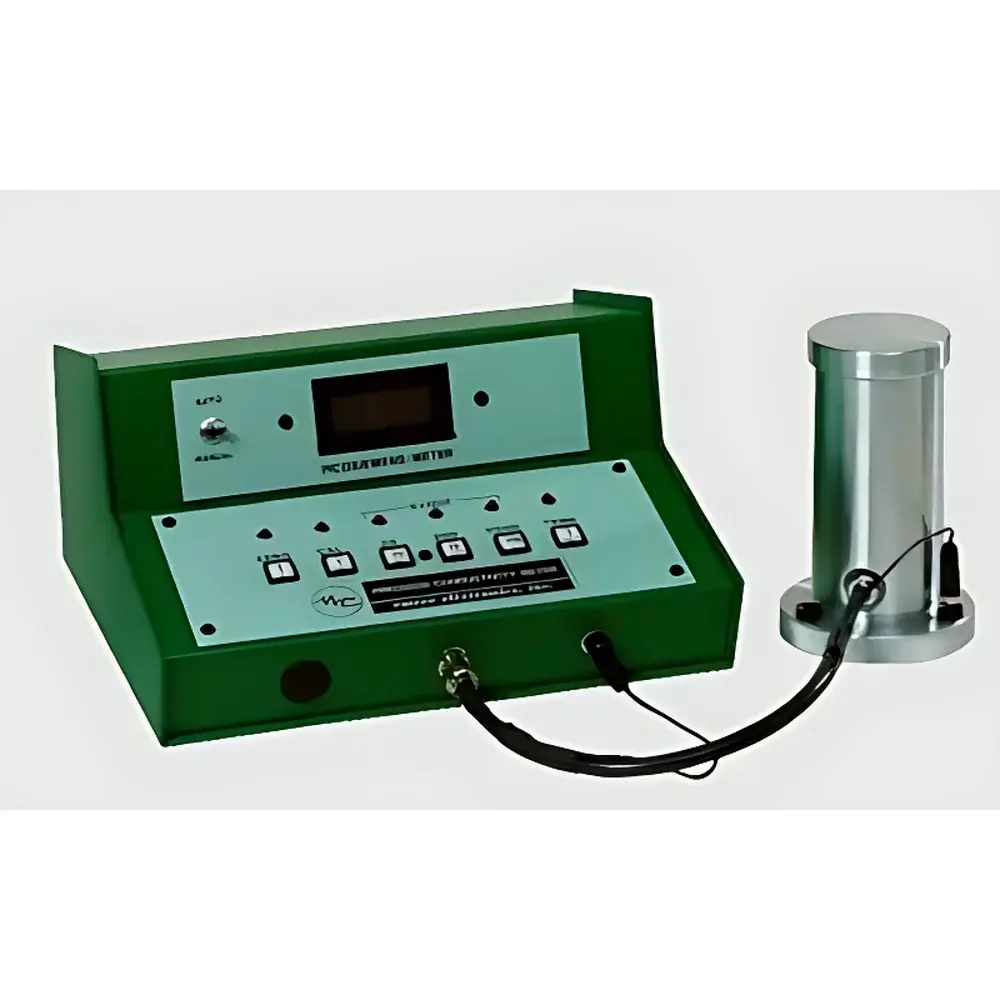
EMCEE 1154 Precision Conductivity Meter
| Brand | EMCEE |
|---|---|
| Origin | USA |
| Manufacturer Status | Authorized Distributor |
| Product Origin | Imported |
| Model | 1154 |
| Detection Parameter | Single (Conductivity) |
| Portability | Benchtop |
| Application Environment | Laboratory |
| Conductivity Range | 0–20,000 pS/m |
| Accuracy | ±½% of reading |
| Minimum Resolution | 0.01 pS/m |
Overview
The EMCEE 1154 Precision Conductivity Meter is a benchtop electrochemical instrument engineered for trace-level electrical conductivity measurement in low-conductivity non-aqueous liquids—particularly hydrocarbon-based fluids such as aviation fuels, jet fuels, diesel, gasoline, and solvent-grade hydrocarbons. It operates on the principle of two-electrode AC conductance measurement at a fixed frequency (typically 1 kHz), minimizing polarization effects and enabling stable, reproducible readings in media with conductivities spanning six orders of magnitude—from ultra-low values near the detection limit (0.01 pS/m) up to 20,000 pS/m. Designed specifically to meet the stringent requirements of ASTM D4308, “Standard Test Method for Electrical Conductivity of Aviation Turbine Fuels,” the 1154 serves as a primary reference instrument in quality control laboratories supporting fuel certification, static charge hazard assessment, and electrostatic safety compliance.
Key Features
- Five-digit LCD display with high-contrast backlighting for precise real-time readout of conductivity in pS/m units
- Four auto-ranging measurement spans: 0.01–2.00 pS/m, 0.02–20.0 pS/m, 0.2–200 pS/m, and 2–20,000 pS/m—ensuring optimal signal-to-noise ratio across the full dynamic range
- Integrated, precision-machined conductivity cell with fixed 100 mL sample volume geometry—eliminates volumetric error and ensures consistent electrode immersion depth and field distribution
- Self-calibrating analog front-end circuitry with temperature-compensated gain stages and zero-drift correction algorithms
- Built-in automatic sampling logic: initiates measurement sequence after thermal stabilization (user-defined delay), captures stabilized reading, and stores timestamped value in internal memory
- Robust aluminum chassis with EMI-shielded enclosure, conforming to IEC 61326-1 for electromagnetic compatibility in laboratory environments
Sample Compatibility & Compliance
The 1154 is validated for use with hydrocarbon liquids having dielectric constants below 10 and viscosity < 10 cSt at 20 °C. It is not intended for aqueous, corrosive, or high-ionic-strength solutions. All measurements adhere to ASTM D4308 protocols—including specified cell cleaning procedures (e.g., sequential rinses with isopropanol and dry nitrogen purge), mandatory 10-minute equilibration time post-filling, and ambient temperature monitoring (20 ± 2 °C). The instrument’s design supports GLP-compliant workflows: each stored reading includes embedded metadata (date/time, range setting, operator ID if configured via external software interface), and firmware maintains an immutable audit trail of calibration events per ISO/IEC 17025 traceability requirements.
Software & Data Management
While the 1154 operates autonomously as a standalone meter, its RS-232 serial interface enables integration with laboratory information management systems (LIMS) or custom data acquisition platforms. ASCII-formatted output includes conductivity value, selected range code, and status flags (e.g., “CAL”, “OVLD”, “TEMP”). Optional PC software (EMCEE DataLink v3.x) provides batch export to CSV, automated report generation per ASTM template, and trend analysis across multiple batches. Firmware supports FDA 21 CFR Part 11–compliant user authentication when deployed in regulated pharmaceutical or aerospace QA/QC settings—enabling electronic signatures, role-based access control, and revision-locked audit logs.
Applications
- Static electricity hazard evaluation in aviation fuel handling facilities per FAA Advisory Circular 150/5200-32
- Quality assurance testing of hydrocarbon solvents used in semiconductor cleaning processes
- Monitoring conductivity drift during long-term storage of synthetic lubricants and transformer oils
- Verification of antistatic additive efficacy in fuel formulations (e.g., Stadis 450, ASA-3)
- Research into charge relaxation kinetics in insulating liquids under controlled humidity and temperature conditions
- Supporting ISO 8502-9 and IEC 60079-32-1 compliance documentation for explosive atmosphere risk assessments
FAQ
Does the 1154 require annual recalibration by an accredited lab?
Yes—EMCEE recommends traceable recalibration every 12 months using NIST-traceable conductivity standards (e.g., PTB-certified hydrocarbon simulants), especially when used for regulatory reporting.
Can the cell be used with samples containing particulates or water droplets?
No—presence of suspended solids or free water compromises measurement integrity and risks cell contamination; samples must be filtered (≤0.45 µm) and dehydrated prior to analysis.
Is temperature compensation available?
The instrument measures at ambient temperature only; users must control and record bath temperature separately per ASTM D4308 Section 7.3—no built-in PTC sensor or compensation algorithm is provided.
What maintenance is required between measurements?
After each test, the cell must be thoroughly rinsed with high-purity isopropanol, dried with oil-free compressed air or nitrogen, and visually inspected for residue or electrode film formation.
How is electrode fouling detected?
A sustained deviation >±1% from baseline reading after standard cleaning, or inconsistent range-switching behavior, indicates potential electrode passivation—requiring ultrasonic cleaning in mild detergent or professional refurbishment.






