
Emfutur JJS-EMFUTUR Ultra Pure Water System
| Brand | JJS-EMFUTUR |
|---|---|
| Origin | Spain |
| Manufacturer Type | Authorized Distributor |
| Origin Category | Imported |
| Model | Emfutur |
| Output (25°C) | 24 L/h |
| Power Consumption | 240 W |
| Flow Rate (with pressure tank) | >1.5 L/min |
| Resistivity (25°C) | 18.2 MΩ·cm |
| Heavy Metals & Soluble Silica | <0.1 ppb |
| Total Organic Carbon (TOC) | <3 ppb |
| Endotoxins | <0.001 EU/mL |
| Bacteria | <1 CFU/mL |
| Particles (>0.1 µm) | <1 particle/mL |
| Conductivity of 2-Stage RO Feed Water | 1–5 µS/cm |
| Feed Water Requirements | Municipal tap water, Temp. 5–45°C, Pressure 1.0–4.0 kgf/cm² |
| Dimensions (L×W×H) | 545×470×610 mm |
| Weight | ~20 kg |
| Electrical Supply | AC 110–220 V, 50/60 Hz |
Overview
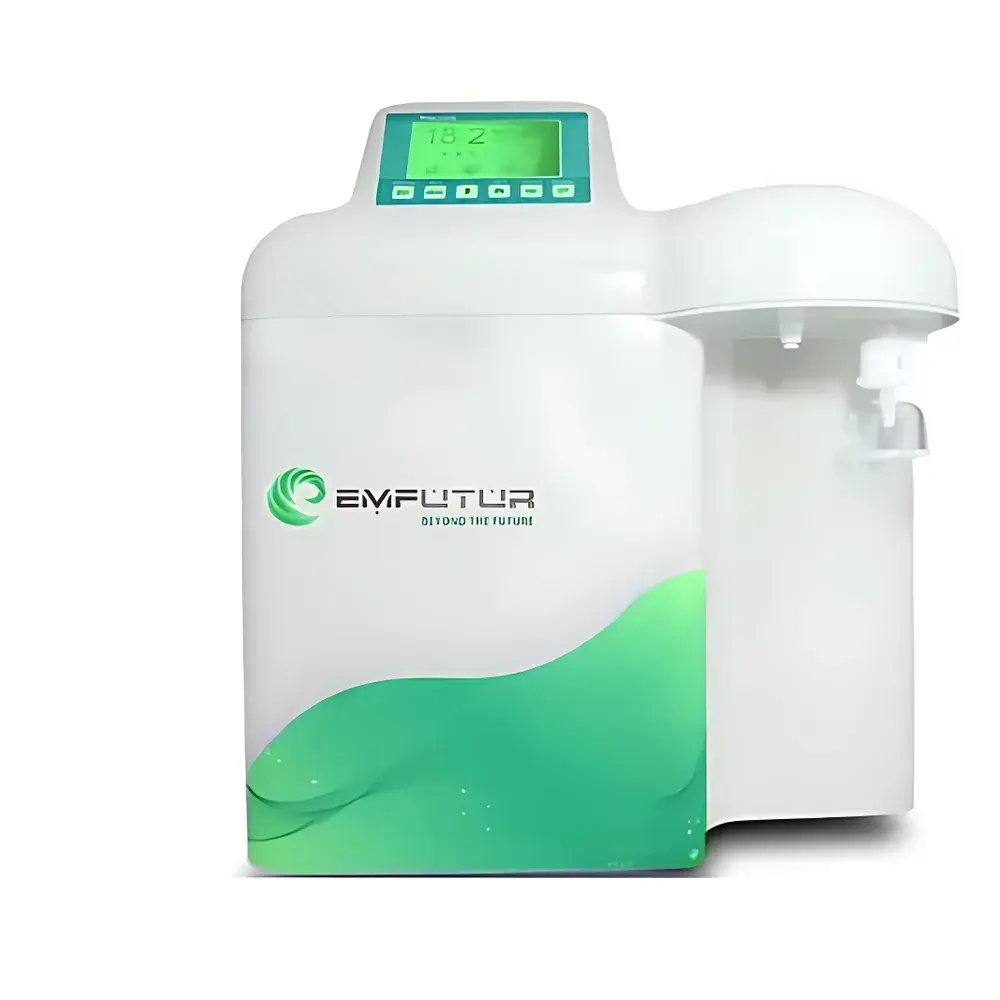
The Emfutur JJS-EMFUTUR Ultra Pure Water System is a fully integrated, dual-stage reverse osmosis (RO) and post-purification platform engineered for the continuous production of Type I ultrapure water in analytical and life science laboratories. It employs a multi-stage purification architecture—including sediment filtration, activated carbon pre-treatment, two-pass RO membranes, electrodeionization (EDI), and final ultrafiltration with a 0.1 µm hydrophilic membrane—to achieve consistent compliance with ASTM D1193-20, ISO 3696:1987, and CLSI EP21-A standards for clinical and research-grade water. The system delivers water at 24 L/h at 25°C with real-time monitoring of resistivity, TOC, endotoxin, and microbial load—ensuring trace-level purity required for sensitive applications such as HPLC mobile phase preparation, cell culture media formulation, and low-background elemental analysis.
Key Features
- Stable 18.2 MΩ·cm resistivity output at 25°C, verified by integrated high-accuracy conductivity sensor with temperature compensation
- On-line TOC analyzer (<3 ppb detection limit) compliant with USP and EP 2.2.44 methodologies
- Endotoxin-retentive ultrafiltration module validated to reduce endotoxin levels to <0.001 EU/mL—critical for immunology and stem cell workflows
- Automated sanitization cycle using thermal or ozone-based protocols, supporting GLP/GMP audit readiness
- Modular design with replaceable consumables (RO membranes, EDI cartridges, UF filters) tracked via RFID-enabled cartridge recognition
- Intuitive 7-inch capacitive touchscreen interface with multilingual support (English, Spanish, German, French) and configurable alarm thresholds
Sample Compatibility & Compliance
The Emfutur system is validated for use with all major analytical instrumentation requiring Type I water per ISO 3696 Class 1 and ASTM D1193 Type I specifications. It meets feed water requirements for ICP-MS, LC-MS/MS, and atomic absorption spectroscopy—where sub-ppt metal contamination and ultra-low TOC are mandatory. All wetted materials comply with USP Class VI biocompatibility testing, and the entire fluid path is constructed from pharmaceutical-grade PEEK, PVDF, and electropolished 316L stainless steel. System documentation includes full IQ/OQ/PQ validation templates aligned with FDA 21 CFR Part 11 requirements for electronic records and signatures.
Software & Data Management
Embedded firmware supports local data logging (≥12 months of timestamped resistivity, TOC, pressure, and flow metrics) with export via USB or Ethernet to CSV or XML formats. Optional cloud connectivity enables remote monitoring through secure TLS 1.2–encrypted REST API endpoints. Audit trail functionality records all user actions—including parameter changes, maintenance events, and calibration interventions—with immutable timestamps and operator ID attribution. Data integrity conforms to ALCOA+ principles (Attributable, Legible, Contemporaneous, Original, Accurate, Complete, Consistent, Enduring, Available) as defined in WHO TRS 992 Annex 4 and EU GMP Annex 11.
Applications
- HPLC and UHPLC mobile phase and blank preparation
- ICP-MS and ICP-OES sample dilution and standard preparation
- Cell culture media and reagent formulation for regenerative medicine
- PCR and qRT-PCR master mix preparation
- Electrophoresis buffer preparation (e.g., SDS-PAGE, capillary electrophoresis)
- Environmental trace analysis (e.g., EPA Method 1631E for mercury speciation)
- Pharmaceutical stability studies under ICH Q5C guidelines
FAQ
What is the recommended service interval for RO membranes and EDI modules?
RO membranes require replacement every 12–24 months depending on feed water quality; EDI cartridges are rated for 18–36 months under typical municipal feed conditions. A built-in usage counter triggers proactive alerts.
Does the system support integration with building management systems (BMS)?
Yes—via Modbus TCP or BACnet/IP protocol over Ethernet, enabling centralized status reporting and alarm forwarding to facility SCADA platforms.
Can this unit be used for sterile filtration in aseptic processing environments?
While the system produces endotoxin-free water, it does not include terminal sterilizing-grade filtration (0.22 µm); users requiring sterile water must add an optional sterile-grade point-of-use filter certified to ISO 13408-1.
Is validation documentation provided for regulatory submissions?
Yes—the factory-supplied validation package includes installation qualification (IQ), operational qualification (OQ), and performance qualification (PQ) protocols with acceptance criteria traceable to ISO/IEC 17025 and ASTM E2500-15.
How is microbial growth prevented in the distribution loop?
The system incorporates recirculating UV irradiation (254 nm, ≥40 mJ/cm² dose) and periodic hot-water sanitization (80°C for 30 min), both programmable via the control interface and logged in the audit trail.



