
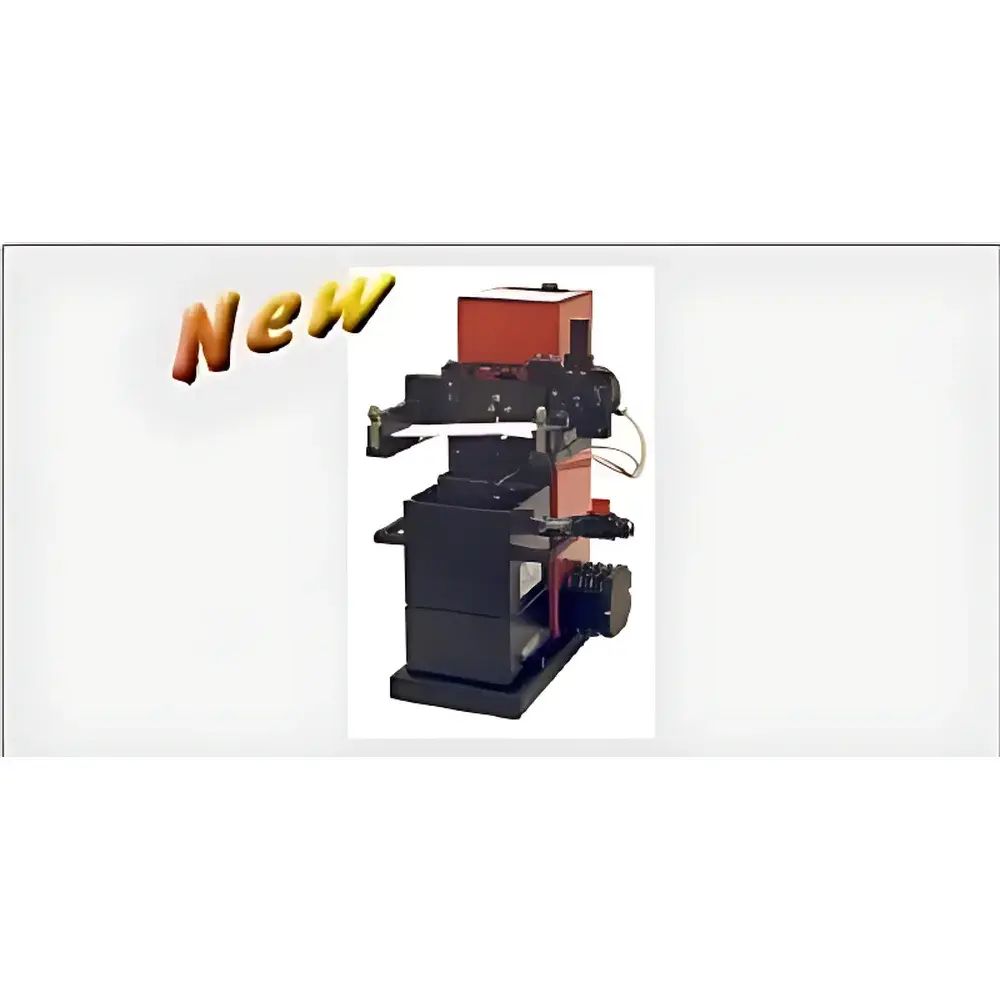
EMTEC emtec PDA.C 02 Penetration Dynamics Analyzer for Wet Expansion Kinetics of Paper and Board
| Brand | EMTEC |
|---|---|
| Origin | Germany |
| Model | emtec PDA.C 02 with WSD 02 Module |
| Power Supply | 230 V, 50 Hz / 115 V, 60 Hz |
| Sample Dimensions | ≥210 mm × (60 ± 0.5) mm |
| Instrument Weight | 8.5 kg |
| Measurement Resolution | ±0.013% strain |
| Reproducibility | ±0.05% absolute strain (0–3% range), ±5% relative error at low elongation |
| Time Resolution | Starts recording from first contact (t = 0 ms), data capture interval ≤100 ms |
| Max. Measurable Wet Expansion | 25% |
| Compliance | Designed for ISO 12625-9, TAPPI T 492 om-22, and ASTM D726-15 aligned test protocols |
Overview
The EMTEC emtec PDA.C 02 Penetration Dynamics Analyzer is a precision-engineered instrument designed to quantify the time-resolved dimensional response of paper, board, and coated substrates upon unilateral liquid contact under controlled tensile load. Unlike conventional two-sided immersion methods, the PDA.C 02 employs a dynamic single-face wetting configuration—where a defined sample strip is subjected to a calibrated mechanical tension while its lower surface contacts a selected aqueous or resin-based liquid (e.g., water, fountain solution, melamine resin, or inkjet ink). This architecture replicates real-world process conditions encountered in paper converting, impregnation, and printing operations. The system captures instantaneous dimensional changes—primarily longitudinal wet expansion—with sub-millisecond temporal initiation and high-resolution strain detection (±0.013%). Its core measurement principle is based on non-contact optical displacement tracking coupled with closed-loop tension control, enabling direct correlation between liquid penetration kinetics and macroscopic dimensional instability.
Key Features
- Unilateral wetting module (WSD 02) with adjustable pre-tension (0–5 N range) to simulate realistic substrate stress states during liquid exposure
- Real-time strain acquisition starting precisely at t = 0 ms—the moment of liquid contact—ensuring no latency in kinetic profiling
- High-resolution optical encoder system delivering strain resolution down to ±0.013% and reproducibility of ±0.05% absolute strain within the 0–3% elongation range
- Full kinetic curve output: wet elongation (%) vs. time (log-scale or linear), with user-definable data points (e.g., ΔL at 1 s, 10 s, 60 s)
- Integrated environmental monitoring: simultaneous recording of ambient temperature, relative humidity, and sample moisture content (via optional hygrometer interface)
- Modular hardware design supporting rapid reconfiguration for different substrate classes (e.g., decorative overlay papers, newsprint, inkjet media, corrugated board liners)
Sample Compatibility & Compliance
The PDA.C 02 is validated for use with standard paper and board specimens meeting ISO 12625-9 specimen geometry requirements (minimum 210 mm × 60 mm). It supports testing across diverse functional categories including decorative laminating papers, gravure- and inkjet-printable grades, packaging boards, and uncoated offset papers. Test liquids include deionized water, lithographic fountain solutions (pH 4.5–5.5), melamine-formaldehyde resins (viscosity 10–500 mPa·s), and commercial inkjet inks. The system’s operational methodology aligns with key industry standards: ISO 12625-9 (wet expansion of tissue and towel), TAPPI T 492 om-22 (dimensional change of paperboard upon wetting), and ASTM D726-15 (resistance of paper to wetting). Data audit trails and user access logs support GLP/GMP environments compliant with FDA 21 CFR Part 11 when paired with validated software configurations.
Software & Data Management
The PDA.C 02 operates via the dedicated emtec PDA Control & Analysis Suite—a Windows-based application featuring intuitive workflow navigation, real-time curve visualization, and automated report generation. All raw displacement-time datasets are stored in vendor-neutral CSV format with embedded metadata (operator ID, timestamp, tension setting, ambient RH/T, liquid ID). The software enables comparative overlay of multiple curves, derivative analysis (dε/dt) for swelling rate quantification, and statistical evaluation across replicate runs. Export options include PDF reports compliant with internal QA documentation requirements and Excel-compatible datasets for integration into LIMS or statistical process control platforms. Audit trail functionality records all parameter modifications, calibration events, and user logins—essential for regulated quality assurance systems.
Applications
- Quantifying differential swelling kinetics between label facestocks exposed to aqueous adhesives or UV-curable inks
- Evaluating dimensional stability of decorative overlay papers during melamine impregnation—critical for laminate manufacturing yield optimization
- Comparing wet expansion profiles of inkjet-coated papers under fountain solution vs. pigment-based ink exposure to predict registration drift in digital press workflows
- Screening base paper candidates for gravure printing by correlating early-time expansion slope (0–2 s) with runnability and dot gain behavior
- Supporting R&D of low-swell barrier coatings by measuring suppression of initial expansion burst (<500 ms) under controlled tension
FAQ
How does the PDA.C 02 differ from traditional wet expansion testers?
It eliminates two-sided immersion artifacts by applying controlled tension during unilateral liquid contact—mimicking actual converting and printing mechanics.
Can the system measure expansion in both machine and cross directions?
Yes, by rotating the sample orientation 90° and repeating the test protocol; directional anisotropy is directly quantifiable.
Is calibration traceable to national metrology institutes?
Strain calibration uses certified gauge blocks and laser interferometry; full calibration certificates are provided per ISO/IEC 17025-accredited procedures.
What liquid delivery mechanisms are supported?
Standard configuration includes gravity-fed reservoir with precision height adjustment; optional syringe pump integration available for viscous resin dosing.
Does the software support multi-user permission levels?
Yes—administrator, technician, and viewer roles with configurable access to method editing, data export, and audit log review functions.



