
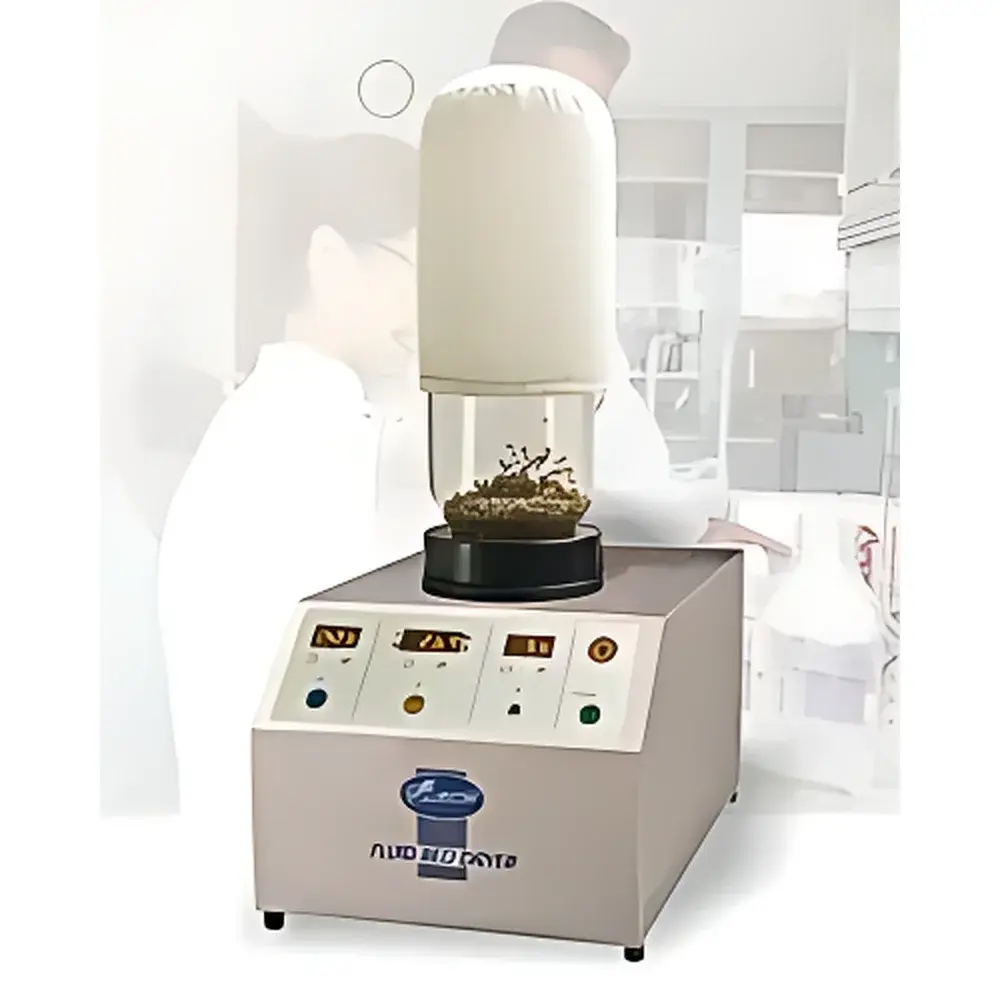
Endecotts FBD2000 Benchtop Fluidized Bed Dryer
| Brand | Endecotts |
|---|---|
| Origin | United Kingdom |
| Model | FBD2000 |
| Temperature Range | 0–200 °C |
| Drying Time Range | 1 s to 99 min 59 s |
| Airflow Rate | 0.4–2.4 m³/min |
| Air Velocity | 0.9–5.0 m/s |
| Chamber Volume | 20 L + 5 L auxiliary |
| Power Supply | 115 V or 230 V, 50/60 Hz, Single-Phase |
| Dimensions (W×H×D) | 260 × 340 × 495 mm |
| Weight | 19 kg |
| Compliance | CE-marked |
| Heating Power | 2 kW |
Overview
The Endecotts FBD2000 Benchtop Fluidized Bed Dryer is an engineered solution for rapid, uniform, and representative moisture removal from granular and powdered samples prior to particle size analysis, quality control testing, or material characterization. It operates on the principle of fluidization—where high-velocity heated air passes upward through a perforated distribution plate, suspending solid particles in a dynamic, turbulent state analogous to a boiling liquid. This mechanism maximizes surface-area-to-volume exposure, enabling highly efficient convective heat transfer and minimizing thermal degradation, segregation, or oxidation risks associated with static drying methods. Unlike conventional ovens, microwave systems, or vacuum dryers, the FBD2000 achieves complete drying in under 15 minutes—with typical cycle times ranging from seconds to several minutes—while preserving sample integrity and compositional fidelity. Its compact footprint and CE-compliant design make it suitable for ISO/IEC 17025-accredited laboratories, pharmaceutical QC environments, and R&D facilities requiring GLP-aligned sample preparation workflows.
Key Features
- High-precision digital temperature control (0–200 °C) with ±1 °C stability via closed-loop feedback system
- Adjustable airflow (0.4–2.4 m³/min) and velocity (0.9–5.0 m/s), optimized in real time by visual observation through the transparent acrylic column
- Programmable digital timer (1 s to 99 min 59 s) with audible end-of-cycle alert and automatic power cutoff
- Dual-chamber configuration: standard 20 L main drying cylinder plus optional 5 L auxiliary chamber for sequential or comparative runs
- Interchangeable drying vessels: stainless steel and borosilicate glass cylinders (2 L and 5 L); 4-position 250 mL multi-vessel adapter for parallel sample processing
- Removable nylon or Dacron filter bags (standard); high-temperature variants available for extended thermal duty cycles
- 2 kW integrated heating element with guarded thermal cut-off and overtemperature protection
Sample Compatibility & Compliance
The FBD2000 is validated for drying a broad spectrum of free-flowing particulates—including pharmaceutical excipients, catalyst powders, food ingredients (e.g., milk powder, starches), mineral ores, ceramic precursors, and polymer granules—without agglomeration or attrition. Its fluidization dynamics ensure homogenization during drying, eliminating stratification and delivering analytically representative sub-samples for downstream laser diffraction, sieve analysis, or BET surface area measurement. The instrument conforms to CE safety directives (2014/35/EU Low Voltage Directive and 2014/30/EU EMC Directive). When operated within defined SOPs, it supports compliance with ASTM D1890 (Standard Test Method for Moisture in Activated Carbon), ISO 787-2 (General Methods of Test for Pigments and Extenders), and USP <1251> (Residual Solvents), as well as internal validation protocols required under FDA 21 CFR Part 11 for electronic record integrity.
Software & Data Management
The FBD2000 is a standalone hardware platform with no embedded software or network interface. All operational parameters—including setpoint temperature, airflow level, and timer duration—are configured manually via front-panel controls and displayed on an integrated digital LED readout. For laboratories requiring audit-trail capability, external data loggers may be connected to monitor and record temperature and elapsed time using calibrated thermocouples (Type K recommended). The absence of firmware or cloud connectivity ensures deterministic behavior, full user control, and compatibility with air-gapped environments common in regulated GMP manufacturing and reference material certification labs.
Applications
- Rapid pre-analysis drying of samples for laser diffraction particle sizing (e.g., Malvern Mastersizer, Beckman Coulter LS series)
- Moisture conditioning of catalysts and adsorbents prior to surface area or pore volume determination (BET, BJH)
- Stabilization of hygroscopic APIs and intermediates before content uniformity or dissolution testing
- Batch-wise drying of mineral concentrates for XRD, SEM-EDS, or ICP-OES sample prep
- Process development support for fluid bed granulation and coating unit operations
- Validation of drying kinetics under controlled thermal and aerodynamic conditions
FAQ
What types of materials are unsuitable for fluidized bed drying on the FBD2000?
Fine cohesive powders (e.g., nanoscale silica, certain clays), fibrous materials, or low-density flakes that lack sufficient terminal velocity to sustain stable fluidization may channel or entrain excessively. Pre-screening via Geldart classification is recommended.
Can the FBD2000 be used for drying heat-sensitive biological samples?
Yes—provided inlet air temperature and residence time are carefully optimized. Its rapid drying kinetics reduce thermal exposure relative to convection ovens, though lyophilization remains preferred for labile proteins or enzymes.
Is the glass drying cylinder resistant to thermal shock during rapid temperature changes?
Borosilicate glass components are rated for continuous use up to 200 °C; however, sudden immersion of cold samples into hot chambers or quenching with ambient air should be avoided to prevent fracture.
How often must the filter bag be replaced, and is cleaning permitted?
Nylon/Dacron bags are single-use per ISO 17025 traceability requirements; reusable alternatives are not supplied due to cross-contamination and filtration efficiency degradation risks.
Does Endecotts provide IQ/OQ documentation for the FBD2000?
Factory-issued calibration certificates for temperature and timer accuracy are available upon request; site-specific qualification protocols must be developed by the end-user’s QA team in accordance with local regulatory expectations.



