
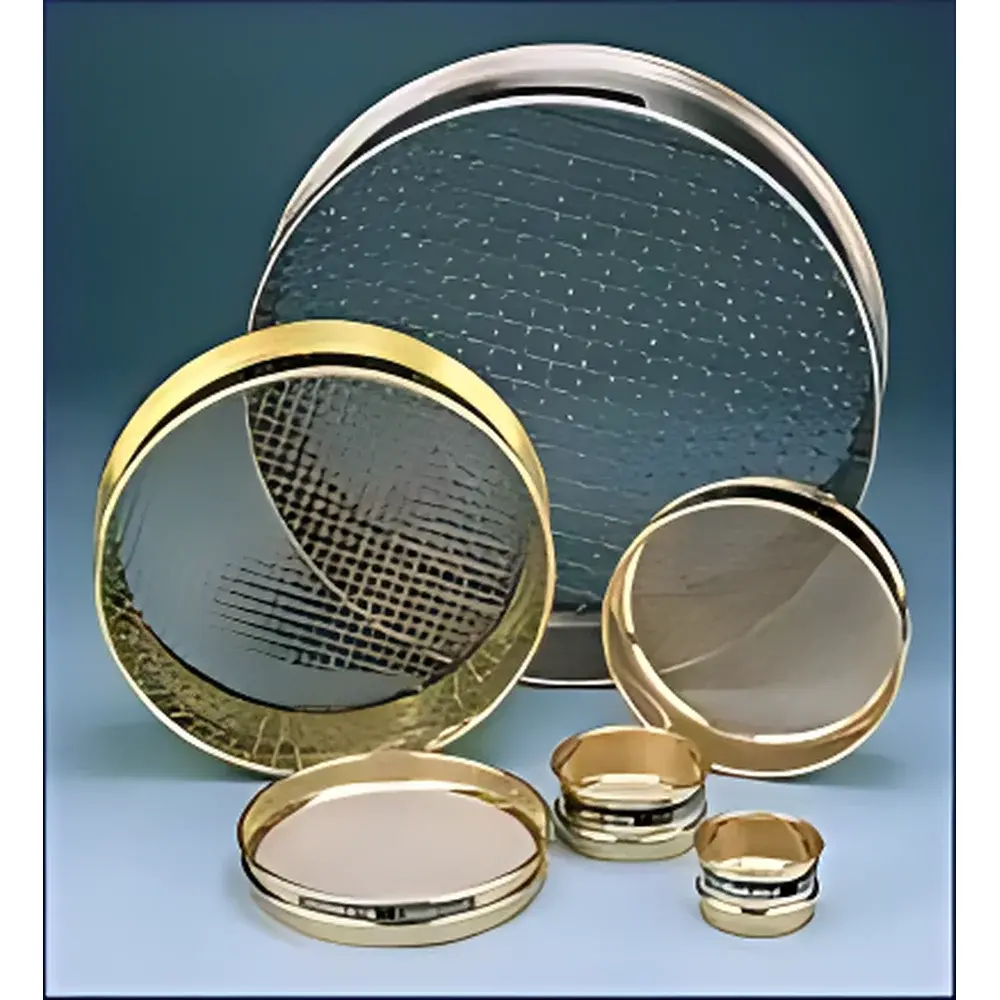
Endecotts Woven Wire Mesh Test Sieves
| Brand | Endecotts |
|---|---|
| Origin | United Kingdom |
| Model | BS EN ISO 3310-1 / ASTM E11 Compliant Woven Wire Test Sieves |
| Diameter Options | 38, 100, 150, 200, 250, 300, 315, 350, 400, 450 mm & 3", 8", 12", 18" |
| Aperture Range | 20 µm to 125 mm |
| Material Options | Stainless Steel, Brass, Electroplated Steel |
| Compliance | BS 410:2000, ISO 3310-1:2016 & ISO 3310-2:2016, ASTM E11-22, UK Kitemark Certified |
| Traceability | Individual serial number per sieve with accredited calibration certificate |
Overview
Endecotts woven wire mesh test sieves are precision-engineered laboratory-grade sieving tools designed for accurate, repeatable particle size distribution analysis in accordance with internationally recognized standards. These sieves operate on the principle of mechanical separation—particles are classified by physical passage through precisely manufactured apertures in a tensioned metal mesh mounted within a rigid frame. The fundamental measurement relies on nominal aperture size (defined as the center-to-center distance between adjacent parallel wires), which is verified using traceable optical metrology systems calibrated to NPL (National Physical Laboratory) standards. Each sieve is manufactured under strict quality control protocols to meet the dimensional tolerances and mesh integrity requirements specified in BS EN ISO 3310-1 (for woven wire mesh) and ISO 3310-2 (for perforated plate sieves), as well as ASTM E11–22 for general laboratory use. Their application spans QC laboratories in pharmaceuticals, minerals processing, construction materials, food science, and advanced ceramics—where regulatory compliance, inter-laboratory reproducibility, and audit-ready documentation are mandatory.
Key Features
- Manufactured in the UK to BS EN ISO 3310-1:2016 and ASTM E11–22 specifications—certified by the British Standards Institution (BSI) and bearing the UK Kitemark for conformity assurance.
- Each sieve carries a unique laser-engraved serial number enabling full traceability from raw material sourcing through optical aperture verification to final certification.
- Optically verified aperture accuracy: apertures measured using computer-controlled digital imaging systems with sub-micron resolution; certified uncertainty ≤ ±1.5% for apertures ≥ 75 µm.
- Robust frame construction in stainless steel (AISI 304 or 316), brass, or electroplated steel—designed to withstand mechanical agitation in sieve shakers without frame deformation or mesh distortion.
- Seamless, fully sealed frame design prevents sample loss during vibratory or tapping sieving procedures—critical for low-mass or hazardous particulate samples.
- Available in both full-height (standard depth) and half-height configurations to accommodate different sieve shaker platforms and sample volume requirements.
Sample Compatibility & Compliance
Endecotts test sieves support dry and wet sieving of free-flowing, non-agglomerating powders, granules, and crushed solids across diverse industries. They are routinely employed in method validation studies compliant with USP , EP 2.9.33, and ISO 13320:2020 (laser diffraction correlation). For regulated environments—including pharmaceutical manufacturing under GMP and clinical trial material testing—the sieves provide documented evidence of metrological traceability required for FDA 21 CFR Part 11 and EU Annex 11 compliance. All calibration certificates include reference to UKAS-accredited measurement procedures and are issued under ISO/IEC 17025:2017 scope. Sieves are supplied with formal declarations of conformity to BS 410:2000 and ISO 3310-1:2016, confirming adherence to maximum permissible deviations in wire diameter, aperture size, and mesh planarity.
Software & Data Management
While Endecotts test sieves are passive hardware components, they integrate seamlessly into digital quality management workflows. Each serial-numbered sieve links to an electronic certificate of conformance accessible via Endecotts’ secure customer portal—containing aperture measurement reports, material certifications, and shelf-life metadata. Laboratories may import this data directly into LIMS (Laboratory Information Management Systems) or ELN (Electronic Lab Notebook) platforms using standardized CSV or XML exports. For audit readiness, all certificates include digital signatures, timestamped verification logs, and revision history aligned with GLP/GMP documentation requirements. Optional QR-coded labels enable rapid field verification during internal audits or regulatory inspections.
Applications
- Pharmaceutical granulation endpoint determination and excipient particle sizing per ICH Q5A and USP .
- Mineralogical classification of ores and aggregates per ASTM C136 and ISO 2591-1.
- Quality control of cement fineness (Blaine surface area correlation) and fly ash grading.
- Food ingredient particle distribution analysis—e.g., flour, sugar, dairy powders—per AOAC 991.02 and ISO 6613.
- Characterization of catalyst supports, battery electrode powders, and additive manufacturing feedstocks.
- Validation of jet mill or air classifier performance in continuous powder processing lines.
FAQ
Are Endecotts test sieves suitable for wet sieving applications?
Yes—stainless steel and brass frames with welded or brazed mesh junctions ensure corrosion resistance and structural integrity during aqueous suspension sieving. Perforated plate variants (ISO 3310-2) are recommended for highly abrasive or viscous slurries.
How often should test sieves be recalibrated?
Endecotts recommends annual verification for routine QC use. Recalibration is mandatory after mechanical damage, excessive cleaning cycles, or exposure to thermal shock exceeding 150 °C.
Do you supply sieves with certified reference materials (CRM)?
Endecotts does not supply CRM but provides traceable aperture certification against NPL-traceable masters. Third-party CRM providers (e.g., NIST SRM 224a, BAM microspheres) can be used in conjunction with these sieves for method validation.
Can I request custom aperture sizes outside the standard range?
Custom woven meshes down to 15 µm and up to 150 mm are available upon engineering review—subject to minimum order quantity and extended lead time. All custom apertures undergo full optical certification.
Is there a difference between “test sieve” and “analytical sieve” terminology?
No functional distinction exists—both terms refer to sieves meeting ISO 3310-1 or ASTM E11 dimensional tolerances for quantitative particle size analysis. “Test sieve” is the preferred term in European and ISO contexts; “analytical sieve” appears more frequently in North American pharmacopeial texts.



