
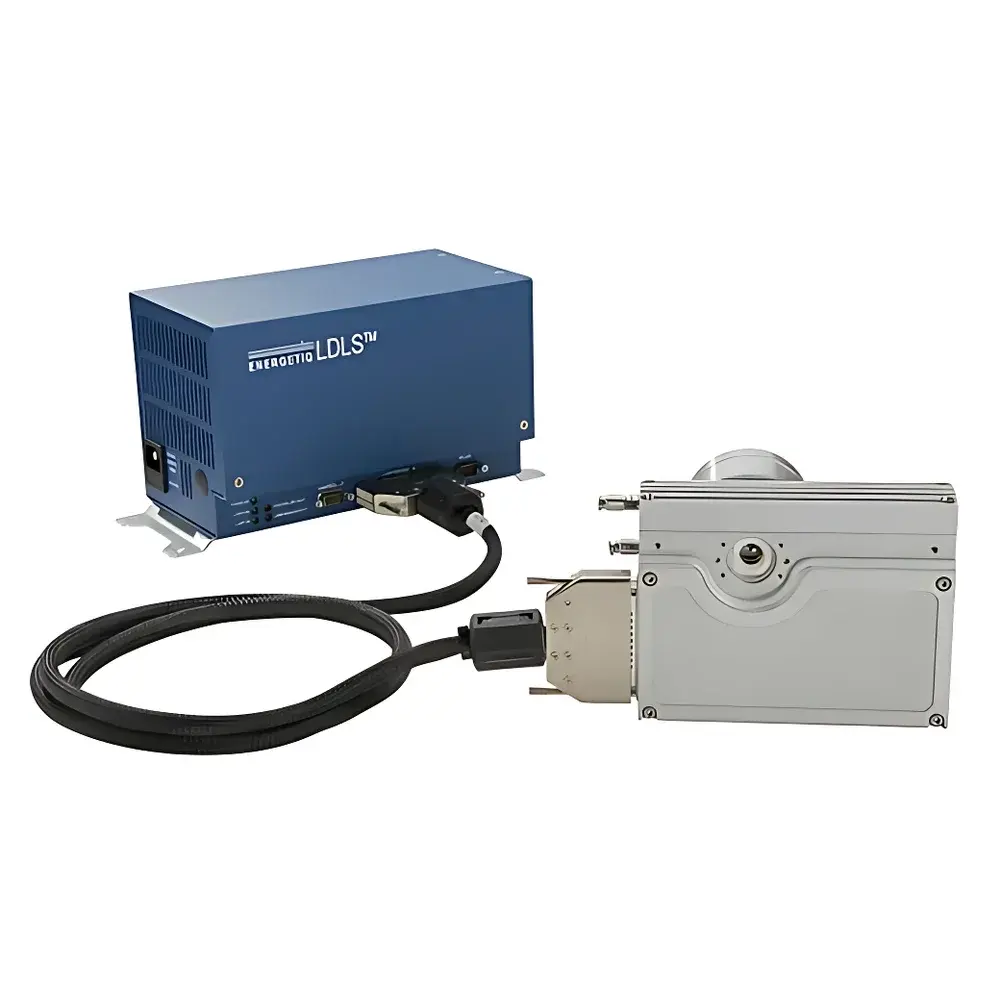
Energetiq EQ-77 LDLS™ Laser-Driven Light Source
| Brand | Energetiq |
|---|---|
| Origin | USA |
| Model | EQ-77 LDLS™ |
| Light Source Type | Laser-Driven Plasma Light Source |
| Illumination Mode | External Illumination |
| Spectral Range | 170–2100 nm |
| Numerical Aperture (NA) | up to 0.5 |
| Typical Lamp Lifetime | >9,000 hours |
| Lamp Dimensions | 135.6 × 144.9 × 56 mm |
| Lamp Weight | 2.7 kg |
| Power Supply Dimensions | 132.6 × 482.6 × 583.6 mm |
| Power Supply Weight | 18.8 kg |
| Output Configuration | Single- or Dual-Beam Optional |
| Radiance | >40 mW/mm²·sr·nm (wavelength-dependent) |
Overview
The Energetiq EQ-77 LDLS™ Laser-Driven Light Source is a high-brightness, electrode-free broadband continuum source engineered for demanding optical metrology and spectroscopic applications. Unlike conventional arc lamps (e.g., xenon or mercury), the EQ-77 employs a focused high-power laser to sustain a stable, high-temperature plasma in a flowing xenon gas environment—eliminating electrode erosion, spectral drift, and intensity flicker associated with electrical discharge sources. This laser-driven plasma architecture delivers exceptional radiometric stability, spatial coherence, and long-term reproducibility across the deep ultraviolet (DUV) through near-infrared (NIR) spectrum (170–2100 nm). Its compact water-cooled lamp head and integrated control electronics are optimized for integration into vacuum-compatible systems, monochromators, ellipsometers, and synchrotron beamline instrumentation where low noise, high photon flux, and minimal thermal load are critical.
Key Features
- Laser-driven plasma operation ensures electrode-free, maintenance-light performance with >9,000 hours typical lifetime—significantly exceeding traditional arc lamps.
- High radiance output (>40 mW/mm²·sr·nm, wavelength-dependent) enables rapid data acquisition in low-light or high-resolution spectroscopy applications.
- Exceptional short- and long-term stability: <0.2% RMS intensity noise over 1 hour; <0.5% spatial centroid drift over 8 hours—critical for quantitative reflectometry and photoluminescence mapping.
- Ultra-broad spectral coverage from 170 nm (vacuum UV, requiring purge or vacuum environment) to 2100 nm supports multi-region calibration and cross-platform method transfer.
- Dual-beam or single-beam output configuration provides flexibility for reference-channel setups, differential measurements, or space-constrained optical benches.
- Compact, modular design: lamp head (135.6 × 144.9 × 56 mm, 2.7 kg) separates from power supply (132.6 × 482.6 × 583.6 mm, 18.8 kg), facilitating installation in cleanroom or UHV environments.
- Water-cooled lamp chamber maintains thermal equilibrium under continuous operation, minimizing thermal lensing and spectral shift.
Sample Compatibility & Compliance
The EQ-77 LDLS™ is compatible with standard optical mounts (e.g., SM1, SM2 threading), fiber-coupled adapters (including UV-grade fused silica fibers), and vacuum feedthroughs (optional). It meets CE safety directives and complies with IEC 61000-6-3 (EMC emission) and IEC 61000-6-2 (immunity) standards. For regulated laboratory environments, its digital control interface supports timestamped operational logs and firmware version tracking—enabling alignment with GLP documentation requirements. While not inherently 21 CFR Part 11 compliant, system-level validation (e.g., audit trail generation via host software) can be implemented when integrated into validated analytical workflows per FDA guidance.
Software & Data Management
The EQ-77 operates via RS-232 or USB 2.0 communication using Energetiq’s proprietary LDLS Control Software (Windows-compatible), which provides real-time monitoring of lamp current, coolant temperature, plasma status, and operational hours. All parameters are programmable—including ramp-up profiles, standby modes, and interlock-triggered shutdowns. The software exports ASCII log files (.csv) containing time-stamped telemetry for traceability and trend analysis. Third-party integration is supported via LabVIEW VIs, Python drivers (PySerial-based), and MATLAB instrument control toolboxes—facilitating automation in custom spectrometer control stacks or semiconductor process monitoring platforms.
Applications
- Semiconductor metrology: broadband reflectometry, OCD (optical critical dimension), and thin-film thickness mapping from DUV to NIR.
- UV-VIS-NIR absorbance, fluorescence, and Raman spectroscopy—particularly where high signal-to-noise ratio and wavelength agility are required.
- Monochromator and spectrograph illumination: superior étendue matching and reduced stray light compared to arc lamps.
- Photoemission electron microscopy (PEEM) illumination: stable, high-brightness DUV output enables surface-sensitive work function and band structure imaging.
- Optical component testing: spectral responsivity calibration of detectors, transmittance/reflectance characterization of coatings and filters.
- Materials science: time-resolved photoluminescence excitation (PLE) spectroscopy and photoconductivity studies across wide bandgaps.
- Advanced imaging: structured illumination, multispectral histopathology, and quantitative phase contrast microscopy requiring stable white-light coherence.
FAQ
What distinguishes LDLS technology from traditional xenon arc lamps?
LDLS eliminates electrodes entirely, removing primary failure modes such as cathode sputtering, bulb blackening, and spectral instability—resulting in higher radiance, longer lifetime, and improved measurement repeatability.
Is vacuum or purging required for operation below 190 nm?
Yes—oxygen absorption strongly attenuates light below ~190 nm; operation in air requires nitrogen purge or vacuum-compatible optical paths for full 170 nm utilization.
Can the EQ-77 be synchronized with pulsed detection systems?
While the LDLS emits continuous-wave light, its electronic shutter and modulation input allow TTL-triggered on/off control with <10 µs rise/fall times—suitable for gated detection schemes.
Does the system support remote diagnostics and predictive maintenance?
Real-time telemetry (coolant temp, plasma voltage, operational hours) is accessible via serial/USB; predictive maintenance intervals are configurable in software based on cumulative runtime and thermal history.
What optical interfaces are available for fiber coupling?
Standard options include SMA-905, FC/PC, and custom vacuum feedthroughs with UV-transmitting fused silica fibers—custom NA-matched collimators also available upon request.




