
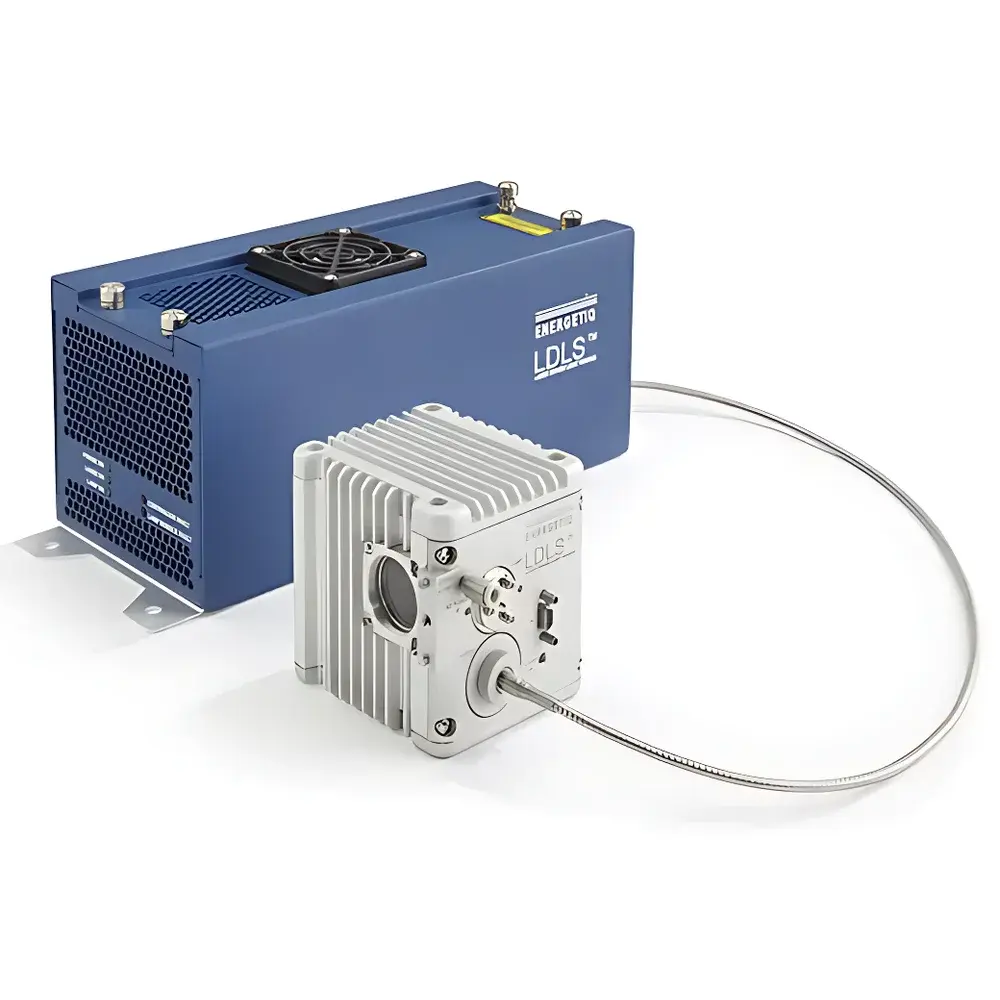
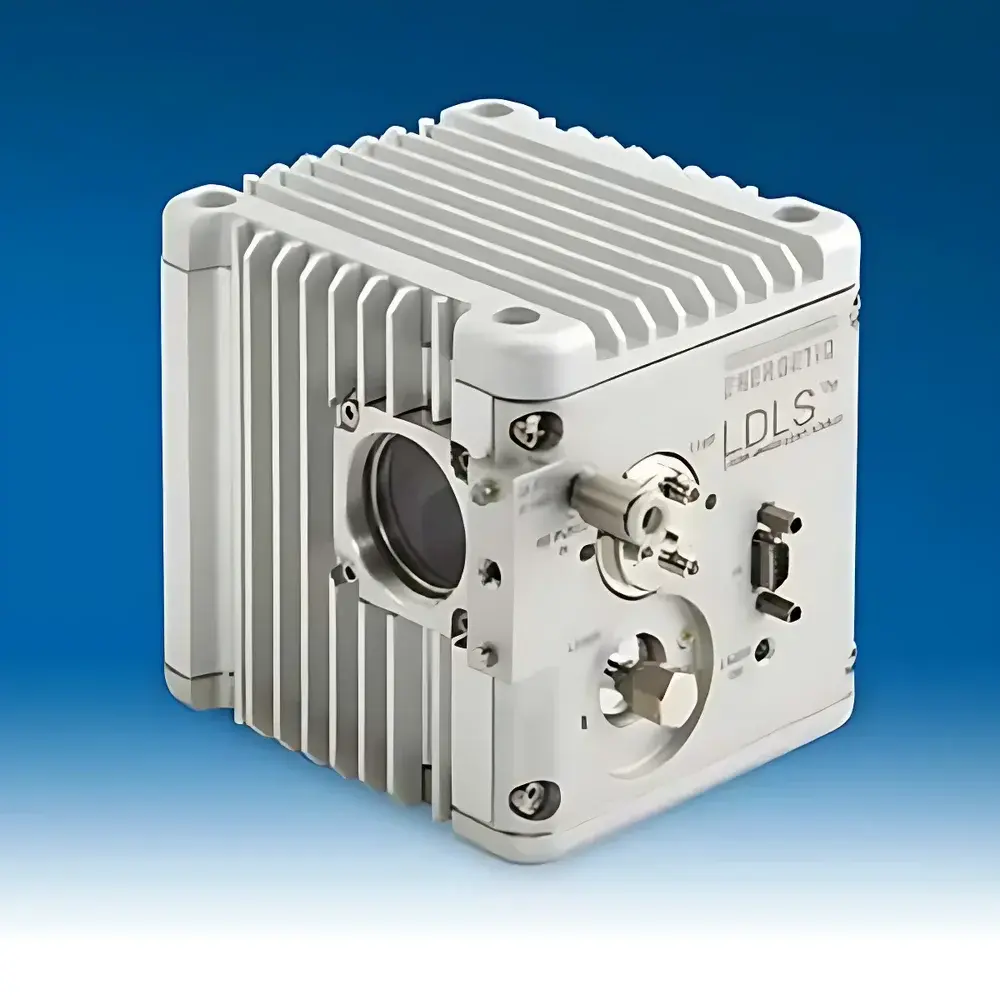
Energetiq EQ-99X Laser-Driven Light Source
| Brand | Energetiq |
|---|---|
| Origin | USA |
| Manufacturer Type | Authorized Distributor |
| Origin Category | Imported |
| Model | EQ-99X |
| Light Source Type | Laser-Driven Plasma Light Source |
| Illumination Mode | External Illumination |
| Spectral Range | 170–2100 nm |
| Numerical Aperture (NA) | up to 0.47 |
| Typical Lamp Lifetime | >9,000 hours |
| Output Options | Free-Space or Fiber-Coupled |
| Source Dimensions | 82.3 × 85.7 × 76.2 mm |
| Source Weight | 0.7 kg |
| Power Supply Dimensions | 107 × 111 × 254 mm (excl. feet) |
| Power Supply Weight | 1.4 kg |
Overview
The Energetiq EQ-99X Laser-Driven Light Source is a high-brightness, electrode-free broadband continuum source engineered for demanding optical metrology and spectroscopic applications. Unlike conventional arc lamps (e.g., deuterium, tungsten-halogen, or xenon), the EQ-99X employs a focused high-power laser to sustain a stable, high-temperature plasma in a flowing xenon gas environment. This laser-driven plasma mechanism eliminates electrode erosion, thermal drift, and spectral discontinuities associated with electrically driven lamps—resulting in exceptional radiometric stability, extended operational lifetime, and broad spectral continuity from deep ultraviolet (170 nm) through visible to near-infrared (2100 nm). Its compact form factor, low thermal load, and absence of high-voltage ignition circuits make it suitable for integration into vacuum-compatible systems, confocal microscopes, monochromator-based spectrometers, and automated analytical platforms requiring long-term unattended operation.
Key Features
- Laser-pumped xenon plasma technology enabling electrode-free, maintenance-free operation
- Continuous broadband emission spanning 170–2100 nm with smooth spectral irradiance profile
- High spatial stability (< ±0.5 µm centroid drift over 8 hours) ensuring repeatability in imaging and scanning applications
- Short-term power stability < ±0.2% RMS (1 s averaging) and long-term stability < ±0.5% over 100 hours (at constant ambient conditions)
- Numerical aperture up to 0.47 for efficient coupling into monochromators, fiber optics, and high-NA microscope objectives
- Modular output configuration: selectable free-space collimated beam or SMA/FC fiber-coupled delivery
- Compact source head (82.3 × 85.7 × 76.2 mm; 0.7 kg) with integrated thermal management and sealed xenon flow path
- Dedicated switching-mode power supply (107 × 111 × 254 mm; 1.4 kg) featuring active current regulation, interlock monitoring, and RS-232/USB control interface
Sample Compatibility & Compliance
The EQ-99X is designed for compatibility with standard optical breadboards, spectroscopic instrumentation, and OEM integration environments. Its external illumination architecture supports both normal-incidence and oblique-angle sample excitation without requiring internal lamp chamber modification. The source meets IEC 61000-6-3 (EMC emission) and IEC 61000-6-2 (immunity) standards. While not classified as a medical device, its radiometric performance aligns with calibration traceability requirements per ISO/IEC 17025 when used with NIST-traceable reference detectors. For regulated analytical workflows—including those governed by USP , ASTM E308, or ISO 13406-1—the EQ-99X serves as a stable primary irradiance source when paired with appropriate calibration protocols and audit-ready software logging.
Software & Data Management
The EQ-99X includes a native Windows-compatible control application supporting real-time monitoring of plasma current, lamp temperature, and power supply status. Firmware-upgradable via USB, the unit provides programmable on/off sequencing, intensity ramping (0–100% in 0.1% steps), and TTL-triggered synchronization for time-resolved measurements. All operational parameters—including cumulative runtime, thermal history, and fault logs—are stored in non-volatile memory and exportable as CSV for GLP/GMP-compliant record retention. When integrated with third-party DAQ systems (e.g., LabVIEW, Python PyVISA), the device supports full 21 CFR Part 11 compliance through external electronic signature and audit trail implementation.
Applications
- UV-Vis-NIR absorbance, reflectance, and transmittance spectroscopy
- Monochromator and spectrograph illumination for high-resolution spectral analysis
- Optical component characterization (coating transmission, filter bandpass, lens MTF)
- Fluorescence excitation and lifetime measurement systems
- Atomic absorption spectroscopy (AAS) background correction and continuum source calibration
- Material science applications including thin-film ellipsometry and photoluminescence mapping
- Environmental monitoring instrumentation requiring stable broadband excitation (e.g., DOAS, CRDS)
- Gas-phase reaction kinetics studies using time-resolved absorption spectroscopy
- Long-duration stability-critical applications such as space instrument ground calibration and metrology reference standards
FAQ
How does the EQ-99X differ fundamentally from traditional xenon arc lamps?
The EQ-99X replaces electrode-based electrical discharge with laser-induced plasma, eliminating cathode sputtering, spectral flicker, and output degradation due to electrode wear.
Is ozone generation a concern when operating below 200 nm?
Yes—operation below ~220 nm in ambient air produces ozone; use in purged (N₂ or Ar) or vacuum environments is recommended for UV-C applications.
Can the EQ-99X be synchronized with pulsed lasers or gated detectors?
Yes—TTL-compatible trigger input enables precise temporal alignment with external equipment at frequencies up to 10 kHz.
What maintenance is required during its >9,000-hour lifetime?
No scheduled lamp replacement or electrode cleaning is required; only periodic inspection of cooling airflow and fiber connector cleanliness is advised.
Does the source support radiometric calibration traceable to NIST?
The EQ-99X itself is not calibrated upon shipment, but its spectral irradiance output is compatible with NIST-traceable transfer standards (e.g., FEL lamps, calibrated photodiodes) for lab-level calibration.




