
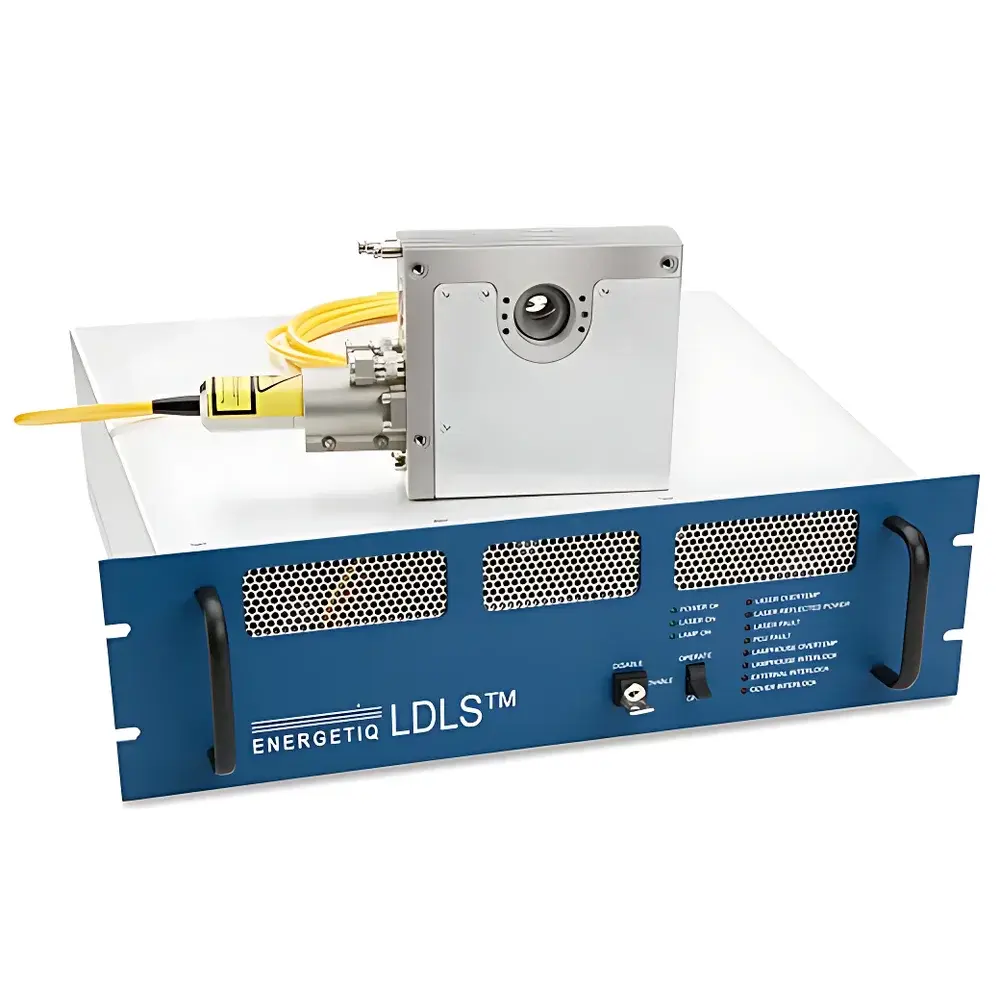
Energetiq EQ400 Laser-Driven Broadband Light Source
| Brand | Energetiq |
|---|---|
| Origin | USA |
| Manufacturer Type | Authorized Distributor |
| Import Status | Imported |
| Model | EQ400 |
| Light Source Type | Laser-Driven Plasma Light Source |
| Illumination Mode | External Illumination |
| Spectral Range | 170–2100 nm |
| Numerical Aperture (NA) | Up to 0.5 |
| Typical Lamp Lifetime | >9,000 hours |
| Lamp Dimensions | 135.6 × 144.9 × 56 mm |
| Lamp Weight | 2.7 kg |
| Power Supply Dimensions | 132.6 × 482.6 × 583.6 mm |
| Power Supply Weight | 18.8 kg |
| Output Configuration | Single- or Dual-Beam Optional |
Overview
The Energetiq EQ400 Laser-Driven Broadband Light Source is an engineered solution for demanding optical applications requiring high-brightness, stable, electrode-free continuum illumination across the deep ultraviolet (DUV) through near-infrared (NIR) spectrum. Unlike conventional arc lamps—such as xenon or mercury—which rely on thermionic emission from electrodes and suffer from spectral drift, electrode erosion, and limited lifetime—the EQ400 employs a proprietary laser-pumped plasma technology. A high-repetition-rate pulsed laser focuses energy into a flowing gas (typically xenon), generating a high-temperature, spatially confined plasma that emits intense, broadband radiation without physical electrodes. This fundamental design eliminates electrode sputtering, thermal fatigue, and associated spectral instability, resulting in exceptional long-term radiometric stability and reproducibility. The EQ400 is specifically designed for integration into precision optical platforms where measurement fidelity, low temporal noise, and minimal maintenance are critical—particularly in metrology-grade spectroscopy, semiconductor process monitoring, and synchrotron beamline instrumentation.
Key Features
- Laser-driven plasma architecture ensures electrode-free operation, eliminating spectral degradation mechanisms inherent in arc lamps.
- High radiant intensity exceeding 10 mW/mm²·sr·nm (wavelength-dependent), enabling rapid data acquisition in time-sensitive measurements such as real-time thin-film monitoring or dynamic reflectance profiling.
- Low-intensity noise (<0.2% RMS, 10 Hz–10 MHz bandwidth) and superior spatial stability (<0.5 µrad pointing drift over 8 hours), supporting sub-pixel registration in imaging and high-resolution monochromator calibration.
- Continuous spectral output spanning 170–2100 nm—covering DUV (e.g., 193 nm lithography reference lines), UV-VIS, and extended NIR—without gaps or discontinuities typical of filtered lamp systems.
- Configurable optical output: factory-selectable single-beam or dual-beam delivery via integrated fiber-coupled or free-space ports, facilitating simultaneous reference/sample illumination or differential measurement schemes.
- Compact, water-cooled lamp head (135.6 × 144.9 × 56 mm; 2.7 kg) with ultra-clean internal construction minimizes outgassing and particulate generation—critical for vacuum-compatible applications including PEEM and UHV surface analysis chambers.
- Digital power supply with Ethernet-enabled control (SCPI-compliant) supports remote triggering, intensity modulation (0–100% via analog/digital input), and real-time status telemetry—including plasma ignition count, coolant temperature, and operational hours.
Sample Compatibility & Compliance
The EQ400 is compatible with standard optical interfaces including SMA905, FC/PC, and kinematic mirror mounts. Its low-ozone emission profile (tested per ISO 15714:2018 Annex B) and absence of mercury or hazardous electrode materials align with RoHS Directive 2011/65/EU and WEEE compliance requirements. For regulated environments—including ISO/IEC 17025-accredited laboratories and FDA-regulated photometric validation workflows—the EQ400’s deterministic plasma ignition sequence, non-volatile operational history logging, and audit-trail-capable firmware support GLP/GMP documentation practices. While not intrinsically certified for Class I laser safety, its integrated interlock circuitry (IEC 60825-1:2014 compliant) ensures automatic shutdown upon enclosure breach or coolant flow interruption.
Software & Data Management
The EQ400 integrates seamlessly with third-party control environments via TCP/IP (SCPI over Ethernet) or USB 2.0. Energetiq provides a cross-platform SDK (C/C++, Python, LabVIEW) enabling full parameterization—including pulse repetition rate adjustment (1–10 kHz), intensity ramping profiles, and scheduled warm-up sequences. All operational logs—including lamp-on time, thermal events, and firmware version—are timestamped and exportable in CSV format. When deployed in automated test systems governed by 21 CFR Part 11, the device supports electronic signature-ready audit trails when paired with validated host software (e.g., Keysight PathWave, Thermo Fisher OMNIC Paradigm).
Applications
- Semiconductor metrology: Critical dimension uniformity mapping, EUV mask inspection calibration, and photoresist sensitivity characterization.
- UV-VIS-NIR spectrophotometry: High-accuracy absorbance/transmittance referencing in ASTM E275, ISO 105-C06, and USP compliant setups.
- Monochromator and spectrograph illumination: Stable, high-etendue source for grating efficiency mapping and stray-light characterization.
- Photonic device testing: Wavelength-dependent responsivity calibration of photodiodes, CCD/CMOS sensors, and optical filters per IEC 61223-3-5.
- Photoemission Electron Microscopy (PEEM): Coherent, low-noise DUV excitation for work-function and band-structure studies under UHV conditions.
- Thin-film and coating analysis: In-situ ellipsometry and reflectometry during PVD/CVD deposition processes.
- Advanced imaging: Uniform illumination for quantitative phase contrast, fluorescence lifetime (FLIM), and hyperspectral microscopy.
FAQ
What distinguishes laser-driven plasma sources from traditional xenon arc lamps?
Laser-driven plasma sources eliminate electrodes entirely, removing primary failure modes—such as cathode sputtering, seal degradation, and spectral shift due to electrode wear—thereby delivering superior long-term stability and >9,000-hour lifetime.
Is the EQ400 suitable for vacuum environments?
Yes—the lamp head features ultra-high-purity stainless-steel construction and bake-out compatible seals (rated to 1×10⁻⁶ mbar), making it appropriate for PEEM, XPS, and other UHV surface science applications.
Can output intensity be modulated dynamically during acquisition?
Yes—intensity is controllable via 0–10 V analog input or SCPI command with ≤10 µs rise time, enabling lock-in detection, pump-probe synchronization, and duty-cycle optimization.
Does the EQ400 require periodic gas replenishment?
No—the sealed xenon plasma chamber operates as a closed-loop system with no consumable gas refills required over its rated lifetime.
How is spectral calibration traceability ensured?
Each unit ships with NIST-traceable spectral irradiance calibration data (170–2100 nm, ±2% uncertainty at k=2), acquired using double-monochromator-based reference standards per ISO/IEC 17025 procedures.



