
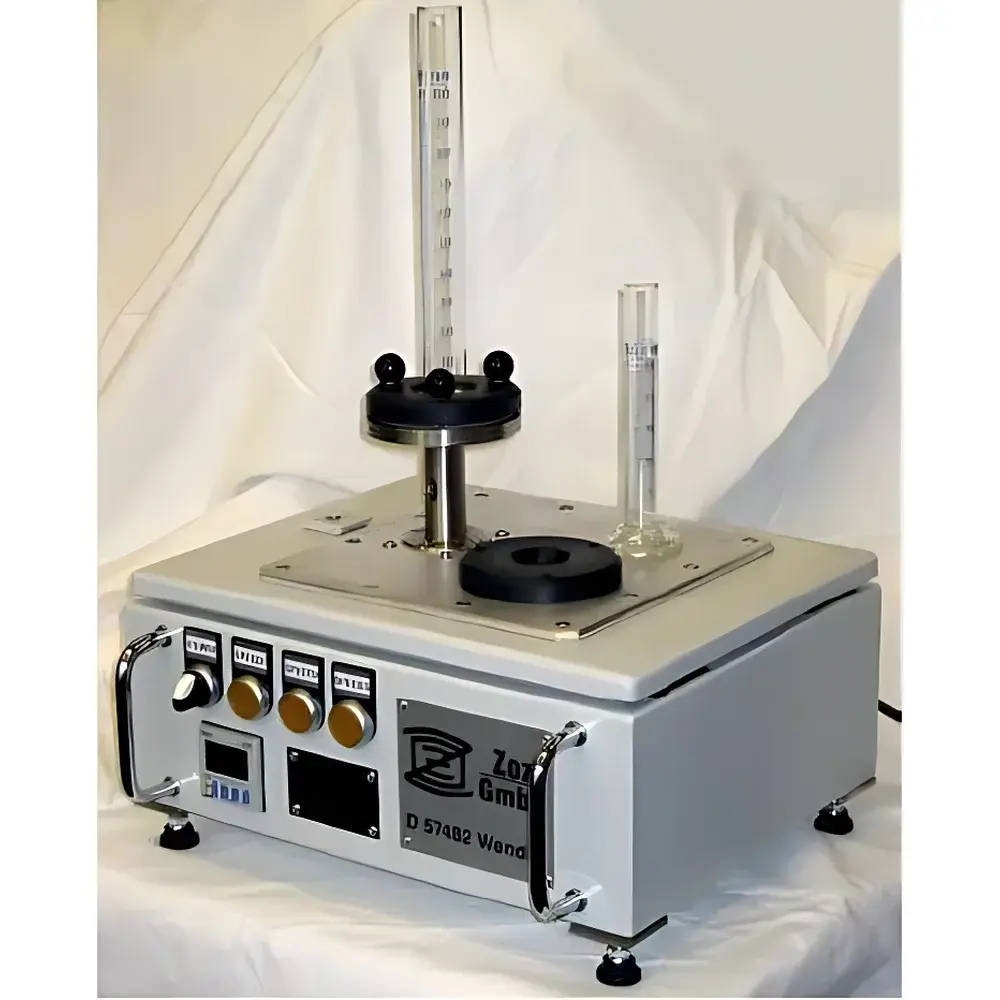
Engelsmann STAV II Tap Density Tester for Powders
| Brand | Engelsmann |
|---|---|
| Origin | Germany |
| Model | KDM01 |
| Instrument Type | Laboratory Benchtop Tap Density Analyzer |
| Measurement Principle | Mechanical Vibration-Based Volume Reduction (DIN ISO 3953 Compliant) |
| Sample Tube Capacity | 25 mL and 100 mL |
| Vibration Frequencies | 100 / 200 / 300 Hz |
| Amplitude | 3 mm |
| Dimensions (L×W×H) | 390 × 380 × 270 mm |
| Net Weight | 17 kg |
| Power Rating | 55 W |
| Voltage | 110/220 V AC |
| Minimum Sample Volume | 10 mL |
| Density Resolution | 0.001 g/cm³ |
| Operating Temperature | Ambient (15–30 °C) |
| Compliance | DIN ISO 3953, ASTM D4781, USP <616>, EP 2.9.34 |
Overview
The Engelsmann STAV II Tap Density Tester is a precision-engineered laboratory instrument designed to determine the tap (or bulk) density of free-flowing and cohesive powders, granules, and particulate solids in accordance with internationally recognized standards—including DIN ISO 3953, ASTM D4781, USP , and European Pharmacopoeia 2.9.34. Tap density is defined as the mass of powder per unit volume after mechanical vibration induces particle rearrangement and interstitial air expulsion. Unlike true density or skeletal density, tap density reflects real-world handling behavior—critical for formulation development, process scale-up, capsule filling, and quality control in pharmaceutical, metallurgical, ceramic, food, and battery material manufacturing. The STAV II employs a vertically oriented, electromechanically driven tapping mechanism that delivers controlled, repeatable impulses at selectable frequencies (100, 200, or 300 Hz) and a fixed amplitude of 3 mm. This architecture ensures consistent energy input across test cycles, minimizing operator influence and supporting high reproducibility (RSD < 1.5% for homogeneous powders under GLP conditions).
Key Features
- Fully programmable tap frequency selection (100 / 200 / 300 Hz) to accommodate diverse powder rheology—from low-cohesion metal oxides to highly cohesive organic APIs.
- Dual-standard sample tube configuration: calibrated 25 mL and 100 mL glass or stainless-steel graduated cylinders compliant with ISO 3953 dimensional tolerances.
- Robust aluminum-alloy frame with vibration-dampened base, ensuring mechanical stability during extended tapping sequences (up to 9999 taps).
- Integrated digital counter and tactile stop button for precise endpoint detection; no manual timing or subjective visual judgment required.
- Low-power, brushless vibration motor (55 W nominal) with thermal protection—designed for continuous operation in regulated lab environments.
- Ergonomic design with front-accessible tube holder and tool-free tube ejection mechanism, facilitating rapid cleaning and cross-sample changeover.
Sample Compatibility & Compliance
The STAV II accommodates a broad spectrum of solid particulates: metallic powders (e.g., Al, Ni, Ti alloys), oxide ceramics (Al₂O₃, ZrO₂), pharmaceutical excipients (lactose, microcrystalline cellulose), active pharmaceutical ingredients (APIs), food-grade starches and dairy powders (including spray-dried milk), battery cathode materials (NMC, LFP), and composite mixtures. It supports minimum sample volumes as low as 10 mL—enabling efficient use of scarce or high-value reference standards. All operational parameters align with Good Manufacturing Practice (GMP) and Good Laboratory Practice (GLP) documentation requirements. The system’s deterministic tapping protocol satisfies FDA 21 CFR Part 11 readiness when paired with validated electronic lab notebook (ELN) integration, and its calibration traceability supports audit readiness for ISO 9001, ISO/IEC 17025, and ICH Q5C stability protocols.
Software & Data Management
While the STAV II operates as a standalone benchtop instrument with manual data recording, it is fully compatible with third-party laboratory information management systems (LIMS) and electronic data capture platforms via RS-232 or optional USB-to-serial interface. Standard operating procedures (SOPs) can be preconfigured for specific material classes (e.g., “Pharma Grade Lactose – USP Mode”), including preset tap counts, frequency selection, and pass/fail criteria. Audit trails—comprising operator ID, timestamp, tube ID, initial/final volume readings, calculated density, and environmental ambient temperature—are exportable in CSV or PDF format. For regulated environments, optional firmware upgrade enables 21 CFR Part 11-compliant user authentication, electronic signatures, and immutable data logging.
Applications
- Pharmaceutical solid dosage development: correlating tap density with flowability (Hausner ratio, Carr index), predicting die-filling consistency in tablet compression.
- Quality control of raw material powders: verifying batch-to-batch equivalence per pharmacopoeial monographs or internal specifications.
- Battery electrode slurry formulation: assessing packing density of cathode/anode active materials prior to coating and calendering.
- Metallurgical powder metallurgy (PM): evaluating green density predictability and sintering shrinkage behavior.
- Food science: characterizing reconstitution kinetics and bulk handling properties of powdered dairy, cocoa, and nutritional supplements.
- Research on powder compaction mechanics: generating density–pressure curves for discrete element method (DEM) model validation.
FAQ
What standards does the STAV II comply with?
It meets DIN ISO 3953, ASTM D4781, USP , and EP 2.9.34 for tap density determination.
Can the STAV II measure both coarse and fine powders?
Yes—frequency selection (100–300 Hz) allows optimization for coarse granules (lower frequency) and fine, cohesive particles (higher frequency).
Is calibration verification included?
The instrument ships with NIST-traceable volumetric calibration certificates for both 25 mL and 100 mL sample tubes; annual recalibration is recommended.
How is reproducibility ensured across operators?
Mechanical tapping eliminates manual technique variability; standardized tube geometry, fixed amplitude, and programmable tap count enforce method uniformity.
Does the STAV II support GMP documentation requirements?
When integrated with compliant ELN/LIMS systems and operated under validated SOPs, it fulfills data integrity and audit trail requirements per ALCOA+ principles.



